
LTL vs FTL freight is used to refer to two standard methods of road freight transportation. Less than truckload (LTL) is a type of shipping that allows for multiple companies to share the same trailer. FTL or full truckload is when a shipper has its own dedicated trailer. That split affects the pricing of the move, the amount of handling that is required, the time it takes, and how tightly a move can be scheduled.
This is typically a decision made by importers when goods are unloaded from the vessel (or plane) at a port, rail ramp or warehouse, and then offloaded to a 3PL, retailer or fulfillment center. For smaller lots, which can be held and who can afford additional terminal stops, LTL may be economical. For some situations, a tight receiving window, fragility, or volume may warrant a complete price for the whole trailer. Both modes are not necessarily cheaper and faster.
What Are LTL and FTL Freight?
LTL vs. FTL freight is about a road-freight choice, not a carrier brand. In both, pallets are transported across land. They vary with respect to who is sharing the trailer, the number of times the cargo is handled, and what’s being purchased on the invoice. First get that mental model. A count of pallets is not enough to determine which is the fit option.
For importers, these modes usually sit between a port, rail ramp, origin warehouse, and a destination warehouse or store. Domestic pickup and trucking coordination is the wider workflow around that line-haul: factory or terminal collection, cross-border trucking where it applies, and connections into ports, ramps, and warehouses. A freight forwarder may arrange that work with local trucking partners. Service models vary by location and by the scope written on the booking.
Don’t base a mode on just the number of pallets. Fragility,appointment rules, cost per unit and if the shipment can handle additional handoffs are all part of that decision.
LTL – Sharing Trailer Space With Other Shippers
Less than truckload (LTL) is the process of combining freight from multiple shippers into a single trailer. Charges for the space or weight occupied by the cargo are only for the individual shipper, and not for the entire box. The carrier sets up a sort of terminal network to sort out these mixed loads and direct them to various destinations.
A real-world scenario: An importer offloads 8 pallets from a port of destination to a regional warehouse. The LTL carrier takes those pallets and bundles them up with other freight with similar travel direction. The trailer can stop at one or more of the terminals. Workers at the docks off unload some of the goods and load up others and then send the trailer off at each stop. These eight pallets sit in that flow until a truck has been assigned to the end delivery route.
The common model is what makes LTL seem like a good option on a small shipment. It is also the reason that importers frequently have to pay more for LTL freight when the freight cannot be stacked or is a difficult place to serve.
FTL – A Dedicated Trailer for One Shipper’s Cargo
Full Truckload will reserve a complete trailer to a single shipper, even if the trailer is not full to the sides. The dedicated capacity is purchased by the shipper for a specific route. The truck normally runs from origin to destination with fewer sorting points.
A scenario with realistic actors: movement of 20 identical pallets from a rail ramp to a 3PL. The loaded trailer is loaded onto an FTL truck and driven to the receiving dock with little rehandling. The load plan, weight distribution and securing remain under the control of the shipper, within legal and safety limits.
FTL trucking from port to warehouse does not have to be “premium service”. It’s a capacity dedicated to it. You might be paying for space that the trailer doesn’t require if the load is only half full and will allow for the use of terminal stops. When the cargo is fragile or valuable or limited to a receiving window, that extra space doesn’t have to cost a lot more than damage, delay or a missed appointment.
Cost Structure: How LTL and FTL Are Priced
If you are comparing two quotes and you look at the first line, you will not be comparing LTL vs. FTL cost and capacity. There are different pricing models. LTL typically charges per class, weight and mileage within a shared network. FTL typically charges a bill for a trailer on a route. Both of the invoices can be rewritten by the accessorials.
Don’t just compare prices per pallet, compare prices per pallet + those extras.
LTL Pricing by Class, Weight, and Distance
Freight class, billed weight, mileage, and density (if applicable) are common factors used to determine LTL rates. Freight class is a classification based on the density, stowability, handling difficulty and liability. Lower density or odd-shaped cargo typically will be in a higher class, and more expensive to transport. If one shipment scales evenly and the other does not, its price could vary widely, even when it comes to two shipments with exactly the same scale weight.
Carriers also impose minimum charges and may reweigh and/or remeasure goods. If the booking density or dimensions are different from the actual density or dimensions, the invoice can be adjusted after pickup.
One of the big pitfalls is underreporting freight to rate it lower. The short-term saving is lost if the carrier reclassifies the freight as such and adds a correction. Provide correct commodity description, pallet quantity, size and gross weight. If you don’t know the class, state it and then have a quote built upon measured density and not a guess.
FTL Pricing by Trailer and Route
FTL rates are generally quoted by the named origin/destination by trailer. Then, you modify that base for fuel, equipment type, market tightness and accessorials. It’s not just the kilos inside the box you’re buying – it’s the dedicated move!
That’s why it’s possible for a higher FTL total to be lower cost per unit. After factoring in handling risk, extra days and destination fees, 20 of these pallets in a single trailer are going to beat four separate LTL shipments. The converse argument is also correct. Even with the seemingly easy line-haul number, four pallets on a 53′ trailer can appear expensive per pallet.
Inquire about the equipment that is assumed: dry van, liftgate truck, or other. If a quote is constructed on the wrong trailer it is not comparable.
Accessorial Charges in Both Modes
Both modes may charge for work outside of a standard dock to dock handoff. These are things like liftgate service, delivery inside, residential delivery, limited access sites, scheduling, detention/wait time, re-delivery, and additional labor.
A real-life scenario: An LTL quote is appealing up until the last minute when you have to pay for the liftgate, residential and appointment charges. An FTL quote seems to be a higher initial price, but it also has more of the site work that the warehouse actually needs. In both modes these limited access locations, mall docks, construction sites, and stores without a forklift change the cost picture.
Specify the delivery conditions in the request for quote. If the site is not provided with a dock, state this. Say if trucks must be booked only between the time of 07:00 until 10:00. Land trucking cost is not the same as a clean line-haul rate, that is one which does not consider the site.
Capacity and Trailer Utilization
The second leg of the LTL vs. FTL cost and capacity question is capacity. LTL rents a portion of a mixed boxcar. FTL is selling the entire box. Dedicated capacity is waste or value based on utilization.
Consider floor space, stack height and legal weight, rather than “how many pallets we have.”
How LTL Consolidates Multiple Shipments
An LTL trailer is a shared puzzle. Each shipment takes up space on length, width and height. The trailer moves through the network as the terminal crews load and unload. Cube friendly and stackable freight is easy to place. Tall and odd-shaped freight, freight with "do not stack" markings and freight loaded on poor pallets are not easily loaded and are subject to additional charges.
It is because of that consolidation that LTL has a cost advantage on small lots. It is also the source of additional details. Your pallets are inside a box with freight that is not under your control. Even if your cargo arrives on time, a delayed inbound trailer at your terminal can push your delivery.
Oversize items, mixed pallet heights and poor wrap quality compound the problems of LTL planning. When goods can’t be stacked or they’re travelling as a single unstackable layer, it’s possible to fill the billable cube quicker than the number of pallets would imply.
How FTL Reserves Full Trailer Capacity
FTL allows the shipper to control the load plan, provided within the weight distribution, securing guidelines. Often times, uniform pallets for a single product line can be an efficient way to fill a trailer. Mixed, low volume SKUs can leave you uncovered and still cost you a fortune.
A good build up of the FTL load can minimize the amount of movement inside the trailer and the number of times cartons are stacked. This is the case with furniture, sanitary ware, glass, electronics, and other freight, which do not benefit from extra dock handling. If not properly designed and configured, an FTL load is an inefficient use of capacity and may shift during transit unless pallets are blocked and braced.
Discuss if the shipment profile is suitable for dedicated capacity. A full replenishment of one SKU family will often do. Unless the pallets are consolidated into one outbound load, a scatter of test-order pallets from several suppliers doesn’t necessarily do the trick.
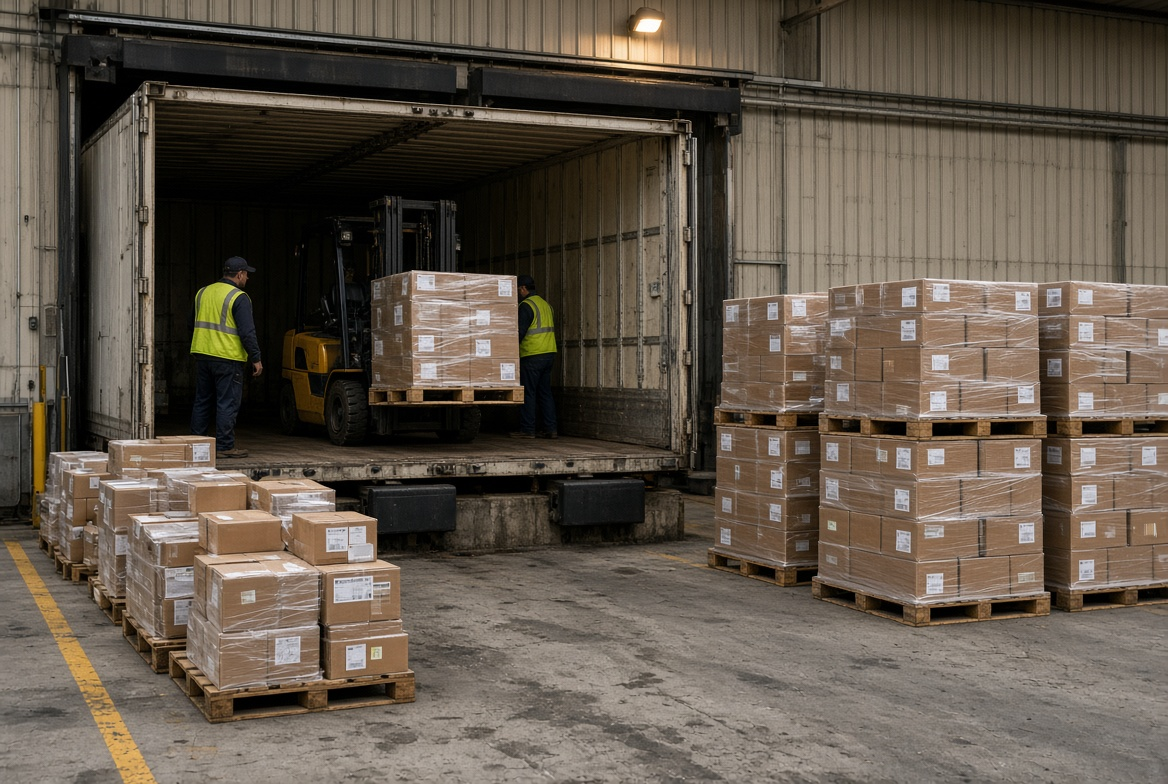
Transit Time, Handling, and Delivery Reliability
The differences in LTL vs FTL deliveries are evident after the rate discussion is over. They are felt by importers at the door of their window, in their days, in their touches and in their window that is more difficult to pin down.
Transit time here would include the road move, terminal time and appointment time. It is not an ocean or air published schedule.
LTL Transit and Terminal Handoffs
Typically, LTL freight is transported via a hub and spoke system. Cargo from depots, terminals are picked up and transported to a terminal for sorting, reloading and dispatch to a terminal or a delivery route. Every handoff is more time and another opportunity for a misroute or short pallet or scuffed packaging.
The pattern may still be OK if there is some slack in the inventory plan and the cargo can be handled normally at the dock. It’s not a good fit if the retailer won’t accept a late appointment, if there isn’t a 3PL slot available, or if the products are delicate and every additional lift is a concern.
If the cost of FTL is not so high as to be prohibitive, and the calendar is tight at the receiving point, then time-sensitive or fragile goods may warrant FTL. The question isn’t "which mode is quicker on paper? The question remains how much extra days and touches your stock position can take.
FTL Transit and Direct Movement
FTL typically operates on a straight path from origin to destination. It is possible to reduce road calendar and handling by using fewer intermediate sorts. Direct does not imply immunity from traffic, weather, border queues and the wrong receiving slot. It does not mean that the trailer is waiting for other shippers’ freight to be sorted onto the same truck.
Match up the mode to the receiving operation. If a window bookers and fines no-shows, a dedicated appointment will generally be preferred in the warehouse. A 3PL with a wider window for freight may be willing to handle LTL without impacting labor planning.
If live unload, driver assistance or specific trailer types are required at the destination, add that to the FTL booking. If the truck can’t get on the dock, it’s not a faster truck.
Delivery Windows, Appointments, and Site Requirements
Both are frequently necessary in retail outlets, distribution centres and warehouses. The difference in operation is the control. An LTL shipment can be on a long delivery route in the city with a broad window. FTL deliveries are more often booked as a single appointment with a narrower range as the trailer is assigned to one consignee.
A real-world example: LTL arrives sometime Thursday on a route with three other stops. FTL is scheduled for Friday 08:30-10:30 to allow for the 3PL to be on the dock. Both images are not universal, but there is a pattern which is common enough to plan for.
Mode is not as important as site rules. Trailers of a particular size are not permitted at some locations. Some require a liftgate. Some will not get after cut-off. Then, gather those constraints beforehand and include them with the rate request, to ensure that the quote reflects the dock that you require.
When to Choose LTL vs. FTL for Import Shipments
The choice between LTL and FTL depends on the size of the shipment, the nature of the goods being carried, the time needed and the receiving regulations of the destination. Use the mode appropriate for that profile. Don’t use the two as synonyms—attached to the same truck.
Reexamine the option when there are changes in volume, product mix, or warehouse facilities. The replenishment for this quarter may not correspond to the pattern in the previous quarter.
Choose LTL When Volume Is Low and Time Is Flexible
LTL is suitable for smaller parcels, test orders, and replenishment deliveries in which the time for the goods is not as critical and the goods can accept additional handlings. By sharing the trailer, you won’t be paying for unused space.
A customer is an importer who arrives at the port with one container and wants to see a 3PL move a few pallets from the port to the customer but doesn’t know just yet if there will be any additional orders. On that brief domestic haul, LTL can manage the cost if the pallets are properly constructed, the delivery time is acceptable and the need for a liftgate or appointment is anticipated.
LTL is less of a fit for fragile, high-value, or same “small” shipment booked into a retailer that can be either short or long on the truck.
Choose FTL When Volume, Fragility, or Timing Justifies Dedicated Capacity
FTL accommodates larger loads, uniform pallet programs, fragile goods, high dollar items, and appointments. Utilization of the trailer pays. The less passes made in between, the better chance the load has to reach the origin dock in the same condition it was when it left.
Example: Importer is releasing complete warehouse replenishment to a 3PL who only takes in loads in booked two hour windows. FTL minimizes terminal touches and can make an appointment more easily held. If you can keep your inventory timing in mind, and keep your packs quality up, the higher trailer rate may still be better for your commercial results.
If the trailer is half empty, perform the math again. Dedicated capacity is not an automatic upgrade, it is a tool.
Hybrid Approaches and Multi-Stop Strategies
Many import programs use both modes. High-volume lanes into a main warehouse may move FTL. Remote or low-volume destinations may stay LTL. Seasonal peaks can flip the mix for a few weeks, then flip back.
Some shippers combine several small lots into one FTL when the calendar allows. That only works if the freight can be received, checked, and staged before dispatch. Cargo consolidation and warehouse coordination is the origin-side version of that idea: goods from more than one supplier are received, stored, and prepared so outbound trucking is planned from a known pallet count instead of from scattered factory ready dates.
Multi-stop FTL can also serve two nearby warehouses on one trailer when both sites can accept the routing and the unload times. That is a planning choice, not a standard product. Confirm dwell time, appointment rules, and who pays if the second stop runs late.
Look at shipment history on a regular cadence. A growing SKU, a new fulfillment node, or a shift from test orders to replenishment can move the break-even point between LTL and FTL without any change in the ocean schedule that brought the goods into the country.
Frequently Asked Questions
What Is the Main Difference Between LTL and FTL?
LTL shares trailer space with other shippers’ freight. FTL uses a dedicated trailer for one shipper’s cargo. That difference drives pricing, how many times cargo is handled, how directly it moves, and how much control you have over the delivery appointment.
Is LTL Always Cheaper Than FTL?
NO. LTL can be cheaper for smaller packages that utilize only a portion of the trailer. FTL may be less expensive per pallet/unit as volume increases, or as accessorials and risk of losing the load increase. Don’t look at the first line-haul number – look at the full invoice and per-unit rate.
Which Is Faster, LTL or FTL?
Because FTL is more direct, and does not require re-sorting the terminal, it is often faster. LTL has a longer cycle time as freight has to wait to be consolidated, unloaded and reloaded. Actual time is subject to distance, appointment, access to the site and network conditions. Both modes are not to be sold as definite number of days.
When Should an Importer Use LTL or FTL After Ocean Freight?
When time is not critical and an additional touch can be added to the cargo, use LTL for smaller moves from port to warehouse or ramp to warehouse. For larger replenishment runs, fragile or high value loads, or receipt narrow windows, use FTL. The mode is determined by the volume, cargo profile and site rules, not by the sea transport mode.
What Information Does a Carrier Need for an LTL or FTL Quote?
Enter origin and destination addresses, understand the cargo description, the number of pallets, dimensions and weight. If known, provide freight class. State delivery rules – liftgate, inside delivery, residential delivery, appointment rules and any access restrictions. Common cause for invoice not matching the quote is due to incomplete site information.
How Can I Reduce Damage Risk in LTL and FTL Shipments?
Utilize sound pallets, tight wrap, corner protection as necessary, and labels that remain readable after a dock sort. Wrap breakable items for several lifts and not just one forklift lift. Provide correct weight and dimensions to plan the load. If the cargo is valuable or breakable, consider if the extra capacity cost of FTL is worth the less handling.