
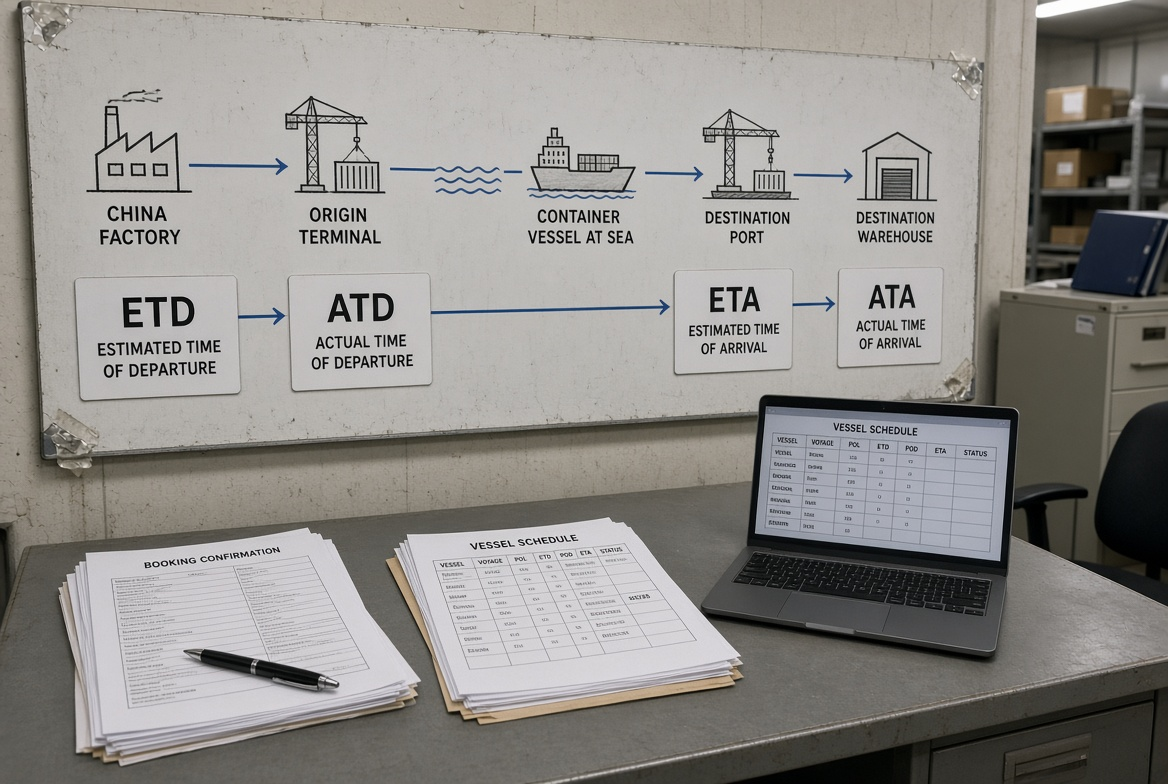
In the shipping industry, ETD, ETA, ATD, and ATA are the four date types that indicate the time at which goods are expected to be departed from an origin and received at a destination. ETD and ETA are predictions made by the carrier (or forwarder). ATD and ATA are the recorded events after the vessel has actually sailed and actually arrived.
First ETA is the delivery date for importers from China. It is not. ETD is also different from ATD. Estimates shift when goods are delayed, a port is not called on, the ship fails to arrive at its port, the weather diverts the ship or the port of destination is overcrowded. This guide explains the meaning of each term, how these dates will be reflected in bookings and tracking, the factors that can affect these dates, and how to plan around an estimate rather than rely on a single date to lock in inventory and sales.
ETD, ETA, ATD, ATA Defined: What Each Date Actually Means
The four abbreviations are on virtually all ocean schedules from China. They appear much the same on a spreadsheet. They have different roles. They are combined by mixing in a factory date, a vessel date and a warehouse date, all rolled up into one “arrival” no one can retain.
ETD – Estimated Time of Departure
ETD (Estimated Time of Departure): The time and date of the vessel’s planned departure (or for certain updates, cargo’s planned departure from the origin terminal). It is published by the carrier on the schedule of services. It is also repeated by the forwarder in the booker’s booking confirmation.
ETD is an importer’s tool for arranging production, factory pick-up, warehouse receiving, export documents and cutoff. If the factory is still packing on the day the carrier requires the container to be gated, then the ETD on the booking is at risk.
ETD can move before a vessel makes its way out of the dock. Some are due to a vessel schedule change, origin port congestion, documents not being submitted in time, late delivery of cargo to the terminal, and the lack of containers or chassis. Use the first ETD as a planning time, not a lock time.
ETA – Estimated Time of Arrival
ETA (Estimated Time of Arrival) refers to the estimated port of arrival date and time of the vessel. That’s the day that most sales and warehouse staffers look at. It’s also the most commonly misunderstood date.
On the destination side, ETA is used to plan warehouse labor, sales or production plans, and customs filing, including trucker bookings. It’s not a sure thing until you get it to your door. The in-lead, clearance, and last mile stages of inland haul, clearance, and last mile will begin once the vessel is in and will be timed separately.
ETA may change before booking and may even change after the ship has departed. On route weather, mechanical problems, catching up for a previous delay, delays through transshipment and delays at the destination port all alter the forecast. The first ETA that you receive is a planning reference. It is subject to vessel schedules, port conditions and disruptions in operational activities.
ATD – Actual Time of Departure
The Actual Time of Departure (ATD) is the actual date and time the vessel left the origin port, with the understanding that the vessel left the origin port or cargo was actually picked up from the origin terminal, whichever the carrier records as the departure time.
ATD simply answers a very basic question: did the shipment depart as planned? If ATD is later than ETD, the downstream dates should be re-evaluated. A new ETA typically follows. This revision should be followed by inventory timelines, promotion windows and by the warehouse receiving slots, not the original booking email.
The ATD may be lower than the ETD as well. This is not as likely to occur on the busy export lanes of China, but does occur when a ship recovers time or a blank sailing is completed. Early ATD is still a change. The new clock is needed in the warehouse and customs departments, not the old one.
The first hard measure of schedule reliability for a given booking is the ETD and ATD difference for importers. A single lost trip is far from a mark against a carrier. Late ATDs for the same service do.
ATA – Actual Time of Arrival
ATA (Actual Time of Arrival): This is the date and time that the vessel made it to the destination port.
ATA triggers destination work – customs filing (if waiting at destination), container pick-up appointments and final delivery scheduling. ETA vs ATA explained in one sentence: ETA is what the schedule said, ATA is what the port said.
If ATA delays beyond ETA, there is an increased exposure of demurrage/detention if the pick and clearance plan remains as per the old dates. If the box is still on the vessel Wednesday, no help from the Warehouse labor on Tuesday. The difference between ETA and ATA is the place where inventory plans can process or fall short.
How These Dates Appear in Tracking, Schedules, and Communications
Definitions are only useful when you know where and which one is current. Days are lost, as the importer has to plan from an old PDF, and the carrier portal already has a new ETA.
Carrier Schedules and Booking Confirmations
First carrier schedule and booking confirmations normally display ETD and ETA of intended vessel and routing. That is the base line for production and logistics planning.
Take it as a reference. Do not freeze it. Seeing isn’t believing, but rolling is! A ship may skip a port. A transshipment hub may not have the appropriate connecting service to the feeder. The departure remains a forecast until ATD posts. Until ATA posts, it’s still a forecast.
Tracking Updates and Status Portals
As the shipment moves, tracking systems and status updates from forwarders will display estimated (ETD/ETA) dates and actual (ATD/ATA) dates. Many portals maintain a revision history, e.g., “ETA revised from 10 Oct to 13 Oct”.
Watch those revisions. Communicate the new dates to Sales, Warehouse and Finance before the old date is a “Customer Promise”. If no one in your company reads the freight forwarder shipment tracking and date updates from China, what good are they? If a portal isn’t opened, it’s decoration.
A simple guideline: The most recent confirmed date on the tracking record trumps the date of last week’s email.
Bills of Lading and Shipping Documents
Some shipping documents, and bills of lading, may refer to ETD/ETA, depending on when they are issued and the way the carrier drafts the form. Estimates are frequently found in early documents. Actuals will appear in later documents.
Those dates are helpful for performance monitoring of a contract and to correlate a booking with a vessel. They won’t suppress the terminal’s action. A berth delay is not prevented by a bill which still has last week’s ETA. The current state of the carrier is in the most recent status and what the agent at the destination sees on the ground.
Common Delay Factors That Shift ETD, ATD, ETA, and ATA
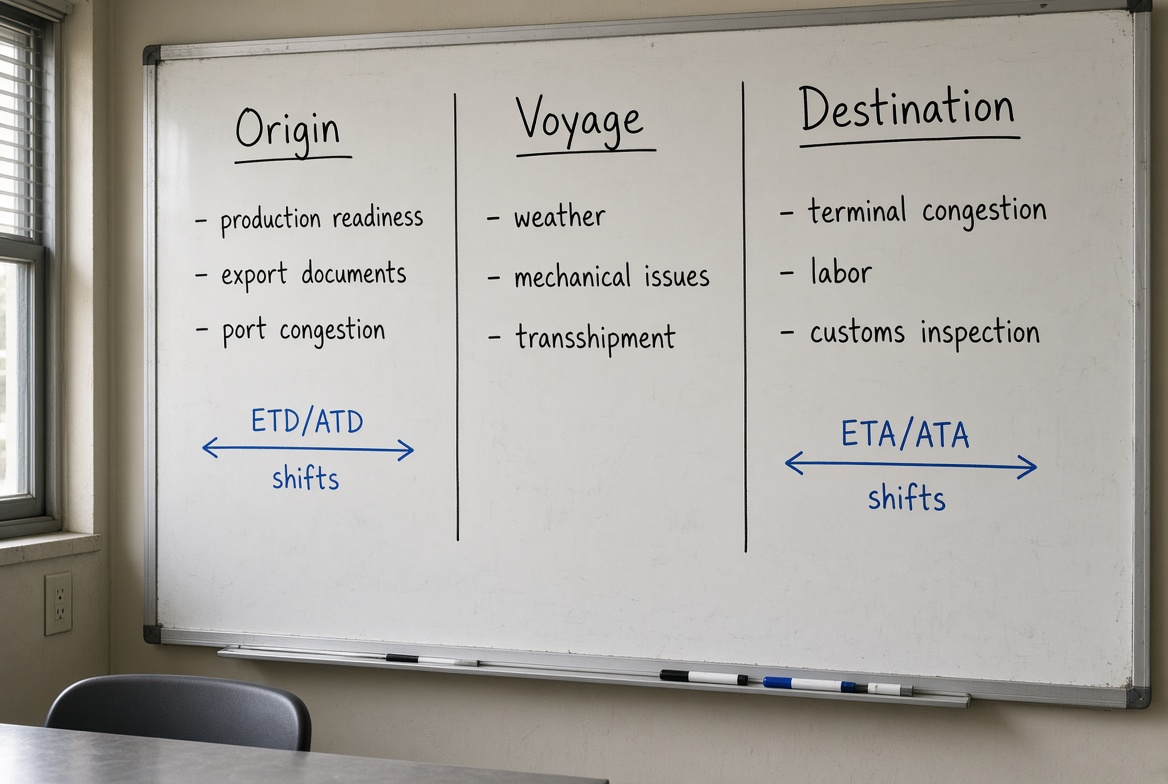
The container ETA and delay factors are NOT a mystery list. They are concentrated at origin, on the voyage and at destination. When you know the cluster that’s moving, you’ll know which date is coming next.
Origin-Side Delays: Production, Documentation, and Port Congestion
Origin delays are the first to be pushed to ETD and ATD. Typical scenes:
- Goods are not ready on the date of the booking assumed. The factory is still completing, checking or packaging.
- Cargo arrives at the warehouse/port after the export cut-off period. A particular vessel is not matched with the container.
- Export documents are missing, non-conforming or missing. The shipment is not released in time by customs.
- Many of the origin terminals are clogged. The ship waits or skips the port or rolls cargo to next sailing.
- Equipment is tight. There is no empty container, there’s no chassis, there’s no gate appointment in the window you need.
There’s more to a late factory than just pickup. Shortens the documentation, inspection and gate-in period. In that way the 2 day production slip turns into a 1 week sailing slip.
En-Route and Vessel-Related Delays
Genuine ATD even when clean does not lock ETA. The voyage is extended by weather, mechanical issues, and schedule recovery from a previous delay. There is another failure point which is the transshipment hub where the mother vessel arrives, the feeder is full or late and the box waits.
Multiple transshipments make lanes more vulnerable to cascading delays than a direct lane. Schedule reliability of the vessels from China is dependent on the service, the season and the amount of slack included in the published rotation. Don’t assume that you are on direct route or through a hub, ask them before you use the first ETA as tight.
Destination-Side Delays: Port Congestion, Labor Issues, and Customs
Cargo may arrive while the vessel is still en route. Congestion in the destination port, labour disputes, equipment shortage and customs inspection backlogs cause delays in discharging the box and in the time available for the box. The published ETA moves out, then ATA posts late and then pick up appointments slide, all in all: Port congestion and ETA revisions go hand in hand.
Free time begins to be lost, if clearance and trucking plans remain on the original ETA, while the container is unavailable. Demurrage/detention is the invoice version of that mismatch. Update pickup and clearance dates as soon as the destination date changes. Don’t let the warehouse catch you off-guard with ATA.
Estimated vs Actual: How to Use These Dates in Planning
It’s important to know the labels. Their application, without cornering your sales calendar is the work.
Building Buffer Time Around ETD and ETA
The first habit is the most important when it comes to ETD and ETA: consider them variables. Plan for buffer in production, inventory and sales. NEVER plan a promotion, retail delivery or production to a published day.
Practical approaches:
- Don’t plan promotions and inbound receiving as a Tuesday, plan them as a date range.
- Retain safety stock to accommodate for a reasonable change in ETA on that lane, rather than a best case sailing.
- Confirm warehouse staff and truckers with new ETA and have a backup window should the date change again.
- Have supplier cut off before the carrier cut off. Factory “ready” and terminal “gated in” are different events.
It’s easier on the wallet than an air rescue or missed retail window. The actual additional days are dependent upon the lane, the season and frequency of such service lapses. Ask for that history. Please don’t make up a general number.
Using ATD and ATA to Validate Performance and Adjust Plans
ATD and ATA are the ways to determine if the plan is still in contact with the port after the contact. Compare expected with actual transportation. Record ETD and ETA differences for lanes and carriers. In a couple of months, that log is a more reliable schedule assumption than the initial schedule you were sent.
Don’t argue about the last booking, use actuals for the next. Assume that the pattern of the service leaving two days late and arriving four days late continues until the service changes.
Communicating Date Changes Internally and with Customers
Notify those who made commitments based on the previous ETD/ETA if they change. Vessels are not required for all sales, warehouse, finance, and key customers. They should include the revised date, reason (in one sentence) and effect on inventory or delivery.
A simple cadence will do: booking confirmed, cargo received at origin, every ETD/ETA change, ATD posted, ATA posted. Better to give early warning than a perfect explanation after the truck has been booked for the wrong morning.
Common Mistakes Importers Make with ETD, ETA, ATD, and ATA
This isn’t the vocabulary part of the pain. It’s taking the wrong date for a contract.
Treating ETA as a Guaranteed Delivery Date
The classic mistake is promising a customer or an internal team a certain delivery date from the first ETA. The ETA moves. Unless you move it, the promise does not.
Typical consequences: Failure to deliver on time, expediting inland transport, and a customer who no longer values future dates on your schedule. ETA: Estimated time of arrival on a vessel. After ATA, clearance and pickup, it is a separate plan to offer door delivery.
Ignoring Revision History and Relying on Outdated Dates
Revisions are issued by carriers / forwarders. Teams continue to plan, based on the initial booking email. The warehouse is getting ready for Thursday. The portal already says Sunday.
Work on the latest known dates. Have a short logbook for revision of critical shipments—old date, new date, source, time received. With 3 people and 3 emails, it ends the debate over “which ETA were we using?”.
Not Aligning Supplier, Forwarder, and Internal Calendars
Suppliers make plans to ETD. The warehouse plans to ETA. A sales plan is developed with a set delivery date that was created during the kick-off call. No one says which date each team is,
Make the four definitions and the update protocol part of shipment kickoff. Name the source of truth (carrier portal, forwarder update or both). Give names of those sending the internal note if date changes. It’s not a slogan, it’s a meeting habit.
How to Work with Your Forwarder to Improve Date Reliability
A China based freight forwarder can’t freeze weather or congested terminals. It can tell you the dates that are "soft not hard" as well as the dates that are slippery and when the cargo will be permanently stuck on the wrong sailing.
Questions to Ask About Schedule Reliability and Contingency Options
Ask questions that result in numbers and options and not reassurance:
- How much has the ETD-ATD (and/or ETA-ATA) gone up or down on this lane/carrier historically?
- How many times do ships on this service miss ports or are delayed?
- What contingency options do we have if this ETD or ETA slips – alternative vessels, routings or ports?
- Is this routing a direct route or does it transship, if so, where?
- What is the relationship between export document cutoff and gate-in cutoff?
Then, those answers will be the basis for determining whether or not the booking provides for a close sale or if it requires additional lead time—or another shipping method.
Setting Up Proactive Milestone Alerts and Status Cadence
Set alerts to reserve confirmed, cargo received, ETD/ETA, ATD and ATA. Include an extra check-in for critical shipments, not in the case of a crisis email.
Take advantage of the updates to update inventory, warehouse labor and sales plans in time. It’s damage control when responding to ATA is late. The second revision of the ETA is planning in that moment it is posted.
OriginLink manages the logistics of picking up in the factory, receiving in the warehouse, consolidation, booking with the carrier, export declaration and handing over to the overseas importer. That is the chain which is ETD or ETA as well as remains usable or just subtly drifts. Request teams running that chain to consider date revisions as operational events, rather than footnotes.
Summary Guidance – Using ETD, ETA, ATD, and ATA as Planning Tools, Not Promises
ETD, ETA, ATD, and ATA are being planned as references. Only ATD and ATA keep a record of what actually occurred. ETD and ETA will change. The task is to catch the move early, add buffer to that estimate and ensure supplier, forwarder and internal calendar are on the same clock.
No clear definitions, no revision tracking and a forwarder who doesn’t report dates when they change will not make every sailing on time. They will prevent you from acting on a prediction like it was a guarantee; prevent you from finding out the actual arrival time when it’s already morning at the warehouse.