How many days does it take Alibaba to ship? It’s not one ocean, one air transport number. Total time for an overseas buyer begins with the placement of the order and continues from production to cargo readiness, handling at origin, the primary freight leg, customs clearance, and last-mile delivery. The “estimated delivery” date listed on a product page is frequently an optimistic guess, which doesn’t account for factory delays, cut-offs or holding in destination.
Here’s how to cut each of those links and create a usable calendar for inventory, launches and replenishment—rather than see one listing date as a plan.
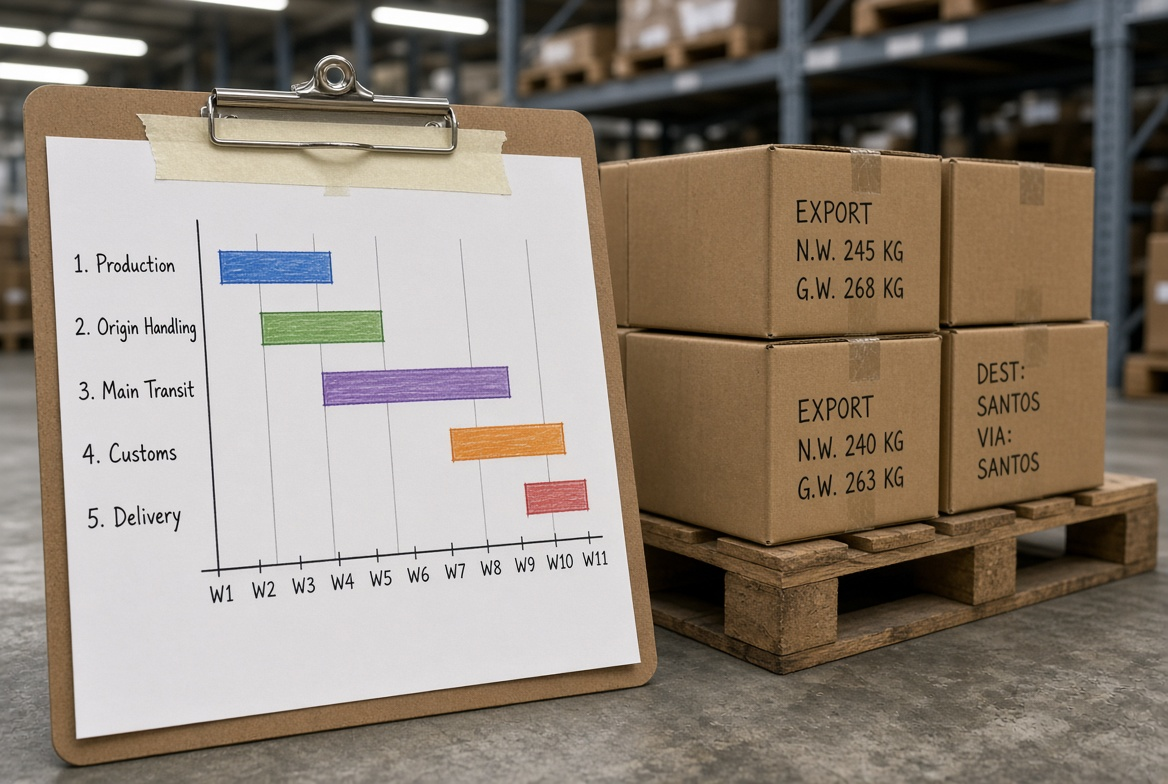
The Real Stages That Define How Long Alibaba Shipping Takes
Total time is a chain. Typically, the actual window for a transit is determined by the slowest phase, not the shortest published window.
Consider using the five buckets to think:
- In preparation for production and cargo readiness.
- Origin handling and export.
- International main leg
- Destination clearance
- Last-mile delivery
Even a supplier can be finished with the sewing and not be ready for shipment. A vessel may come in and the cargo may still be awaiting entry or inspection or may be waiting for a delivery date. By only focusing on ‘shipping days’ you are ignoring the portion of Alibaba order processing and transit time that is moving your stock-out date.
Production lead time and cargo readiness
The shipping clock doesn’t begin to count when you click “Buy”. It begins at the carton packing stage, marking and counting then moves to picking up or receiving at the warehouse.
Production may involve purchasing fabric or components, garment or component manufacturing, sample or bulk approval, sample or bulk packing, or pre-shipment inspection requested by the buyer. The typical scenario is that the importer places an order with a 15-day lead time for the main leg but doesn’t realize the factory requires a few weeks to complete the work and pass inspection. Transit window was never a problem. The goods were not in order.
Request the supplier for operational dates: quantity ready, pack is complete, labels are on, documents match cartons, person on site to pick up. That’s not the same sentence: "Goods will be finished next week".
Origin handling and export cut-offs
Once the factory is operational, there needs to be movement of the cargo. The activities that happen before departure are pick up or supplier delivery, warehouse receiving, measurement, consolidation, export declaration and carrier cut-off.
Cut-offs are unforgiving. When the cartons arrive after the vessel/flight cutoff, the shipment is held for the next sailing or next day. This is not a carrier defect but rather a failure of the carrier. This is a sequencing issue. Buyers expect this stage to be shorter, because it’s longer than the inland factories, the peak booking weeks and the incomplete commercial invoices.
International transit, clearance, and last-mile
The most popular listings describe the ocean movement, air movement or express network, which is the main leg. You can’t simply arrive, you must deliver!
Once the cargo is delivered, it is still required to be reviewed by destination customs. There are documents that release some shipments. Some are detained for the inspection, duty payment or lack of documentation. After that, there’s still a need for a truck to have an appointment at a warehouse, fulfillment center or business address. The only time someone says they have come to a tracking page is when the main leg has completed. This scan will determine the length of time Alibaba takes to deliver.
How Freight Method Shapes the Transit Window
A freight method change is used to determine the length and risk profile of the primary leg. It is not a time or destination clearance eraser. Each has varying cut-off point, space and handling sensitivities. Use the method that you have time for and not the shortest on a product page.
When comparing times between air and sea shipping from Alibaba, you need to take into account both documents and ready cargo. A late mode that has been booked for an earlier production date is still late.
Express and small parcels: fast but schedule-sensitive
Express is often the quickest option for small commercial parcels and samples. The speed will be based on pick up, flight availability, and the customs actions taken in the destination country.
If the pick-up is missing, the commercial invoice is incomplete or the batteries are not declared, the speed advantage is lost. Express networks ride on tight cut-offs. If the courier is not available on the same day, then the parcel is left for the next available courier. Use express as a quick job, clean paperwork, clean pick-up window isn’t a recovering factory.
Air freight: faster than sea, but not instant
For time critical commercial goods, transportation solution air freight offers a middle ground between express parcels and ocean cargo. Airport pairs, frequency of flights, priority of goods and space are among the factors that affect transit.
Air will not go through customs. It also does not ensure a daily direct flight on all lanes. Cargo can be hooked up by means of a hub. There are still some screening, warehouse cut-off at origin and destination handling around the flight time. Do use air where the inventory calendar doesn’t have time to accommodate ocean movements, and where the cargo profile warrants the expense—do not use air because the listing specified the product was “ready to ship.”
LCL and FCL: longer transit, more exposure to sailing schedules
Ocean freight is subject to sailing schedules, port rotations and availability of containers. Alibaba shipping time to USA and other long-haul markets is thus frequently touted in ocean mode: the primary leg is longer, and the timetables are public.
LCL provides additional handling service. Cargo needs to arrive at a consolidation warehouse early enough to be picked up and loaded on to other cargo. Upon arrival it can be deconsolidated prior to release. FCL can avoid some of that shared handling, but still await a suitable vessel and box to gate in before cut-off.
A decision that many importers have to make is whether to sail earlier to a crowded port, or to sail slightly later to a cleaner rotation. It is possible that the most reliable is the one that leaves the station earlier than the one that is theoretically conceived to leave earlier. Check the entire chain, not just the date advertised.
Production and Origin Factors That Stretch Timelines
Much of the delay occurs in China before people book space. That origin work must be built into planning lead times for Alibaba orders or the freight method chosen will never have a chance to get off the ground.
Sample approval, revisions, and inspection
Time will be subtracted for sample rounds. A buyer asks for a change in color, fit, packaging or print placement, and the factory re-enters the process. Pre-shipment inspection (whether called for by the buyer, or provided by the supplier) must have a window to be booked and a passing grade before goods can be despatched.
Schedule one revision and one reasonable inspection date. Launch calendars always break when that is considered to be the production-complete date.
Packaging, labeling, and compliance prep
Production can complete whilst the cartons are waiting. Custom boxes, bar code labels, country of origin labels, safety labels, manuals, packing rules for different countries must be accurate prior to export.
It’s the same problem as always – the factory sends the message “order complete” and the warehouse discovers cartons are unmarked or the inside labels are incorrect. This takes more time to solve on the dock than it takes to verify the packing spec at deposit.
Consolidation from multiple suppliers
It’s difficult to come by several suppliers who will have their orders completed by the same day on Alibaba. Each of the cities, each of the production queues, each of the packing standards has different performance, the combined shipment waits for the slowest supplier.
You may make up production dates in advance, ship lots separately or wait for the last lot and expect a consolidation warehouse to hold early cartons until the last lot arrives. Every option is going to reset the shipping clock at the beginning. Never think of one booking taking up four factories without incurring wait time.

Customs and Destination Factors That Add Time
Exports from China is not equal to sales. The time for customs clearance of Alibaba orders is subject to different countries, products, and documents. This is the point where buyers of origin tracking only will be surprised.
Import clearance windows and documentation
Clearance speed is based on the file and not the freight route. All commercial invoice, packing list, bill of lading or air waybill and product description must correspond to the contents of the cartons. Consistency is also required for the classification, value, and importer of record.
A frequent cause for holds on express parcels is missing or conflicting paperwork, as is also the case for ocean containers. The entry is not ready if the invoice states “accessories” and the cartons include branded electronics. Fill out documents before leaving. Do not want to “put it right when it comes.”
Inspections, quotas, and special requirements
On some shipments documents are released. Some are selected for random or targeted inspection. Extra review time may be added to the process due to rules specific to a product—such as those for certain electronics, food-contact items, batteries or branded items—that a general consumer-goods shipment does not encounter.
Be aware that not all Alibaba orders pass in the same window. Don’t assume that what worked for a previous shipment will work for the next one, ask what the destination needs for that product category.
Port and airport congestion, strikes, and disruptions
Peak seasons, labor strikes, the weather and terminal congestion are all beyond the buyer’s control. They should still be on the calendar. A sailing can come in and wait for a berth. An air shipment can be delivered and left for ground handling.
If you know that the traffic is busy, plan some buffer time and observe the watch statements from the forwarder or destination agent. An ocean box that missed the shelf date is an emergency booking which costs more than the buffer booking.
How to Plan Realistic Alibaba Shipping Timelines
An Alibaba shipping timeline for importers works better as a backward schedule than as a single delivery promise. Use the method below before you commit deposit and production.
Work backward from your deadline, not forward from the order
To plan a realistic shipping timeline for Alibaba is challenging.Planning realistically for Alibaba shipping timelines is difficult.
For importers, an Alibaba shipping timeline is more appropriate than a single shipping promise, as it is mentioned above. Follow the method below first before you make any deposit and production.
Build buffer for the slowest stage, not the average
Use the date for which the goods are required to be on the shelf or in the warehouse or in the fulfillment center. Count backwards through last mile, clearance, main transit, origin handling, production and sample time.
That exercise will tell you if the plan is achievable prior to investing money. The plan is not ready until the only way that the date works is a best case factory and a perfect customs file.
Use milestones, not just one “delivery date”
Track a short list:
- Sample approved
- Production complete
- Cargo ready
- Shipped
- Arrived
- Cleared
- Delivered
One suggested delivery date conceals which phase slips. Milestones allow you to adjust a method, split a shipment or postpone a promotion when it’s still time to act!
Frequently Asked Questions
How long does Alibaba shipping usually take from order to door?
There is no universal O-to-D number that will apply to all listings. The total time includes production time, origin handling time, main freight leg time, destination clearance time and last mile time. The same product can have two orders on the same page, one order may be ready and the other is still going on the samples.
Why is my Alibaba order taking longer than the estimated delivery time on the product page?
Listings tend to be optimistic in terms of travel time. They could disregard production overruns, late carrier cutoffs and/or missing documents, inspections, and/or congestion on arrival. Before considering the date as a commitment, compare the supplier’s date for the cargo to be ready to transport with the method booked.
Does air freight always clear customs faster than sea freight?
No, air cargo may arrive earlier, but clearance requires documents, classification and possibly inspection. A full ocean file may flow faster than a partial air file. Method changes transit. Does not automatically change customs treatment.
How much time should I allow for customs clearance?
Use a large window and assume it is an unknown value. The amount of clearance required will depend on destination, product, accuracy of the documents and the need for inspection. Add that window to the back of the schedule, not in front.
Can I speed up shipping after production is already late?
At times and then only on the future stages remaining. If there is space in the main leg and the shipment is accepted, a ready shipment can be transported from ocean to air or express. It will not make up lost time on the production weeks already gone, it will not improve the documents if they are still incorrect. When changing method, determine the remaining deadline and additional expense prior to the change.
How do I plan timelines when ordering from multiple Alibaba suppliers?
Determine the cargo ready date of each supplier and determine if the supplier is for waiting and consolidating or separate lots. If you want one departure, the combined timeline is the one that is slowest. Work out production schedules in advance, or schedule in receiving in the warehouse around production dates.