
Shipping dangerous goods internationally is a compliance process, not a labeling job. You classify the product, pack and mark it to that class, prepare a matching declaration, and obtain carrier approval before anyone books space. A gap at any of those steps can stop cargo at origin, force a re-pack, or trigger penalties.
A supplier saying the goods are “safe” does not make the shipment general cargo. Carriers and authorities work from the safety data sheet, the class, the UN number, and the declaration—not from a verbal assurance. If you are moving chemicals, batteries, adhesives, paints, aerosols, or other regulated items, treat classification as the first decision and booking as the last.
Step 1 – Correct Classification for How to Ship Dangerous Goods Internationally
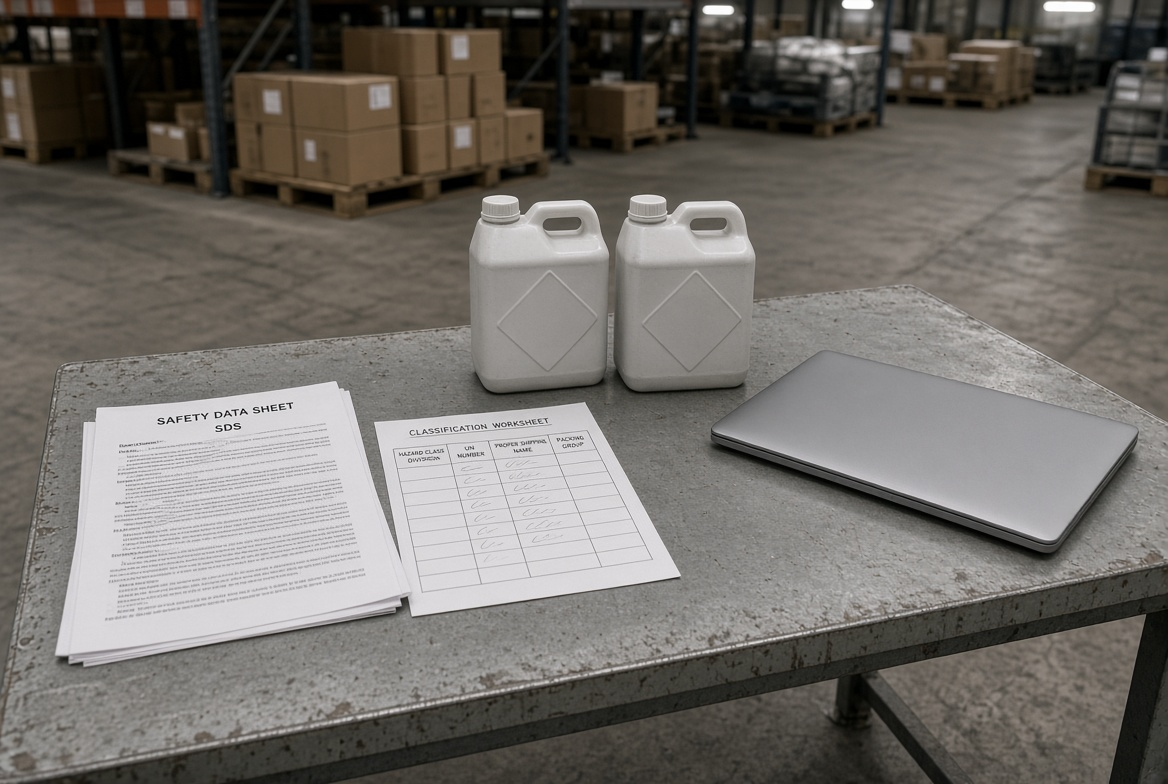
Every DG shipment starts with classification. Class, division, UN number, proper shipping name, and packing group decide the packaging you may use, the labels that belong on the carton, the documents the carrier will accept, and whether the cargo can move by sea, air, or only on certain routes. Guessing any of those fields is how cargo becomes “general cargo” on paper and regulated cargo on the warehouse floor.
Hazard class and division
Products are assigned to a hazard class that describes the main risk—flammable liquid, corrosive, toxic, oxidizing, miscellaneous, and so on. Some classes also use a division when the hazard needs a tighter description, which is common for explosives, gases, flammable solids, and certain organic peroxides or infectious substances.
A typical scene looks like this. A shipper emails a booking for “cleaning agent, non-hazardous.” The SDS lists a flash point that places the liquid in a flammable class. The booking method, packaging, labels, and declaration all change. The commercial name on the carton does not override the SDS.
Classification is product-specific. Two SKUs in the same product family can fall into different classes if the formulation, concentration, or physical state is different. Read the current SDS for the exact item being shipped, not a catalog page for a similar grade.
UN number and proper shipping name
The UN number and proper shipping name are the standardized identifiers used on the package, the hazard communication, and the shipper’s declaration for dangerous goods. They exist so a warehouse in Shenzhen and a carrier desk in another country are looking at the same substance, not two marketing names.
The common pitfall is using a trade name, a factory nickname, or a vague description such as “chemical sample” or “battery pack accessories.” Those words may appear on the commercial invoice. They do not replace the proper shipping name required for DG documentation. If the SDS and the classifier give you a proper shipping name, that is the name that should appear on the declaration and, where required, on the package.
Do not invent a UN number from memory or from an older shipment of a “similar” product. Formulations change. A lithium battery design that once moved under one entry may need a different description after a change in watt-hour rating, packing configuration, or test status.
Packing group and degree of danger
Within many classes, packing group I, II, or III reflects the degree of danger. Packing group is not a paperwork extra. It influences the performance level of the packaging, some marking choices, and fields on the declaration.
Treat packing group as a required input whenever the classification assigns one. A product that looks “mild” in daily use can still sit in packing group II. Packaging that is strong enough for warehouse handling is not automatically strong enough for that packing group. If the SDS or classifier leaves packing group blank for a class that normally uses one, stop and resolve the gap before anyone orders drums or cartons.
Step 2 – Compliant Packaging, Marking, and Labeling
Classification only helps if the physical package matches it. This is the step warehouses actually fail: the class is correct on email, and the carton that arrives at the shed is the wrong specification, missing a mark, or wearing last year’s label stock.
UN-specification packaging and compatibility
Many DG items require UN-specification packaging—tested drums, jerricans, boxes, or combination packages approved for the relevant class and packing group. “Thick carton” and “export drum we always use” are not the same as a specification package.
Compatibility matters as much as the test mark. A package can be certified and still be wrong if the inner packaging, cushioning, or closure does not match the liquid, powder, or article inside. A corrosive that attacks the inner liner, or a battery packed so terminals can short against metal, will fail screening even if the outer box looks official.
Do not assume the supplier’s factory carton is acceptable because it survived domestic trucking. Origin handling in China often exposes the same carton to a second check at the forwarder’s warehouse or the carrier’s DG desk. That is when non-compliant packaging is discovered—usually after the booking is already in the system.
Marks, labels, and orientation arrows
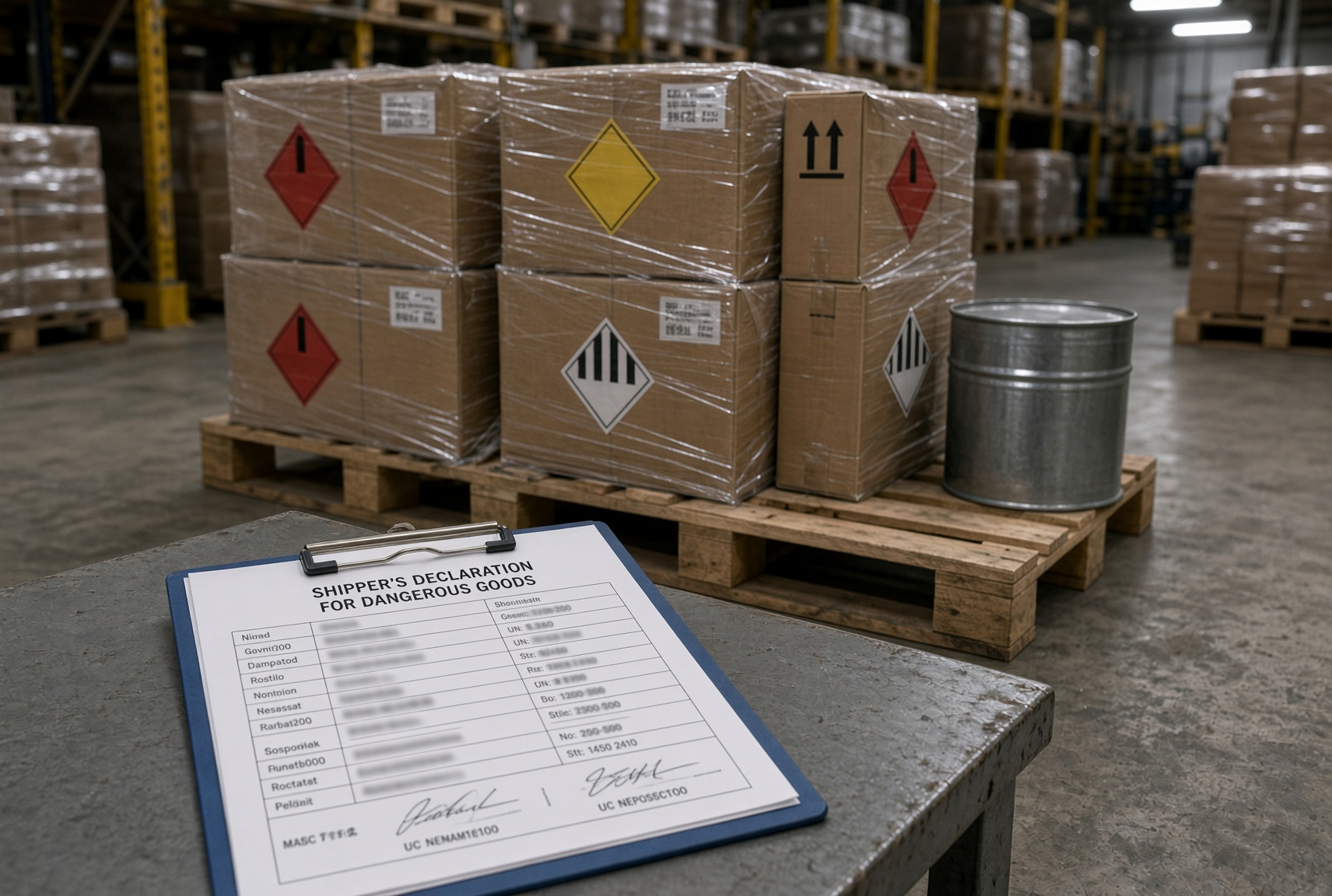
DG packaging and labeling requirements are about matching the package to the classification, not decorating the box. Where required, packages show the proper shipping name, the UN number, the correct hazard label or labels, and handling marks such as orientation arrows for certain liquids.
A frequent error is applying the right diamond label and omitting the UN number, or printing a UN number that does not match the declaration. Another is mixing leftover labels from a previous SKU. From a few meters away the carton looks “DG ready.” At the acceptance check it does not.
Keep marks durable and visible. A label that peels in humidity, or a stencil that sits under stretch wrap so the number cannot be read, creates the same problem as a missing mark. If overpacks are used, confirm which marks belong on the inner packages and which must be repeated on the overpack.
Limited quantities and excepted quantities
Some products can move under limited quantity or excepted quantity provisions when the substance, inner quantity, package type, and mode all qualify. Limited quantity dangerous goods shipping can reduce some labeling and documentation burden. It does not mean “ship as general cargo.”
Confirm eligibility before you plan a simpler process. Quantity limits are per inner packaging and often per package. A product that qualifies in small retail bottles may not qualify when the factory fills a larger jerrican. Air and sea rules also differ. A limited-quantity plan that works for a sea consolidation can fail the air acceptance check.
If the shipment only qualifies in part—one SKU yes, another no—do not mix them into a single “LQ” carton and hope the carrier sorts it out. Split the cargo or pack the non-qualifying line under full DG rules.
Step 3 – The Dangerous Goods Declaration and Supporting Documents
The declaration is the document carriers and authorities use to see classification, packaging, quantity, and emergency information in one place. Dangerous goods classification and declaration have to tell the same story. If they do not, the physical cargo is treated as unreliable even when the boxes look correct.
Shipper’s Declaration for Dangerous Goods
A shipper’s declaration for dangerous goods typically records the proper shipping name, UN number, class or division, packing group where assigned, number and type of packages, quantity, packing instructions or equivalent packaging description as required for the mode, shipper and consignee details, and a 24-hour emergency contact when the mode requires one. Special provisions or handling statements belong on the same form when they apply.
The declaration must match the cargo that will actually move. If the warehouse short-ships a drum or substitutes a different inner size, the declaration is wrong the moment the truck leaves. Do not sign a declaration against a packing list you have not seen.
Air and ocean formats are not interchangeable templates you can copy-paste without review. Use the form and language the booked mode requires, and keep the signed copy with the rest of the export set.
SDS, test reports, and special certificates
Carriers and authorities often ask for the SDS that supports the classification. For batteries they may ask for test summaries or other design documentation. Certain chemicals, aerosols, or magnetized materials can trigger extra certificates or handling statements.
The usual failure is an SDS that is outdated, written for a different concentration, or issued in a language and layout the acceptance desk cannot use. Another is an SDS that describes the product as non-hazardous while the factory has already applied DG labels “just in case.” Those two files cannot travel together.
Send the SDS for the shipped formulation, with a date the classifier is willing to stand behind. If a test report is required, match it to the exact battery model or article, not to a sister SKU.
Consistency across invoice, packing list, and DG declaration
Commercial documents and the DG declaration are read as a set. If the invoice says “adhesive, 200 kg,” the packing list shows 12 cartons, and the declaration shows a different net quantity or package count, the discrepancy becomes the reason for a hold.
Use the declaration as the master reference for hazard information. Then align product description, quantity, and package count on the invoice and packing list so they do not contradict it. You can keep a commercial name on the invoice. You cannot keep a commercial name that implies the goods are unrestricted when the declaration says they are not.
Step 4 – Carrier Approval, Booking, and Operational Constraints
Classification and paperwork do not create a booking. Carrier approval for dangerous goods is a separate gate. Many origin delays start here: the cargo is packed, the declaration is signed, and the airline or ocean line has not accepted the commodity on that route.
Pre-approval and DG screening by carriers
A large share of air DG, and a meaningful share of higher-risk ocean DG, goes through pre-approval or commodity screening. The carrier wants the class, quantity, packaging type, and sometimes the SDS before allocating space. Booking a general-cargo slot and mentioning DG later is how shipments lose the vessel or the flight.
Send the classification and packaging details while the cargo is still at the factory or the origin warehouse. Written acceptance—an approval reference, a screened booking, or an equivalent confirmation from the carrier or its DG desk—should exist before the truck is dispatched to the terminal. Verbal “should be fine” from a sales contact is not screening.
Route, mode, and quantity limits
Acceptance is not global. A product that moves by sea on one trade lane can be refused on an aircraft type, a passenger flight, a specific airline, or a connecting hub. Quantity limits can apply per package, per shipment, or per hold. Magnetized material, certain batteries, and some chemical classes are the usual examples, but the list is not fixed and should be checked per booking.
Do not assume sea conditions transfer to air. Do not assume last month’s approval covers this month’s quantity or a different destination. If the commercial plan depends on air, confirm the mode before the factory fills packages sized only for ocean limited-quantity rules.
DG surcharges, handling, and cut-off times
DG often carries a surcharge, needs segregated handling, and is subject to earlier cut-offs than general cargo. Terminals and airlines schedule DG acceptance windows. Missing that window does not usually mean the cargo rolls as general freight. It means the cargo waits for the next accepted departure.
Budget time for screening, possible packaging corrections, and the earlier cut-off. If several suppliers are consolidating into one export, identify the DG lines first. One undeclared aerosol in a mixed pallet can delay the entire consolidation.
Common Mistakes That Get DG Shipments Rejected
Most common dangerous goods shipment rejections are not exotic regulatory disputes. They are mismatches between what the cargo is, what the package shows, and what the documents say.
Misclassification or missing classification
Typical errors:
- Booking as general cargo when the SDS shows a DG class.
- Using a class or UN number from a previous order of a different grade.
- Shipping a kit or set without classifying every regulated component.
- Treating “sample” as a category that needs no class.
If classification is incomplete, stop the booking. A forwarder can help gather documents and run carrier screening. The shipper still owns the product facts that make classification possible.
Wrong or missing packaging, marks, and labels
Typical errors:
- Non-UN packaging where specification packaging is required.
- Correct hazard labels with a missing or wrong UN number on the package.
- Inner packagings that leak, overfill, or leave terminals unprotected.
- Limited-quantity marks used on a quantity that does not qualify.
- Old labels left on reused drums.
These issues are visible at warehouse receiving. Catch them there, not at the airline counter.
Declaration errors and document mismatches
Typical errors:
- Typos in the UN number, class, or proper shipping name.
- Package count or quantity that does not match the packing list.
- A signed declaration dated before a last-minute pack change.
- An SDS that describes a different product than the one on the invoice.
- Emergency contact missing or unreachable for the mode that requires it.
If the cargo changes, the declaration changes. Re-issue it. Do not annotate a signed copy in the margin and send it onward.
A Practical DG Readiness Checklist for Shippers
Use this list with the factory, the origin warehouse, and the forwarder before anyone requests a sailing or a flight.
Before classification is finalized
- Obtain the current SDS for the exact formulation and SKU being shipped.
- Confirm the product has not changed since the last approved shipment—concentration, battery rating, inner size, or packing method.
- Identify whether the cargo is a single substance, an article, a kit, or a mixed load.
- Engage a qualified DG classifier or specialist when the SDS is ambiguous, incomplete, or inconsistent with how the factory describes the goods.
- Decide the intended mode early. Classification outcomes and packaging choices depend on it.
Before booking and handover to carrier
- Lock class or division, UN number, proper shipping name, and packing group.
- Confirm UN-specification or other permitted packaging, inner packaging, and closures.
- Apply marks and hazard labels that match the locked classification.
- Prepare the shipper’s declaration so every field matches the physical packages.
- Attach the SDS and any required test reports or certificates.
- Align invoice and packing list quantities with the declaration.
- Obtain carrier approval or completed DG screening in writing for that mode and route.
- Confirm the DG cut-off, surcharge, and any segregation or handling constraint.
- Keep the approved pack list stable from warehouse outbound to terminal gate-in.
OriginLink coordinates dangerous goods shipments from China when the cargo can be classified, packed, declared, and accepted under applicable rules. That work still depends on complete product data from the shipper. No forwarder can invent a class the SDS does not support.
Frequently Asked Questions
What is the first step in shipping dangerous goods internationally?
Correct classification. Establish class or division, UN number, proper shipping name, and packing group from the current SDS and, where needed, a qualified classifier. Packaging, labels, the declaration, and carrier screening all follow that result.
Who is responsible for classifying dangerous goods: supplier or forwarder?
The shipper is responsible for providing accurate product information and a correct classification. A supplier in China may hold the SDS and know the formulation; a forwarder can help review documents and prepare the booking. Neither role replaces the need for a classification that matches the goods actually handed over.
What is a shipper’s declaration for dangerous goods?
It is the signed document that states how the cargo is classified, how it is packed, how much is in the shipment, and how it should be identified in an emergency. Carriers use it at acceptance. It must match the packages, not an earlier draft of the order.
Can dangerous goods always ship by air if they can ship by sea?
No. Air acceptance is often narrower. Some classes, quantities, packagings, or battery configurations that move by sea are refused on aircraft or on particular airlines and routes. Confirm the air product and quantity before the factory packs to sea-only rules.
Why do carriers reject DG shipments even when documents look complete?
Because the documents, the marks on the box, and the physical packaging must agree, and the carrier must accept that commodity on that service. A clean PDF with the wrong inner quantity, a reused drum, an unapproved route, or an SDS that does not match the cargo will still fail screening.
Are there simpler rules for small quantities of dangerous goods?
Sometimes. Limited quantity and excepted quantity provisions can apply when the substance, inner quantity, package, and mode all qualify. Those provisions are conditional. Confirm them for the actual bottle or cell size and the booked mode. Small quantity alone does not make the cargo general freight.
No executable internal link plan provided.