
ISPM 15 is the international standard for wood packaging material (WPM) in trade – pallets, crates, cases, boxes and dunnage. It must be treated according to an approved method (as listed in the standard, e.g., heat treatment or fumigation) and marked with a visible official mark to indicate the wood has been treated to make it less likely to contain pests. Cargo which is otherwise clean may be held, reworked or refused if the packaging does not pass that test.
Most of those stops are due to two assumptions. The first is that only large machinery crates require ISPM 15, and small pallets, blocks & bracing wood is acceptable. The other is that a fumigation certificate may be used in place of the mark on the wood. The remainder of this guide will discuss what is considered WPM, the rules of treatment and mark, documents versus inspection, frequent mistakes on China exports, special cases, and a checklist that can be followed prior to stuffing.
What Counts as Wood Packaging Material (WPM) Under ISPM 15
There are a few critical questions to consider when deciding what type of wood to use for international shipping: Is this piece of wood keeping the cargo safe or is it damaging it? If the answer is yes, consider it to be WPM until it has been proven that it is not.
There are generally two parts to WPM – ISPM 15:
- Wooden pallets and pallet blocks
- Wooden crates, cases and boxes
- Wooden spools and cable drums
- Items used for securing cargo with wedges, blocks or straps.Items used to wedge, block or support cargo.
- Other raw wood for stabilising the goods in a container or on a trailer
It’s not the product that’s the issue, it’s the packaging. WPM can support a machine, a carton of apparel or a pallet of electronics. The inspector examines the wood in the first place.
The following materials are normally excluded from the raw-wood rule: That may include fully manufactured wood like plywood, oriented strand board (OSB) and other engineered wood. Some thin veneer and some small wood parts can also not be classed as a typical WPM. Working word: often. Construction still matters. Mixed packaging is not an exemption, it is a crate that appears to be made of plywood on the front but is actually solid-wood battens on the frame.
The real dilemma at origin is size. A warehouse team will examine a two metre crate and pass by a few unmarked blocks that serve as spacers. The blocks are still considered WPM. Destination officers are not concerned with the appearance of the timber being graded.
Dunnage and bracing inside containers
After the cargo itself appears ready, many shipments (FCL and LCL) fail in Dunnage and bracing wood compliance. Wood is employed in containers to secure machinery, fill gaps, to protect corners and prevent cartons from moving. Scrap lumber from the factory yard, old fence posts, and unmarked pieces of pallet lumber are popular options as they are very readily available and free of charge.
This is a costly habit at their destination. If the dunnage is not treated or marked it remains WPM. Even if all commercial pallets are marked with ISPM 15, whole load can be treated as non-compliant if there are no valid ISPM 15 marks. The crate is just half of the solution for machinery and project cargo out of China. The wedges, sleepers and the cross-braces placed around the unit must adhere to the same rule.
A common issue that leads to log jammed cargo after arrival is non-compliant WPM. By coordinating the customs and packaging requirements for the destination country with the booking documents, it is more likely that a pallet mark issue will not be identified once the vessel or aircraft has arrived.
ISPM 15 Treatments and the Official Mark
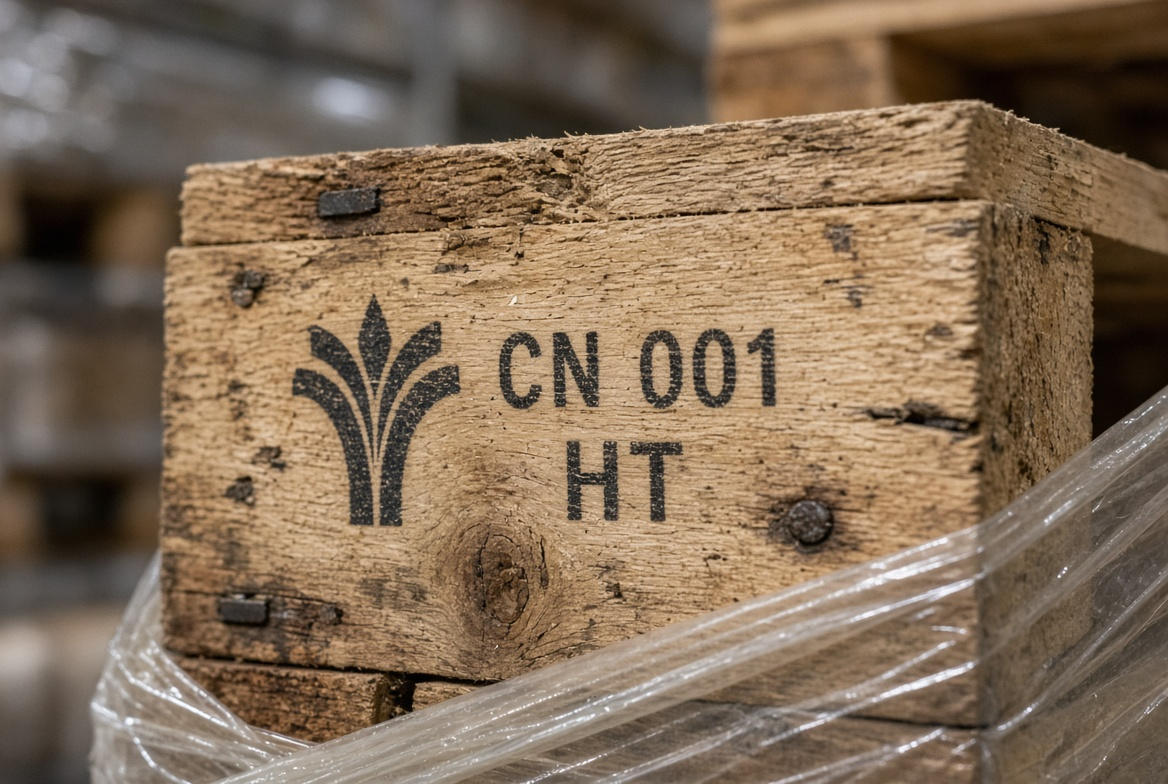
Two treatment paths that are touted to shippers regularly are heat treatment and fumigation under ISPM 15. Heat treatment (typically indicated by the mark HT) raises the wood temperature to an appropriate level for a specified period. Fumigation is the most common method and is still accepted by the destination and recognized by the standard, and is typically displayed as MB. Destinations and Carriers may have limited treatments. The timber must be treated in a manner that is accepted by the recipient.
The main signal is the official mark. The typical ISPM 15 mark for pallets and crates consists of:
- The wheat-ear symbol provided by IPPC.
- Two letters country code (country code) of the country to which the treatment is applied.
- This code is provided by a producer or treatment-provider.
- A treatment code, for example HT or MB
- A small number of marks are present for debarked wood and are indicated as DB.
Debarked is when the bark has been removed to the tolerance of the standard and not treatment. The IPPC mark to be applied to export pallets must be clearly visible, easy to maintain and be located in such a way that an inspector can observe it without opening the load. For assembled crates, it is typically an outer face that is clearly visible. On pallets, it refers to a block or stringer that can be read over the top when wrapped.
No window, a marker that is smudged or a handwritten “HT” under stretch film is not reliable. Wood is inspected as it is visible to the officers.
Who applies the mark and how to verify it
The official mark is applied by a treated wood supplier or a certified applicator. The manufacturer of the product you are making is not necessarily the one treating the pallet. The reason verbal assurance fails is that of that split. Fumigation last week is not a stringer that an inspector reads on it.
Before accepting pallets or crates at the China warehouse, do the following checks:
- IPPC symbol is there and not blacked out.
- All the country code, producer code and treatment code are readable.
- The mark is stamped and/or branded, not just written in ink
- Each individual article, be it a pallet, a crate, a piece of dunnage, is marked, or is part of an assembly that is marked, as appropriate.
Mixing marked pallets from one supplier and clean pallets from another in the same container booked for the same supplier, is not acceptable, and does not cover the gap when the certificate is issued.
Reused and repaired pallets/crates
WPM can be reused in international trade if it has a valid mark and is in good condition. The repair case is more difficult. If pieces have to be replaced the treated article may have to be re-treated and re-marked depending on the quantity of original treated wood that is left. A hybrid unit is a unit that is a combination of marked and unmarked replacement blocks, and is not visually acceptable.
A typical mistake made on stuffing days is that a broken pallet which has been marked is replaced with an unmarked spare which the forklift can complete the load with. In pictures, the cargo appears the same. The wood does not.
Documentation, Inspection, and What Happens at Destination
ISPM 15 is a packing standard. It is not a certificate of product safety, a quality mark or evidence of compliance of the goods with destination regulations. Wood is subjected to plant-health and customs officers’ examination for marks, bark, condition, and the presence of untreated wood added after treatment.
Documents still matter. When an officer queries the wood’s treatment, a treatment record or fumigation certificate or phytosanitary paper can assist the story. They are not a substitute for a missing mark. Many places pay attention to the physical article initially. When no valid stamp exists, it is rare for a PDF in the document pouch to conclude the hold.
Consequences of non-compliance with WPM may lead to treatment on site (if permitted), separation and destruction of wood, re-export of the packaging or shipment, or delay while the importer works out a solution. The exact procedures differ depending on the destination and the amount of the load that is affected. Don’t assume that one penalty number will make up for another. Take note of the mark in place before the container doors close, and make plans around that mark being accurate.
The most convenient time to monitor the compliance of WPM for China export is at the origin, and the pallets and crates can be rejected and replaced. After the box is on a ship, there are only a few choices left: destination treatment and additional time.
When certificates help (and when they do not)
When they match the wood in front of the officer: the same treatment type, the same date window, the same supplier or treatment facility, and a load that still has valid marks on them, certificates will help. When the certificate specifies one batch and the stuffing team a different set of pallets, they don’t come in handy. They also are not helpful if dunnage had been added after the treated pallets were issued.
This is compounded with multi-supplier booking which only worsens the situation. Marked crates are sent from factory A. Cartons at Factory B are shipped on unmarked pallets. Scrap wood is added to the structure for bracing at Factory C. The commercial invoice appears to be complete. The container does not shall.
That is why it is recommended to inspect incoming dunnage, pallets and crates before they are exported from the warehouse. If you combine materials from several Chinese suppliers, you will be able to check the marks at point of origin, take out the non-compliant wood and replace it with treated wood before the cargo arrives on site.
Common ISPM 15 Errors That Cause Holds or Rework
The majority of holds have their roots in a few origin errors:
- Damage to a pallet, crate, block or dunnage piece that results in a missing mark.
- Mark is either missing an IPPC symbol or a treatment code, or the stamp is invalid or incomplete.
- Rough lumber in the container that is not treated for wood bugs.
- Using a combination of marked and unmarked pallets in an FCL or LCL shipment
- By assuming all crates made of plywood are exempt, this will result in a significant loss of revenue.By taking it on faith that all crates that look like plywood are exempt, a lot of money could be lost.
- Reuse of unmarked or locally circulated pallets that have not been treated for export purposes
- Showing a fumigation certificate and not a mark on the wood.
- Making changes to pallets at stuffing after pre alert photos taken
Completed with labels, paint or wrap where no face is visible for evaluation or inspection
A pre-shipment WPM checklist the shipper can run
Run this at the warehouse or stuffing point, not after the truck has left:
- List every wooden article in the load: pallets, crates, cases, drums, blocks, dunnage, and braces
- Confirm each article has a visible, legible ISPM 15 / IPPC mark, or is a recognized manufactured-wood construction that the destination accepts without a mark
- Read the mark: symbol, country code, producer code, treatment code
- Reject handwritten marks, painted-over stamps, and pieces with no mark
- Do not use scrap or yard wood for bracing
- Keep marked and unmarked wood in separate stacks so they cannot be mixed at stuffing
- Photograph marks on representative pallets and crates, plus any dunnage, before doors close
- If non-compliant wood appears, stop stuffing and replace it; do not “cover it with a certificate”
- Record which supplier provided which packaging so a later query has an owner
- Confirm the packing list and photos match the wood that actually went into the container
A checklist does not create treatment. It stops untreated wood from riding with treated wood.

Special Cases: Machinery Crates, LCL Consolidations, and Exemptions
Machinery and industrial equipment leaving China often travel in purpose-built wooden crates with internal sleepers and external battens. Those crates are WPM. So are the internal supports. A crate built from mixed plywood skins and solid-wood framing needs the solid wood treated and marked, even if the panel faces look like manufactured board.
LCL consolidations add a second risk. Several suppliers’ pallets share one container. One unmarked pallet can put the whole consolidation under review. The consolidator has to apply the same mark check to every inbound lot, not only to the largest crate.
ISPM 15 exemptions for plywood and similar manufactured wood are widely recognized when the material is fully processed engineered board. Thin veneer and some small components are also commonly excluded from the raw-wood rule. Those exemptions are not a blanket pass for every “wood-looking” pack. Destination plant-health rules can still ask questions about construction, bark, and added solid-wood pieces. Keep the claim high level and verify the actual build and the destination’s current practice before you treat an exemption as automatic.
Do not use this article as a country catalog. Treatment acceptance, inspection intensity, and remedy options change. The stable rule is the one you can control at origin: treat and mark the solid wood that supports the cargo, or replace it before export.
Frequently Asked Questions
What is ISPM 15?
ISPM 15 is the international phytosanitary standard for wood packaging material used in international trade. It exists to reduce the movement of pests in solid wood packaging. It is not a certificate that the product inside the crate is safe, legal, or correctly classified.
What wood packaging does ISPM 15 cover?
It covers wood used to support or protect cargo: pallets, crates, cases, boxes, drums, and dunnage. Small blocks and bracing wood count. The size of the piece does not remove the requirement.
What treatments are recognized under ISPM 15?
Recognized treatments include heat treatment and fumigation as provided under the standard, shown on the official mark with codes such as HT or MB. Destinations may limit which treatments they accept. The mark must reflect a treatment the destination will recognize.
Is a fumigation certificate enough without a mark?
No. The valid ISPM 15 mark on the wood is the primary requirement. A certificate can support the treatment record. It does not replace a missing, unreadable, or incomplete mark.
Does plywood need ISPM 15?
Fully processed manufactured wood such as plywood or OSB is often treated as outside the raw-wood WPM rule. Verify the construction. Solid-wood frames, battens, and added dunnage still need to comply. Check destination practice before you ship on an exemption assumption.
What happens if WPM is non-compliant at destination?
Authorities may require treatment of the wood, re-export, destruction of the packaging, or hold the shipment while a remedy is arranged. Time and extra handling are the usual costs. Exact measures depend on the destination and how much of the packaging is affected.
If you already have origin, destination, cargo details, and a packaging plan for pallets, crates, or dunnage, share your shipment details so a forwarder can review WPM compliance, stuffing photos, and documents against the booking before the wood is locked in the container.