
When four plans come together: exact cargo data, packing that can be lifted, a mode that corresponds to the piece, a route that passes factory gates, roads, bridges and terminals at both ends, you import and ship your machinery safely from China. The crate, equipment, and ability of the truck to leave the plant are all determined by length, width, height, gross weight, center of gravity and lifting points.
This is a how-to, not a mode catalogue. Take the machine data before collecting the other data. Packing and equipment come second. Look to the inland one and customs third. There are still many that fit a special container. When the initial survey photo arrives, the bookings are rebuilt by calling every press “breakbulk”, or every over-height crate “OOG” which is a problem that requires a larger ship.
Define the Machine Before You Pack or Book
Never order a “standard crate” verbally and “about 20 tons” from a warehouse or a carrier by requesting to “hold space.” First, write a physical brief: what are the actual length, width, and height, gross weight, center of gravity, rated lifting points, skid or crate design, and whether the plant can use a forklift, crane or rollers. Include in the same note packing condition: bare machine, on skid, fully crated or still on wheels.
Adjectives are defeated by photos and drawings. A packing list which only contains model and weight leaves the lift crew wondering where the slings go.
Dimensions, weight, and center of gravity
The length and width determine how the piece is carried, either a box, flat rack or on a vessel deck. Factory doors, truck tarps, terminal gates and bridges are determined by height. The selection of crane, axle load and whether the point load can be placed on the floor or the trailer are determined by the weight. Lashing points, tilting risk, and if a square crate will roll and roll when a trailer corners are determined by center of gravity.
A drawing that displays the high side (not just the footprint) of the machine is able to save a failed lift. No overall dimensions does not equal data! The numbers are not rounded off to the nearest 5 tons.
Lifting points and packing design
Check for rated lifting lugs rather than paint marks or holes in the frame. Check the skid will lift without bending and that the corners of the crates align with the slings. Check if machine can be tipped over. Modest angle is acceptable on some frames! Others leak oil, crack a casting, or change the center of gravity when they pick up a casting.
Common problems on this step: none of the lugs are rated, the wooden skid is not strong enough with the first hoist or no mention of edge protection and the straps bite into a painted frame. Fix those on paper before cutting of timber.
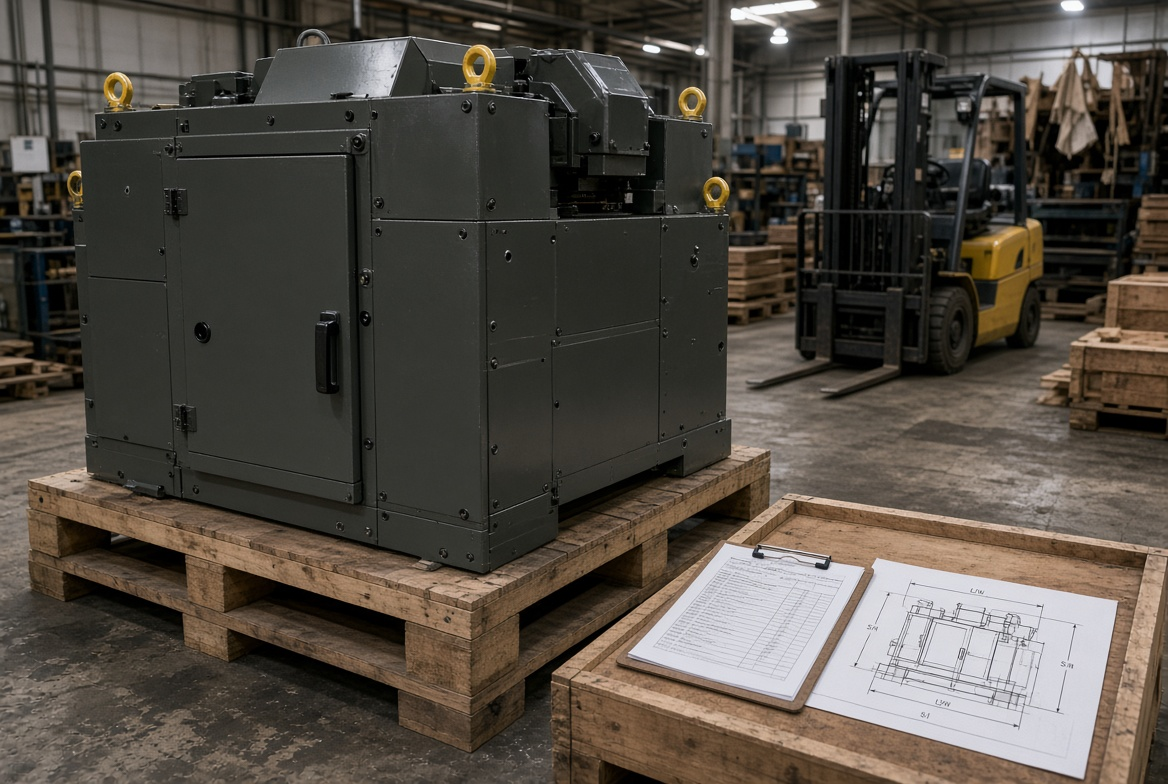
Packing and Crating for Machinery and Heavy Equipment
The correct packing and crating of machinery serves two purposes. It ensures that the machine is protected during a long sea haul or inland haul, and provides the lift crew with a structure to pick up, block and lash without being mistaken. The term “export-standard crate” does not represent a specification. The grade of the timber, size of the bearer, lagging, wrapping and fixing the machine inside the crate are.
Skids, crates, and bare machine loading
When the machine is sturdy, the points for lifting are obvious, and there is no need for complete box weather protection, all that is required is a skid. If there are exposed ways, electronics, painted surfaces or parts in the unit that should not be strapped directly, a closed crate is the better option. As long as it’s a flat rack or a vessel deck that is designed to accept it, and you have written a lashing plan against that frame, rather than against a crate that doesn’t exist, bare machine loading can be performed.
It’s better to have no crate than a lighter one than is appropriate for lift. The wood is the first to fail. The machine is then hung on slings that were not designed to pierce painted covers.
Protection for sea and inland transport
Rust and corrosion are the death sentence of untreated metal and sea air and long truck legs. A thick lid is not as important as waterproof wrapping and desiccants that are sized to the volume of the crate, and corrosion protection on machined faces. Blocking and bracing in the crate should prevent the machine from walking. A “strong” box that can be moved by the press is a timber wrapper.
Test plant-packs for rain at the factory gate and spray at sea. They could be exposed to the elements overnight on an open trailer, and start rusting before they arrive at the terminal.
Mode Choice When You Import and Ship Machinery from China
Machinery typically arrives in China in one of four types of container: a standard dry container, an open top or flat container, a multipurpose or heavy-lift ship or a breakbulk general cargo ship. The right family follows the cargo brief. It doesn’t have the habit of calling all the oversize items, breakbulk machinery from China.
Limits are specific to each container, chassis, terminal and vessel. Check the actual unit and sailing with the operator. Do not consider a drawing of “a flat rack” a standard flat rack with a standard payload or lashing points.
When a standard or special container works
A dry van can still be the cleanest move if the packed height will not exceed the height of the door, the payload will be inside the box rating and the lift can be performed at the job site. The taller or wider pieces will require an open-top or flat rack which can be lowered from above or lashed on an open platform.
The problem is that one assumes that all open-top or flat rack has the same internal length, payload and lashing configuration. Compare the packed unit to the specific equipment that is being sold, not to a generic drawing.
When a multipurpose or breakbulk ship is needed
When a piece is too heavy or too large for a container and its inland movement, or when a liner box can’t provide the side access and heavy lashing required, the planning path turns to a multipurpose or heavy-lift ship, or a breakbulk general-cargo vessel. These are NOT regular liner boxes with a fixed time allocated weekly and can NOT be booked like a 40ft. box.
Ignore flat rack vs multipurpose vessel as a preference, and consider it a cargo issue. If a machine is crated within the flat rack’s envelope, it does not require a multipurpose hold. An overrunning press that skids does. The same applies to equipment selection, packing, loading, securing, and route checks for industrial equipment as it does to machinery and heavy equipment shipping: If the mode doesn’t work, neither will the packing and loading or the securing and route checks.
Loading, Lashing, and Route Planning
Even with a correct mode, if the lift is unsafe or the piece is not able to travel the road, the lift will still be incorrect. Write a loading sequence for heavy machinery: Factory to Truck to Terminal to Ship. Apply the same reason at the destination. Each handoff has a different crane, ramp, and gate.
Loading sequence and lift plan
Name the lifting points, sling arrangement, and whether the piece may be tilted. Confirm that the factory yard can receive the truck or crane you intend to use. A lift that works at a deep-water terminal is useless if the machine cannot exit a low factory door or a soft yard.
Plan the ocean lift after the factory exit, not before. The first failure is often the plant gate, not the ship’s hook.
Lashing, dunnage, and weight distribution
Identify lifting points, sling setup and if and how the object may be tilted. Ensure the factory yard is able to accommodate the truck or crane that you plan to use. A lift that operates at a deep water terminal is pointless if the machine is unable to leave a low factory door or soft yard.
FACTORY EXIT should be followed by the ocean lift, not before. In my opinion the first failure is often the plant gate, not the ship’s hook.
Origin and destination route checks
Machine is held in place by chains, wedges, blocking and dunnage. Weight should be distributed evenly over the axle/stowage limits applicable to the move being made, flat rack or deck. An overhang that would not seem to be a problem in the factory can become a road rule or terminal gate violation.
Lashing that bites a painted cover or an unrated eye creates damage to the cargo it was designed to carry. Note the contact points and edge protection with the chain size.

Customs, Documents, and Delivery for Machinery Imports
How to import industrial equipment from China is not only a lift problem. The machine is still required to have a consistent commercial description, a packing list that is compatible with the crate and a delivery plan the site can accept.
Key documents for machinery shipments
The minimum set you’ll receive is a commercial invoice, packing list, and bill of lading or air waybill. Include papers on the machine, if they have them: serial numbers, certificates, packing declaration describing the crate, customs request papers, etc.
The lag is typically a discrepancy. Invoice indicates one model and weight. Another one is specified on the packing list. The marks on the crate don’t match either. Prior to shipping out the cargo, align those three records.
Destination clearance and final delivery
Entry, possible exams, duties and taxes, and the road from port to site all sit after the ocean leg. Book a delivery appointment against the packed dimensions, not against the machine’s catalog height. A wrong address or missing notify party on the bill of lading strands a piece that already cleared.
Documents and routing should be planned together. Readers who need that coordination in more detail can review export and destination customs clearance as a separate process from the lift itself.
A Practical Checklist Before You Book
Send photos, drawings, and a packing list. Do not send “machine, 20 tons, cheapest vessel.” Work the list in this order:
- Exact dimensions, weight, center of gravity, and lifting points
- Packing and skid or crate design
- Mode choice: container, special container, multipurpose or heavy-lift, or breakbulk
- Origin and destination route checks
- Loading and lashing plan
- Documents and delivery details
Sample scenarios
A crated CNC whose packed envelope fits a surveyed flat rack can stay in the special-container family if the inland route clears. A skidded press that overruns container payload or height usually needs a multipurpose or heavy-lift discussion, not a second attempt at a dry van. A hull section or plant module that cannot be boxed or racked is a breakbulk planning problem from the first photo. Those are cargo outcomes, not brand labels.
Mistakes that send machinery to the wrong mode or route
- Guessing dimensions instead of measuring the packed unit
- Ignoring center of gravity until the first lift
- Skipping a route survey because the port accepted the booking
- Calling every OOG booking breakbulk
- Planning the ocean lift and forgetting the factory exit
Frequently Asked Questions
What data does a forwarder need to quote machinery shipping from China?
Exact packed length, width, and height; gross weight; center of gravity if known; lifting points; packing state; origin factory or warehouse; destination site; and photos or drawings. Serial numbers and any special handling notes belong in the same pack. A model name and a rounded tonnage are not enough to price or book.
When should I use a flat rack instead of a multipurpose ship?
Use a flat rack if the packed unit fits into the envelope and payload of the selected equipment, the lashing plan can be applied to an open platform, and the lashing plan would allow for the inland movement of the rack. If these limits are exceeded, or side access and hold stowage is required, then move to a multipurpose or heavy-lift discussion. Check the unit, racks are not the same.
Do I always need a route survey for heavy equipment?
Any time packed height, width, and/or axle load may contact a bridge, gate or road limit, a route check must be performed. Standard trailer may not carry in-gauge pieces of light weight. Typically, heavy or OOG pieces will, at origin and destination. The first overpass is the one that trucks stop at by using the catalog sheet to guess the height.
Can heavy machinery move in containers?
Yes, if the packed dimensions and payload will fit into a dry van, or open top or flat rack and the lift is safe. Many machines in industrial applications do not require a breakbulk vessel. Fit is measured on the packed unit not the unit before crating.
What are the main risks in loading and lashing?
Unrated lifting points, flexing of skid, slings at an incorrect angle, off center stowing, overhang violation of road/gate rules and lashing that damages the frame. There are three lifts, the ocean lift being one of them. The same reasons apply to a factory exit and destination discharge that it does to a gunshot counter.A factory exit and destination discharge fail for the same reasons as a gunshot counter.
What documents are required for machinery imports?
At least: commercial invoice, packing list and bill of lading or air way bill, all with uniform descriptions and weights. Provide certificates, serial lists and packing declarations when necessary in accordance with the destination and/or the cargo. The clearance is still subject to the clearance rules of the importing country.
If the unit has been dimensioned and weighted and you need to get a live reading of the unit, you need to provide the machinery details to do a shipping assessment.