When accurate line data (machine count, dimensions, weight, center of gravity, lifting points, and how units depend on each other) sits by a packing and crating that can withstand the lift and the sea, and a mode that matches those pieces (container, open-top or flat rack, multipurpose or heavy-lift, or breakbulk), and a route that can clear factory gates, roads, bridges and terminals at origin and destination, then a complete production line from China moves safely. This article is an implementation of the importation of a production process from China: line data first, packing and mode are second, and route and customs are third.
Not all lines are break bulk lines. Special containers are still available for many machines. Often the out-of-gauge problems are packing or route problems, not a call for a larger ship.
Define the Production Line Before You Pack or Book
Never request for a line drawing or a sailing until the line is reduced to numbers. A usable brief describes each machine, its packed and unpacked dimensions, the machine’s net and gross weight, the machine’s center of gravity, the machine’s rated lifting points, and whether the machine can be moved by a forklift, crane or rollers. Include the packing state: bare machine, on a skid, fully crated or on wheels as it is going to leave the factory.
About 20 tons is not a brief, standard crate. A warehouse can’t construct a skid to take the lift without drawings, and a carrier can’t guarantee whether the piece will fit in a container, flat rack or a hold without drawings.
Line data and interdependencies
The length and width determine deck/hold stowage and two machines on one trailer. Factory doors, container door opening, terminal gates and bridges are dictated by height. The selection of the crane and the amount of weight that it can carry on the road depends on weight. The centre of gravity will determine if the piece will tip over, how it will rest on a flat rack and where the lashing must go.
One might say as much as the heaviest unit, the interdependencies are important. If a machine needs a specific machine to function, such as a sealer to be used with a specific filler; or if the machine is part of a control cabinet that should always be used with a specific machine; or if a machine must be moved with a specific frame, etc.; then it should be included as a set. When one crate is late at the origin or the final crate is at destination, the other crates are idle. The serial numbers or crate marks should be grouped like that as well, and the packing list should be a plant layout and not a random list of items.
Lifting points and packing design
Think of the machine as a rigger will think of it. Rated lifting lugs, sling points and fork pockets must be marked on drawing and on unit. If the frame is made from a wooden skid which is flexible, then the frame will move the center of gravity as soon as the load is lifted by the crane. Damage claims are caused by the straps when they bite into painted steel or hydraulic lines before the truck rolls out of the yard.
Inquire if the machine can be tilted. One exception to this is a controlled list that is placed on a flat rack at some frames. The rest must remain standing from the factory floor to the foundation bolts. There’s only one answer that will alter the height of the crates, the type of trailer and whether the open-top or the multipurpose hatch can even be used.
Packing and Crating for Production Line Machines
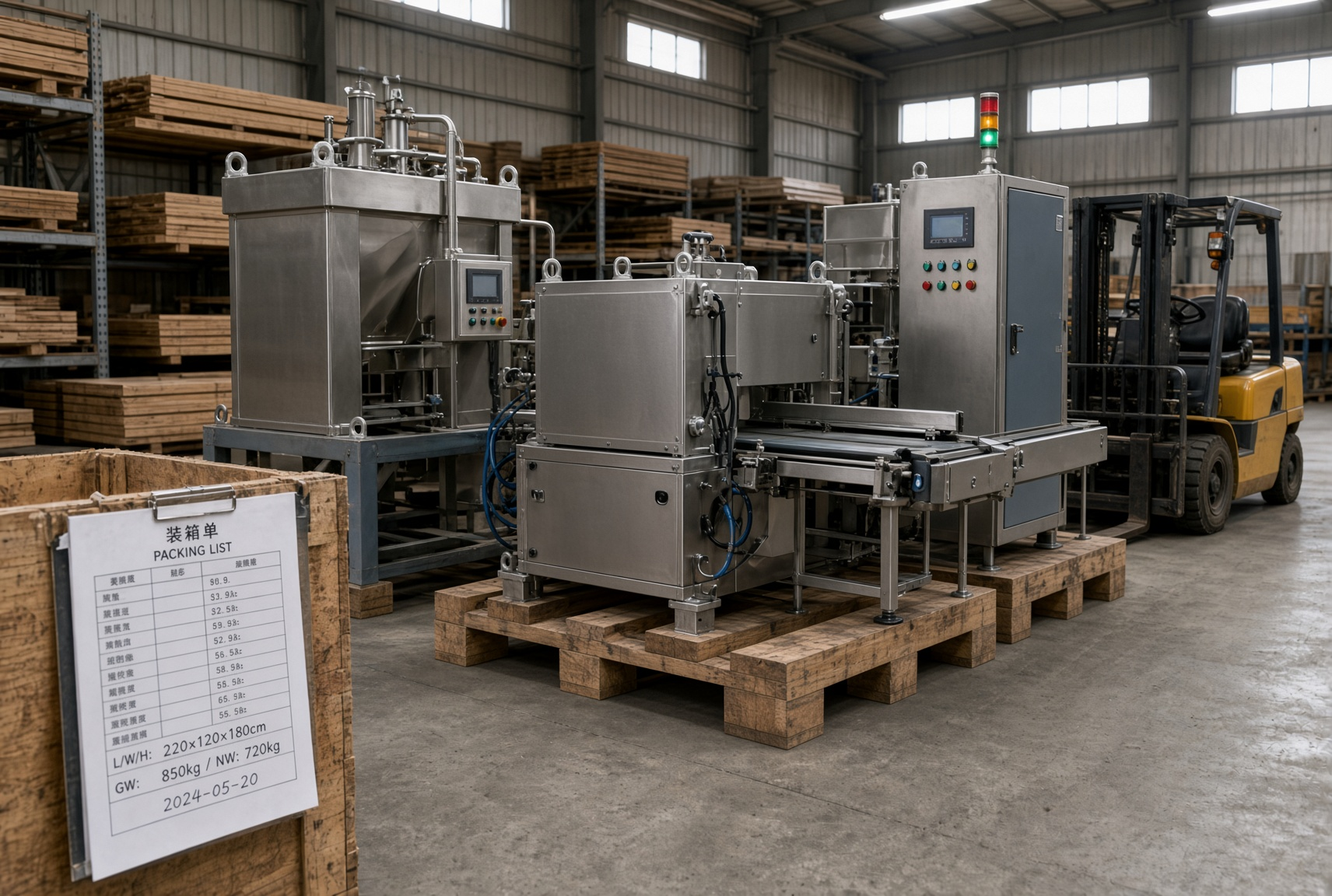
Proper packing serves two purposes. This is for the protection of the machine and also provides the next handler with a safe line to lift and brace the machine. There is no standard of “export standard crate”. The crate is required to align with the lift, sea spray and miles that follow inland after discharge.
Skids, crates, and bare machine loading
If the frame is stiff, lifting points are rated and the route is one that would not allow the finished surfaces to be exposed to weather or repeated handling, then a skid is sufficient. A full crate is the safe choice when panels, electrics or alignment surfaces can’t take a knock, or when the unit will be stored in a yard or on a trailer for days. Bare machine loading may be used with a flat rack or in a hold if the OEM has verified lifting points, weather protection and lashing pads and if the destination port has the capacity to accept an uncrated frame.
The common problems are also opposites: the frame is too light to bear the slings, and the frame ends up crushing on the first lift, or the frame is too heavy and then the salt air and the rain take their toll, because there’s no water-resistant cover on the frame.
Protection for sea and inland transport
Sea time plus inland time is a long corrosion window. Production line packing and crating doesn’t start with waterproof wrapping over machined faces, it begins with desiccants inside sealed wrapping, and/or vapor-corrosion protection where the OEM permits it. Blocking and bracing must prevent the machine from walking in the crate. Any box with a loose machine is still a damage file.
On top of a PDF, designate centre of gravity and “this way up” on the crate, not just on a PDF. Those loading the truck at 6 am will not open your email.
Mode Choice When You Import and Ship a Production Line from China
Most complete lines are either standard dry container lines, special container (open-top or flat rack) lines, multipurpose or heavy-lift ship lines or breakbulk general-cargo lines from China. Line data determines the family. It is not required that the booking be based on the.
Consider every family’s limits to be per route. The height of doors, the number of payloads and lashing points vary according to the equipment owner and the port. Make sure that you are using the correct unit and the proper berth before you freeze crate drawings.
When a standard or special container works
Machines which can be moved in dry vans (or several smaller machines in a single dry van with a packing list to keep them grouped) are those which will pass through a door height and payload. Open-top can be used with taller pieces that can be loaded from the top. These are generally wider, heavier, parts that require side entry or a flat rack.
Not all open tops or all flat racks are the same height, length or lashing pattern. If a rack is successful in a terminal, it may not be successful in the next gate check. Compare packed unit with the individual piece of equipment, such as lashing gear, and with any overhang.
When multipurpose or breakbulk is needed
For pieces that exceed weight or size limits for containers, require side access or hatch access, or require lashing to deck strong points instead of container corner castings use a multipurpose or heavy lift ship, or a breakbulk production line from China booking. These sailings are not weekly liner cut-off sailings! Space, crane time and stow position are dependent on the cargo. Do not plan them as a “container roll over”.
Once those families are on the table, the selection of equipment, packing, loading, securing and route checks for the line are all part of one huge and project cargo planning conversation and not a late decision, say, from a dry-van booking.
Loading, Lashing, and Route Planning for Production Lines
Even if it’s correct, it doesn’t work if the lift or road is incorrect. There are three types of loading on a production line: factory to truck; truck to port; and port to ship. Every handoff comes with a different crane, a different ground bearing and a different set of people who had never seen the drawing.
Loading sequence and lift plan
Begin at the factory gate; not at the vessel. Can the tightly-packed machine get out of the workshop? Is the weight being lifted at the sling angle that the truck ramp or yard crane is capable of? Some frames don’t tilt and some skids only accept forks from one side. Add that to the list of sequences to write off before booking a ship’s hook.
Next repeat the questions at the terminal: range of the crane, flat rack landing position, next machine in line load first for the same order of discharge at destination? A “ready” crate is situated behind a door that is 20cm low, which was done during planning only the ocean lift – no factory exit.
Lashing, dunnage, and weight distribution
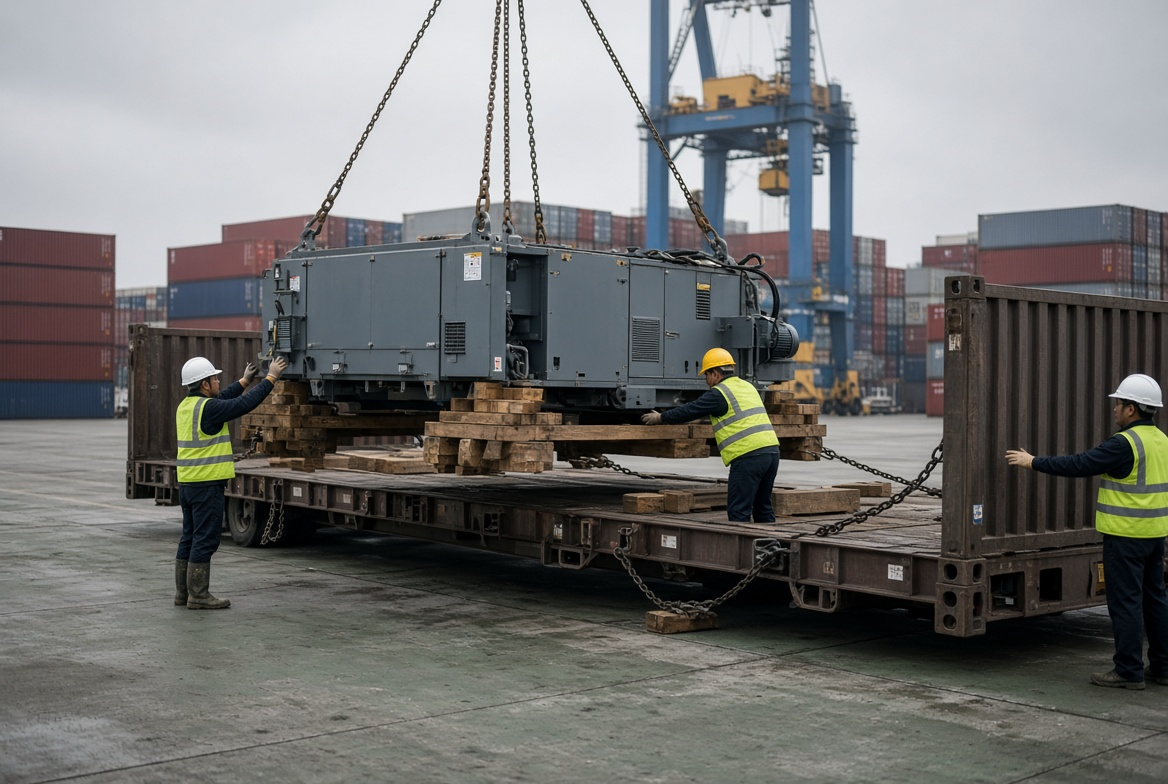
The real center of gravity, not the crate stencil, is held by chains, wedges, blocking and timber. The weight should be distributed in the middle of the trailer or the middle of the deck and within the weight and stowage limits for the move. In the factory yard, this overhang could be acceptable, but it may not be in accordance with road or terminal regulations. This damage occurs even if the machine doesn’t move.
Take pictures post lashing and prior to roll up truck. They are less expensive than an argument as to whether the piece was already marked or not when it left the plant.
Origin and destination route checks
Route planning for a production line is a survey, not a map pin. Review bridge clearances, axle width restrictions, turning radius and terminal gate guidelines at origin and destination. A flat rack that loads at the port is no good if it cannot get off the factory street or onto the destination plant.
If there is a height, weight or width restriction, verify the route with the current restrictions; not last year! In the event that required, permits will be based on the measured packed dimensions and the actual truck configuration. When a truck has a line on it and has to park under a bridge, it’s because the driver guessed the height of the bridge.
Customs, Documents, and Delivery for Production Line Imports
Production line remains a customs entry. The freight plan will only be effective if the documents are stating the same machines that the plant will be installing.
Key documents for production line shipments
At least: commercial invoice, packing list, BILL OF LADING/air waybill, machine-specific papers destination requires like certificates, serial numbers, model lists, etc. and any dual use or licensing notes that apply to that machine. The description on the invoice should be the same as the packing list description. The invoice contains the word “packaging line” and the packing list lists twenty crates, with no names on them, the entry would stall until the packing list is rebuilt.
Use invoice, packing list and crate marks for serial numbers. The numbers are the same for destination examiners and site engineers.
Destination clearance and final delivery
Post-arrival services: filing of formalities, potential examination, duties and taxes according to the destination’s regulations and delivery from terminal to site. Schedule the delivery appointment with the actual discharge window and availability of the crane or forklift at the site. When the address is incorrect or the notify party is not on the bill of lading, a full line is left in depot while the foundation waits.
Documents and routing must remain on same page. Those who require processing of the clearance themselves can check export customs clearance and destination customs clearance with the packing list that they have already created.
A Practical Checklist Before You Book
Copy this sequence. Don’t go to the "cheapest vessel" option.
- Exact Line Data: Number of Machines, Dimensions, Weight, Center of Gravity, Lifting Points, Interdependencies.
- Packing and skid/crate design including weather protection.
- The type of mode for transportation: container, special container, multipurpose or heavy-lift, or breakbulk mode.
- Origin/Destination routing (with gates, bridges and axle limits).
- The loading and lashing plan for factory, truck and ship.
- Documentation and site delivery including serials, appointments.
Send pictures, drawings, and a packing list. Don’t rag the quote, just send 20 tons, production line.
Sample scenarios
A special-container project may result if lifting points and route height are verified for a packaging line that has several mid-size frames for packing, which operate within the length and height of a flat-rack. Even a food-processing line that happens to have a few vessels that are very heavy or tall might require a multipurpose ship because hatch access and heavy lashing are more important than a weekly liner cut-off. If the packed shape of a textile line is not accepted by a container family, then breakbulk stowage might be necessary. These are planning patterns and not a guarantee of the same equipment on your line.
Mistakes that send production lines to the wrong mode or route
- Estimating sizes rather than measuring packed units
- Lack of understanding of the centre of gravity when selecting a skid, a tilt or a lashing pattern
- Avoiding the route survey and finding the bridge once the truck is loaded.
- Confirmed flat rack would do to call everything that is out of gauge “breakbulk”
- Planning the ocean lift and forgetting where the factory door, truck ramp or destination gate is
Frequently Asked Questions
What data does a forwarder need to quote production line shipping from China?
Machine count, Packed and unpacked dimensions, Weights, Center of gravity, Lifting points, Packing state, photos or drawings, origin factory address, destination site address, any parts to travel together. If these are not available, then a quote is just a best guess on equipment class.
When should I use a flat rack instead of a multipurpose ship?
Utilize a flat rack if the packed unit is of the same length, width, height, and payload as the flat rack, can be secured to the flat rack, and can move along the origin and destination roads. If the piece must be moved on a multipurpose or heavy lift ship because the container equipment does not provide the necessary weight or shape or if the piece requires hatch or side access that the container does not provide, move the piece on a multipurpose or heavy lift ship. Specify what unit in question is this, which is not a slogan.
Do I always need a route survey for a production line?
Yes if packed height, width or axle weight approaches local limits. A line that passes a berth can fail a factory street or plant gate. If all dimensions fit within a normal trucker’s range, it’s not necessary to perform a complete survey, although you still check doors and gates by numbers, not memory.
Can production line machines move in containers?
Yes, if they fit door height and load or an open top/fat rack has been confirmed for that unit. Importing an Industrial Production Line from China is not a one-step process of breakbulk. Install on equipment and book.
What are the main risks in loading and lashing?
Unrated lifting points, flexed skid, lasing over the rated angle of a lug, weight load off centre, overhanging lash that infringes road or terminal rules and lasing to damage the load being lifted. There are 3 lifts, the ocean lift.
What documents are required for production line imports?
Commercial invoice, packing list, transport document and any document certificates or serial lists requested by destination. Descriptions should be consistent between papers. Entry, future exam, duties and taxes follow, followed by a delivery appointment that the site is capable of fulfilling.
If line data is available, packing state, origin, destination and a live assessment are required, if you need a shipping assessment share production line details and you will get a live assessment.