
The 20 ft vs 40 ft vs 40 HC choice is a cost and risk decision and not a reflex to be booked the biggest dry box. The wrong size can result in paying for unused cube, battling the height of the door at the factory, hitting payload before the floor is full or excess handling after the box has arrived at destination. Under the umbrella of that choice lie conditions of factory loading, multi supplier consolidation, and destination charges for importers shipping FCL from China.
This guide outlines and compares the common dimensions, useful volume, load capacity, price per cubic centimeter, and best use scenarios for each type of cargo. A 40ft is not always cheaper than a 20ft and a 40HC isn’t always “the taller 40ft, so always use that.” Which container works is determined by density, stacking height, door clearance and restrictions within the building.
Key Dimensions and Capacity: 20ft, 40ft, and 40HC at a Glance
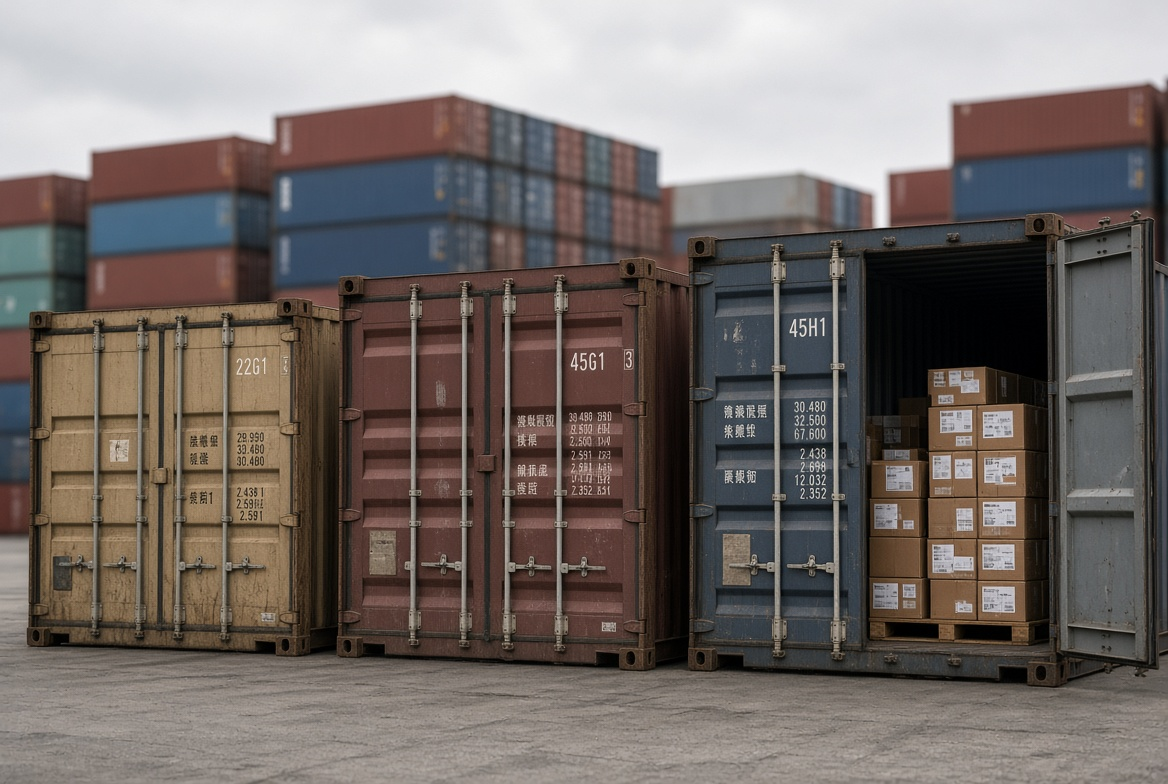
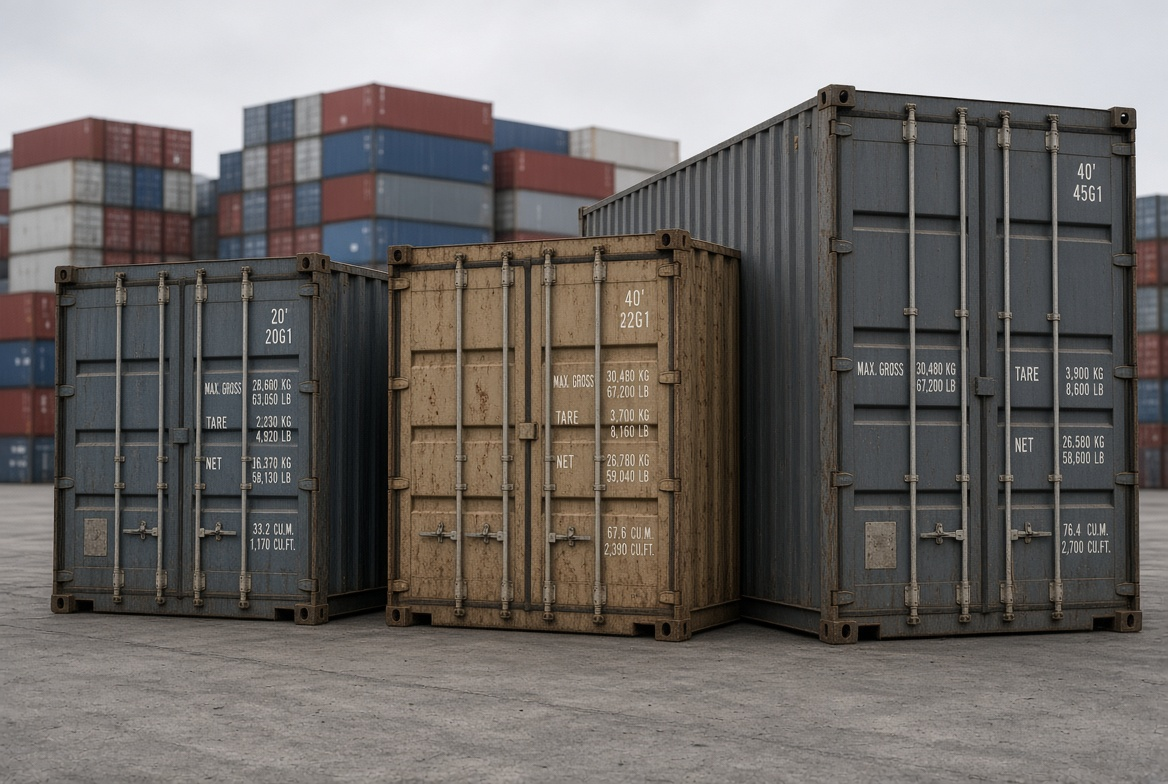
The majority of FCL shipments from China are shipped in 3 types of standard dry boxes: 20ft standard dry box, 40ft standard dry box and 40ft high cube (40HC) dry box. External envelopes are ISO compliant. Some manufacturers, age and condition may vary in the length, width, height, door opening and payload. Use the numbers below as planning numbers. When a load plan is frozen, verify the actual unit being booked prior to doing so.
External and Internal Dimensions, Door Opening, and Theoretical Volume
The following are typical planning ranges for the 20ft, 40ft and 40ft high cube dimensions:
| Spec | 20ft standard | 40ft standard | 40ft high cube |
|---|---|---|---|
| External L × W × H | about 6.06 × 2.44 × 2.59 m (20′ × 8′ × 8′6″) | about 12.19 × 2.44 × 2.59 m (40′ × 8′ × 8′6″) | about 12.19 × 2.44 × 2.90 m (40′ × 8′ × 9′6″) |
| Internal L × W × H | about 5.90 × 2.35 × 2.39 m | about 12.03 × 2.35 × 2.39 m | about 12.03 × 2.35 × 2.70 m |
| Door opening (W × H) | about 2.34 × 2.28 m | about 2.34 × 2.28 m | about 2.34 × 2.58 m |
| Theoretical volume | about 33 CBM | about 67–68 CBM | about 76 CBM |
The difference most loaders feel is the extra height on 40HC. A second layer of cartons, or a taller pallet (which will rub a standard door), can make an empty 40ft a complete 40HC. Pallet patterns tend to be poor on a sudden extra aisle of floor space, but not on internal width which remains more or less the same throughout all three.
The restriction that spreadsheets lack is that of door height. A pallet that fits the internal height may be too high to fit through the door opening. The standard 20ft and 40ft doors are lower than the ceiling. Cargo that is height-sensitive typically goes in the 40HC doors even if the floor seems the same as the 40ft.When the floor appears the same, but the door is taller, then the cargo is typically height-sensitive and should go in the taller door: 40HC.
Payload Limits and Safe Working Weight
Unlike FCL, where there are two different limits (container capacity and payload), the container capacity is the only limit for less-than-load service. Volume is the amount of space that can be filled. The actual weight of the cargo loaded into the box (excluding tare weight) is known as payload. Typical published maxima range in a ‘band’ around 21-28 tonnes for a 20ft and 26-29 tonnes for a 40ft/40HC, depending on the max gross rating and tare of the unit. Those numbers are not a loading target.
Care should be taken to ensure that safe working weight is lower than the maximum plate weight after considering axle limitations on origin or destination trucks, terminal handling rules and the arrangement of the goods on the floor. Tiles, hardware, some parts of machinery, building materials can reach weight well before cube.Dense cargo can reach weight well before cube. If so, a 20ft can be the clean box although the 40ft might have free air.
The following factory or warehouse rework, additional weighing, rejected gate-in, destination penalty, or delayed booking are potential consequences from an overweight container. Please do not intend to use the last tonne on the CSC plate. Inland move and the terminal accept plan to a weight.
Cost Logic: Ocean Freight, Destination Charges, and Cost per CBM
The physical size will only tell you what fits. It is the Cost per CBM for 20ft 40ft 40HC that decides on whether to book that fit or not.
Ocean Freight Rate Structures for 20ft, 40ft, and 40HC
Often times these boxes are sold with the price as three separate items, rather than as a straightforward triple of a 20ft. box. A 40′ will not be double the cost of a 20′, just more. A 40HC tends to be one level higher than the 40ft. The gap varies from trade lane, carrier, equipment balance, and market week.
Such a structure is the reason for the weakness of “the cheapest container on the booking” being a weak test. A 20ft with a lower all in ocean line may have a higher unit cost for the CBM if the cargo is light and bulky. If two of your containers can be eliminated by a 40HC of higher line-haul, then it can be less expensive per container.
Request quotes from the same origin, destination, cargo-ready date and scope of service. Last quarter rate sheets are not a decision tool.
Destination Charges, Inland Transport, and Hidden Cost Drivers
One line is ocean freight. Terminal handling, delivery order fees, destination THC and documentation and inland truck and rail can follow the container size and weight. The axle limits, permit rules or yard restrictions for some inland routes require a heavier 40ft or taller 40HC than the ocean quote was for.
It’s easier to install a 20ft at a small dock at a warehouse. There may be a need for a 40HC to have more space at destination or a different chassis. Such details are not included on the origin ocean line. As always, they end up in the importer’s price.
Origin handling, ocean, destination handling and inland move (if applicable) to that box size.
Calculating Cost per CBM and Cost per Unit for Decision-Making
Don’t make it theoretical cube, use usable cube. The actual load capacity of the carton (33, 67 and 76 CBM) depends on carton shape, pallet height, bracing, and clearance on the door.
A simple frame:
- After stacking and door size restrictions, estimate usable CBM (or sellable units) for each size.
- Include variable expenses associated with the box including ocean, key destination fees and inland delivery.
- Calculate the total and usable CBM or units.
Illustrative example only — not a quote and not a current market rate.
Lifted cartons that are light and stackable:
- Usable volume: 40ft(58 CBM). Assumed ocean + key destination charges: USD 2400. The cost of a single usable CBM is approximately USD 41.
- Extra carton layer = 40HC usable volume: 70 CBM Assumes ocean + key destination charges will be USD 2,600. Cost per useable CBM: approximately USD 37.
The 40HC is the better cost per CBM box, despite its higher number of containers per box. Switch to heavy load at 22 tonnes at 18 CBM. The 20ft may be closed in one box, but they won’t pay for 40ft of unused floor. Before assigning either result as a rule, recut the same math with your carton list.
Loading Realities: How Cargo Type and Packaging Drive the Best Choice
Only after mapping the actual cargo can dimensions and rates be considered a booking. The top importer container loading tips begin with density and stack strength and not with a name of a preferred container.
Dense, Heavy Cargo: When 20ft Often Outperforms 40ft and 40HC
The 20ft. is often the best container size for heavy cargo from China. Tiles, stone, metal fittings, some industrial components and packed building materials are delivered while a considerable amount of the cube remains empty. If that’s the case, it’ll cost you more money for the 40ft or 40HC booking, and it will also purchase unused air and heavier inland move.
A 20ft is also easier to be in truck axle limits and easier to be placed at smaller docks. The operational advantage is just as tangible as the freight line: No more overweight conversations, no more last minute de-vanning at origin and a cleaner delivery appointment.
Two 20ft (as opposed to shipping one overloaded 40ft) may be the more prudent choice if the purchase order is still too heavy for one 20ft. It is not a preference for “more containers”, it is a loading decision.
Medium-Density General Cargo: The Classic 40ft Use Case
Many lots of consumer goods, electronics, apparel (average carton height) and palletized general cargo are more suited to a standard 40ft. box. Weight and cube tend to be closer together towards the end of the run. Images of the typical US pallet size (around 20–21 pallets that fit together in a single layer) or Euro pallet size (around 21–23 pallets) are the most common planning pictures found for pallets.
We choose the 40ft as the default because it’s the compromise box. It is the wrong standard in case the load is significantly heavier than that shape or significantly taller.
Light, Bulky, and Height-Sensitive Cargo: Where 40HC Shines
The case of 40HC is when the additional height is worth the extra weight of cargo. Standard 40ft are wasted on furniture, lighting, large home-goods cartons, tall display units and some plastic or foam-packed goods which do not fit in the 2nd or 3rd layer. The additional internal height (and a higher door) can allow for the addition of a layer or the use of a taller pallet with a 40HC without a change in floor length.
This additional cube may reduce the containers in a program. Both origin handling and destination appointments are changed simultaneously with one 40HC replacing two loosely filled 40fts, changing the unit cost. The per-box rate may be even greater. However, there may still be a program cost drop.
Avoid using 40HC just for the sake of space—because “high cube sounds like more space.” If the cartons are small and compact, then the additional foot of height proves to be of no value.
Operational Impacts: Factory Loading, Consolidation, and Destination Handling
The size of the container is directly from the first factory dock to the importer’s warehouse. A perfect-looking box for a packing list can fail, though, at one of the doors.
Factory Loading Constraints and Door Height Considerations
Many Chinese factories load onto a dock that wasn’t designed around a 40HC, and load with a forklift. The last pallet in or out is determined by mast height, ramp angle and door clearance. If something fits on paper, it may not be possible to load it without tipping and/or restacking or crushing the bottom of the carton.
If the factory has not loaded a 40HC before, request pictures of the dock and the desired pallet level prior to freezing a booking. It is at the origin that the cheaper-looking box becomes the expensive box, that is last minute re-work.
Multi-Supplier Consolidation and Container Size Strategy
Value buyers from other parts of the world will often import to a Yiwu, Dongguan, Shenzhen, Ningbo or other Factory warehouse, and then ready 1 FCL. The size strategy changes as a function of that flow.
A 20ft will fit one supplier or a smaller, higher frequency lot that should be ready to go before the rest of the lot for the month. A 40ft/40HC may be worth considering if multiple factories are able to access the same receiving window and the warehouse can facilitate the entire load. Actually, the time is the limiting factor. One late supplier leaves a 40HC half full and you pay for the full box.
Provide the supplier cities, dates and carton quantities early to allow the load plan to adjust size. After the last factory has packed it’s too late to change containers.
Destination Unloading, Inland Transport, and Warehouse Constraints
The destination equipment is as important as origin docks. If a warehouse has a low door, a short yard or a trucker is limited on weight, then he/she may want a 20ft. The taller box may be more suitable for a site that will accept a 40HC but does not require increased unload appointments.
Arrange the move inland prior to the boat leaving the water. If a 40HC does not arrive at the delivery site, the cluster will be reloaded, stored or sent back to the terminal – all of which will wipe out the ocean saving you had hoped.
Common Mistakes Importers Make When Choosing Between 20ft, 40ft, and 40HC
The most costly error is a habit, not the lack of ISO tables.
Always Defaulting to 40ft Without Checking Density and Height
If a 40FT is booked because “that is what we always book” it will result in empty boxes and a low cost per CBM. It also conceals 20ft and 40HC with the same habit. Copy the equipment type from the previous shipment before the team that books.
Ignoring Weight Limits and Overlooking Over-Weight Risks
The only way to get dense cargo over the working weight of a 40ft or 40HC is to plan only in CBM. There are consequences such as origin restow, added trucking, terminal refusal, and cargo shift if the load was not initially braced for the actual mass. Compare the packing list with a reasonable estimates, rather than the maximum number on an arbitrary picture of a container.
Comparing Only Ocean Freight and Ignoring Total Landed Cost
The ocean line is the noisiest and typically the least full line. Destination charge, inland limits, extra handling for an overweight or overheight box and cost of a second container are all part of the comparison. Two origin freight quotes that look close can turn around after delivery.
How to Work with Your Freight Forwarder to Optimize Container Size
Freight forwarder container size optimization from China is effective if the forwarder has the same cargo information that you have. Nonspecifics are generic 40ft bookings.
Data to Share for a Data-Driven Container Recommendation
Include a valid file name (not a product name):
- Description of goods and packing (cartons, pallets, crates)
- Length, width, height and gross weight of carton or pallet
- Total number of pieces/Total gross weight
- The ability to stack cartons and maximum stack height.
- Supplier’s location and date of readiness for cargo.
- Incoterm and named place
- To and from any known dock, or any known truck limits, in the destination port or door.
This package is a China-based one allowing for a modifiable CBM, weight distribution, and a comparison to the 20ft / 40ft / 40HC in the same scope. If there are missing dimensions, you have to guess. If no input is given, the default is the box the previous similar shipment was used in.
Questions to Ask About Rates, Sailing Options, and Total Cost Scenarios
Request 3 parallel views (side/front) of the same lane:
- Sailing rate difference for 20ft, 40ft and 40HC – NOT a best rate.
- The number of times you sail and the cut-off that you really have for your ready date.
- Inland restrictions and destination charges that vary per tonne and/or per size
- Whether a 2nd container is removed from the program based on 1 size.
Use the size of a container as a variable not as an admin field that is completed after production. A few centimetres in carton size can be much more than a small difference in ocean rates.
Summary Guidance – Turning Container Size Into a Competitive Advantage
Planning lever – right choice between 20ft, 40ft and 40HC. Settle for match density, stack height, door clearance, and usable cube, and then match them to payload. Maintain the conversation of the ocean booking with the factory dock and destination warehouse.
Importers that provide full carton information and request side-by-side size scenarios typically will spend less time dealing with overweight loads and half empty boxes. The practical benefit is less of a surprise from factory to delivery – and a container that is worth its freight rather than half loaded.