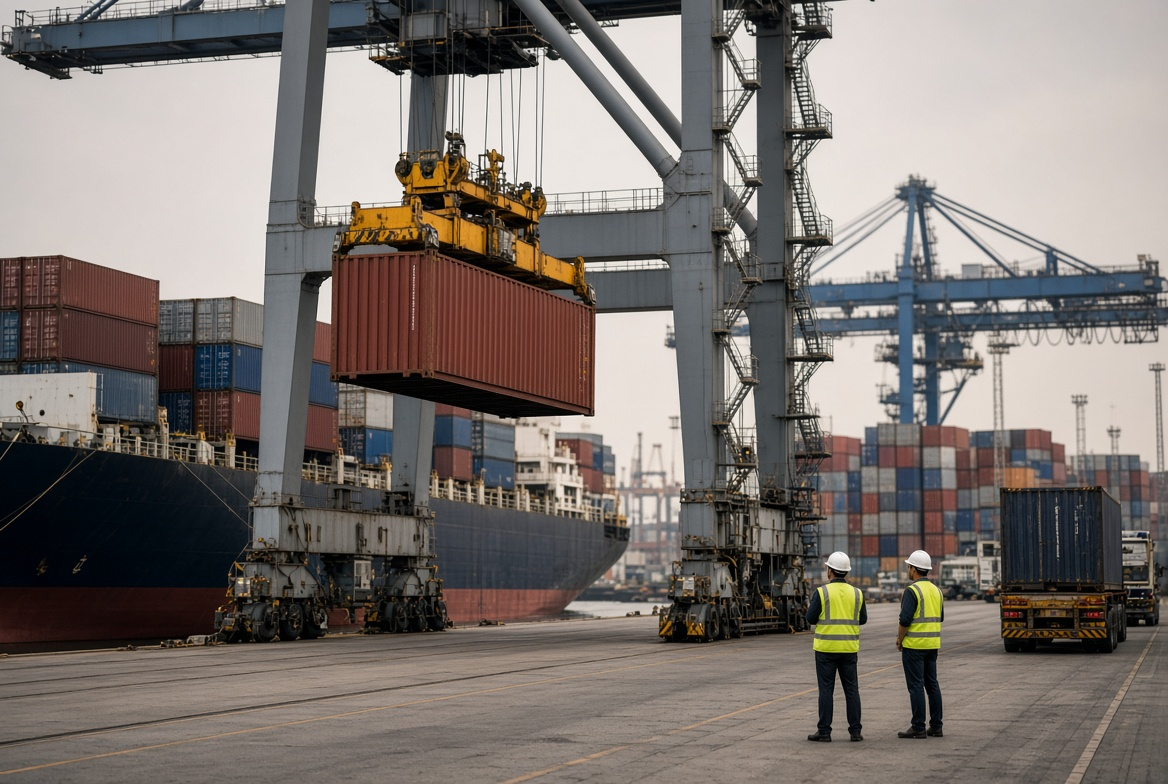
The fees that port terminals impose on a container for loading and unloading between the vessel and the truck or rail, including yard movement and stacking, is called Terminal handling charges (THC). The answer to the question, what are the terminal handling charges in shipping is a short one: It’s not the ocean freight; it’s a standard terminal-side cost that typically gets charged twice, first at the load port in China, and again at the discharge port in the overseas destination.
Some carriers or forwarders include THC in an “all in” ocean rate. Some add origin THC and destination THC as two separate lines. The only way people get quote comparisons wrong and the only way destination invoices catch people off guard is if they assume that THC is already in every base rate. This guide explains the content of THC, origin/destination differences in THC, the usual party paying THC under common Incoterms and service scopes and how to incorporate THC in a landed-cost model prior to booking.
THC Defined: What Are Terminal Handling Charges (THC) in Shipping?
THC is the terminal’s charges for the box on its own land. Not the vessel voyage, not a factory pickup, not in-land trucking, and not warehouse storage away from the terminal. The “THC” is an importer who reads it on a China quote and pays for the movement of the container within the port fence.
Terminal Operations Behind the THC Line Item
A container at a working terminal is unloaded from a rail wagon or truck, hoisted into the yard, stacked and back onto the vessel. But after discharge, it is the reverse way around: the box is taken from the ship, passes through the yard and is offered for collection. The yard moves, the lifts, the terminals make up the business at the heart of terminal handling charges explained to importers.
It is not the job of the holder of that work, namely the terminal operator, but of the crew of the ocean carrier’s vessel, or the inland haulier. Hence, often times THC is not lumped in with “ocean freight.” The carrier can pick up the THC and move it through. The real service remains the physical handling of the cargo.
Origin THC vs Destination THC: Two Separate Charges
If a driver is carrying load from origin to destination, the THC might be charged twice – once on the origin and once on the destination.
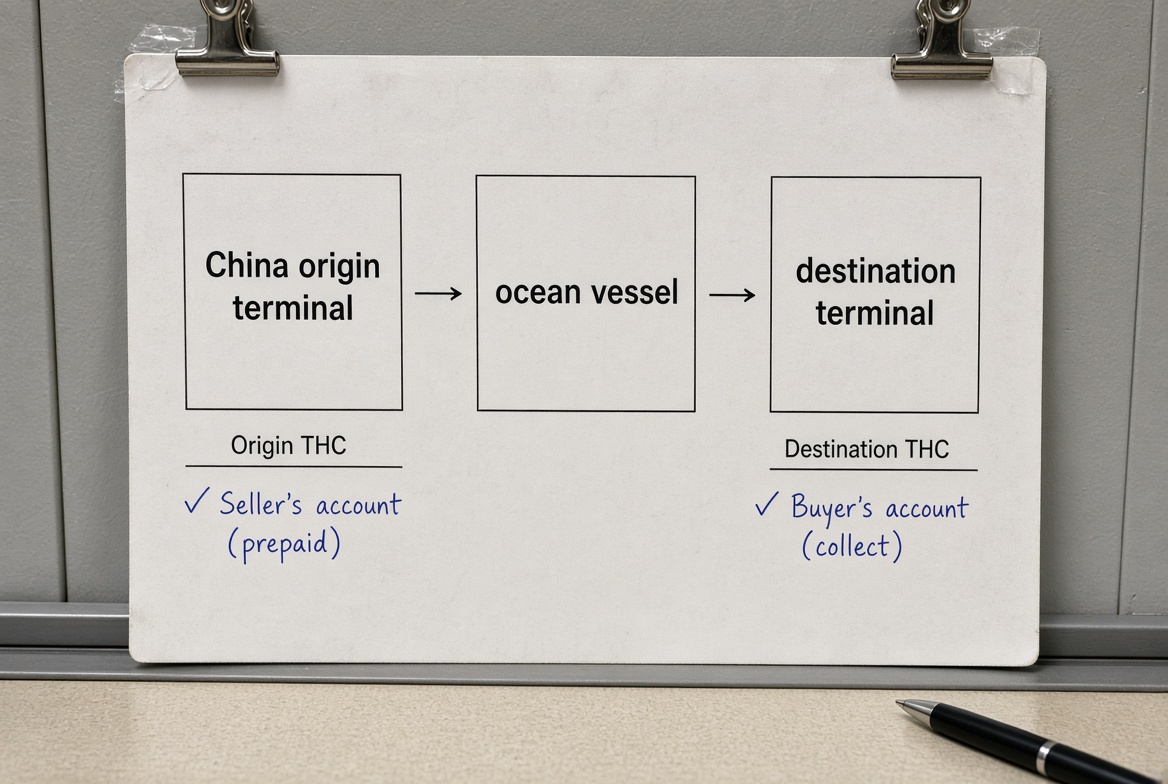
Normal full container shipment from China generates two THC events, rather than one.
Origin THC is levied at the Chinese load port. The terminal handles the shipping/forwarding of the Container and prepares it for loading. The overseas discharge port is the charge point for Destination THC. The terminal removes the container from the ship and provides it for loading or for further transportation.
The two charges are from two different terminals, two different tariffs and two different currencies. On the same booking, there can be a significant difference between origin THC and destination THC in sea freight. Do not view a Shenzhen or Ningbo origin THC as a preview of the THC at destination Los Angeles, Rotterdam, Felixstowe or Melbourne. Treat them as 2 cost lines, 2 owners.
How THC Appears in Quotes: Bundled vs Itemized
Every carrier and forwarder report and price THC in their ocean freight quotes and ocean freight invoices differently. It can be actual in both instances. The presentation will make it easier to compare two offers.
All-In Rates That Include THC
All-in Ocean rates incorporate base freight and origin THC, destination THC or both into one rate. The quote is clean looking. Comparison feels faster. The danger is that it is difficult to know the proportion of that number that is the voyage and how much is terminal handling.
A quote that is not including THC charged by one forwarder and another that is not including them, does not make the latter quote cheaper until it is rebuilt on the same scope. When the inclusion list is written down, all-in pricing is helpful. It is a snare if it is presumed in the inclusion list.
Itemized Quotes Showing THC Separately
An itemized quote breaks down base ocean freight, origin THC, destination THC, bunker/peak season surcharges and other accessorials into individual lines. That structure is more difficult to read and more difficult to audit. It can be determined if a low ocean rate is being counterbalanced by a high destination THC.
Itemization also uncovers the holes. If origin THC is given and destination THC is not given, inquire about the following: Is destination THC payable at arrival, is destination THC included elsewhere, or is it just omitted? Nothing on a destination line is not the same as a ZERO charge.
Why the Same Lane Can Show Different THC Treatments
For normal business reasons: carrier tariff policy, forwarder packing of offer, trade-lane habit, port to port/cy/cy or door to door, the same lane from China can produce bundled THC, as well as split THC.
Before ranking rates ask one question: is THC included or excluded, at origin or at destination or both? After that, request the same analysis from each bidder. A freight forwarder THC break down from China can only be useful if all the quotations are based on the same map.
Who Pays THC? Incoterms, Service Scope, and Contract Terms
The following are examples of THC under Common Incoterms EXW, FOB, CIF, DAP, DDP.
Under EXW, the buyer is typically responsible for all handling charges at the origin as well as international freight charges and charges at origin. That usually results in the origin THC and destination THC being with the importer unless a forwarder has included them in a service package.
FOB means that the seller is responsible for origin terminal handling up to the point of loading. Buyer pays for destination THC and after discharge. CIF is generally used and the seller will pay the origin THC and the ocean freight to the named port. The destination THC and import costs remain with the buyer.
In DAP or DDP, the seller or his forwarder is selling the delivered result. That delivered price usually includes both THCs, and is therefore not as inexpensive as a port-to-port ocean line. “Often” does not equal “always.” If the DAP/DDP term does not specify terminal charges in the destination, please ask before cargo sailed.
Under DAP or DDP, the seller or the seller’s forwarder is selling a delivered result. Both THCs are often inside that delivered price, which is why the unit rate looks higher than a port-to-port ocean line. “Often” is not “always.” If the DAP or DDP quote is silent on destination terminal fees, ask before cargo sails.
Final allocation will be dependent on the sales contract, the booking note and who the terminal invoices. The gap will appear as a conflict at the destination gate should the commercial team have different assumptions.
Port-to-Port vs Door-to-Door: How Service Scope Shifts THC Responsibility
Port to port quote is based on terminals to terminals move. Origin THC and destination THC can be included, excluded or split. That is not included in the area of factory pickup and final delivery, unless they are extras.
A door-to-door quotation is dependent on two handoffs – at the factory and at the delivery address. The forwarder needs to take the box through both terminals to do the job, and this will generally be included in the end to end price. The importer will still have to determine if this price is DDU, DAP, or DDP as clearance and duty are on a separate line from THC.
Align the scope of services with your team’s capacity. A door-to-door structure eliminates operational hassle if you are not using any destination agent, and don’t like the idea of paying a terminal invoice in another currency. A clear port-to-port breakdown might be more cost effective for those already in control of drayage and clearance.
THC in the Total Cost Picture: Beyond the Base Ocean Rate
It’s the line that importers negotiate first, ocean freight. The THC is the number that impacts the P&L even if it is included in the first number.
THC as a Significant Component of Landed Cost
If the base ocean rates are high, THC may appear small. If the base rates are lowered, or if the trip is rather brief, THC can be a much larger proportion of the shipping cost. Only the ocean line is compared, and the wrong winner is selected.
A practical way of doing this is to determine the origin charges which include THC, ocean freight and named charges, and destination charges which include THC and inland delivery. If two quotes move up and down ranks after that addition, then the ranking was incomplete.
THC Variability by Port, Terminal, and Container Size
It is normal for a port to vary in its THC depending on the size of the container. Tariffs vary between different ports. Various terminals within the port complex can have varying rates. Often, a 20ft box and a 40ft or 40ft high cube box are priced differently – not a simple doubling.
Peak, congestion or equipment-related adjustments are added to the published handling fee at some terminals. These extras don’t always have the designation “THC” but they do come with the same terminal invoice family. For planning purposes, ask for the THC for the real origin port, destination port, terminal (if applicable) and container type. The average of a generic “China THC” offers no budget.
THC vs Other Terminal-Related Charges: CFS, Demurrage, and Storage
The most frequent mix up is between THC vs CFS and demurrage charges.
The main charge of CFS is based on the cargo volume of LCL. These include consolidation/deconsolidation within a container freight station. Any FCL cargo which does not get opened at a CFS should not be moving with a CFS line as if it’s THC.
Demurrage and terminal storage are levied when the container/cargo is kept over free time. These are penalties or occupancy charges which are based on time. A standard processing fee that is expected on a regular shipment that arrives on time is called THC.
When the destination invoice is higher than the quote, split up the handling fee from the overtime fee before you discuss the rate. One is intended budget cost.One is budgeted cost. The other is a process failure.
Common Mistakes and Risks When Importers Misjudge THC
Most problems with THC are not issues of "exotic tariffs". They are after-book errors that occur when you compare and contrast.
Comparing Only Base Ocean Rates and Ignoring THC
If you look at just the ocean freight line, it is the quickest method to choose the wrong quote from China. A quote could include one without destination THC. The other may have THCs and seem pricey. The invoice will not matter which row you selected in the spreadsheet.
Typically, this translates to budget bloat, a bad meeting with finance, and a destination charge not added to the cost of the product.
Assuming THC Is Fixed and Identical Across Ports
There is no “flat fee” for THC. Shanghai is not quite the same as Qingdao. Long Beach is NOT Savannah. A 20ft THC is not a 40HC THC. The cost models that duplicate the previous year’s number on a new port pair will slowly get away from it.
Add a new origin/destination, request the current THC for that origin/destination and equipment type. Then put a review date on the model. Terminal tariffs move.
Not Confirming THC Responsibility in Contracts and Quotes
Typically, sales contracts just mention an Incoterm and then they’re done. Quotes frequently only mention a rate and end there. Both documents have not stated in one sentence who pays the origin THC and who pays the destination THC.
That also causes double payment in some and unpaid terminal bills in others. Include THC allocation as a standard check point in procurement and in the booking recap: origin THC payer, destination THC payer, included/excluded, quantity (if known).
How to Use THC Knowledge to Compare Quotes and Plan Budgets
It helps to have an understanding of the definition. The result is different when it is used in the following three quotes.
Questions to Ask Your Forwarder About THC
We will use a short list and send the list with the cargo information:
- Does this ocean freight quote cover THC or does it come as an additional charge?
- What will be the origin THC and destination THC amount for these ports in this container size?
- What if the carrier/service loop is changed on the same lane, how do those THC amounts change?
- Is there any tariff change that is known and added to the base THC?
If the response is “all-in,” elicits what is included in the “all-in.” If the answer is “standard THC,” request the number.
Building a Simple Total Landed Cost Model That Includes THC
A model that works doesn’t require a consulting spreadsheet. Record: For each lane:
- Origin charges such as Origin THC and any documented origin extras.
- Adjust ocean freight and named sailing surcharges.Adjust ocean freight and named sailing surcharges.
- Destination charges (including destination THC) are not calculated.
- Transportation of goods within the city area or between ports and cities.
- Clearance and duty – if they are in your scope
Get all competing quotes in the same rows. The ranking that comes out of that exercise is the ranking that you can bring to a booking meeting. It also provides finance with a number equivalent to the billing number of the terminals.
Summary Guidance – Treating THC as a Normal, Plan-able Cost Element
THC is a common part of container shipping. Not a surprise fee nor is it an ocean freight replacement. Origin THC and destination THC are two completely different events paid under two different tariffs and assigned by Incoterms and by the wording of the quote and by the scope of services provided.
Upfront comparisons of offers are more honest and fewer destination invoices are perceived as emergencies for importers who recognize that THC is a planned line (confirmed in the contract, itemized or clearly bundled in the quote, and incorporated into the landed cost). It will still be charged. It shouldn’t come as a surprise to the budget.