
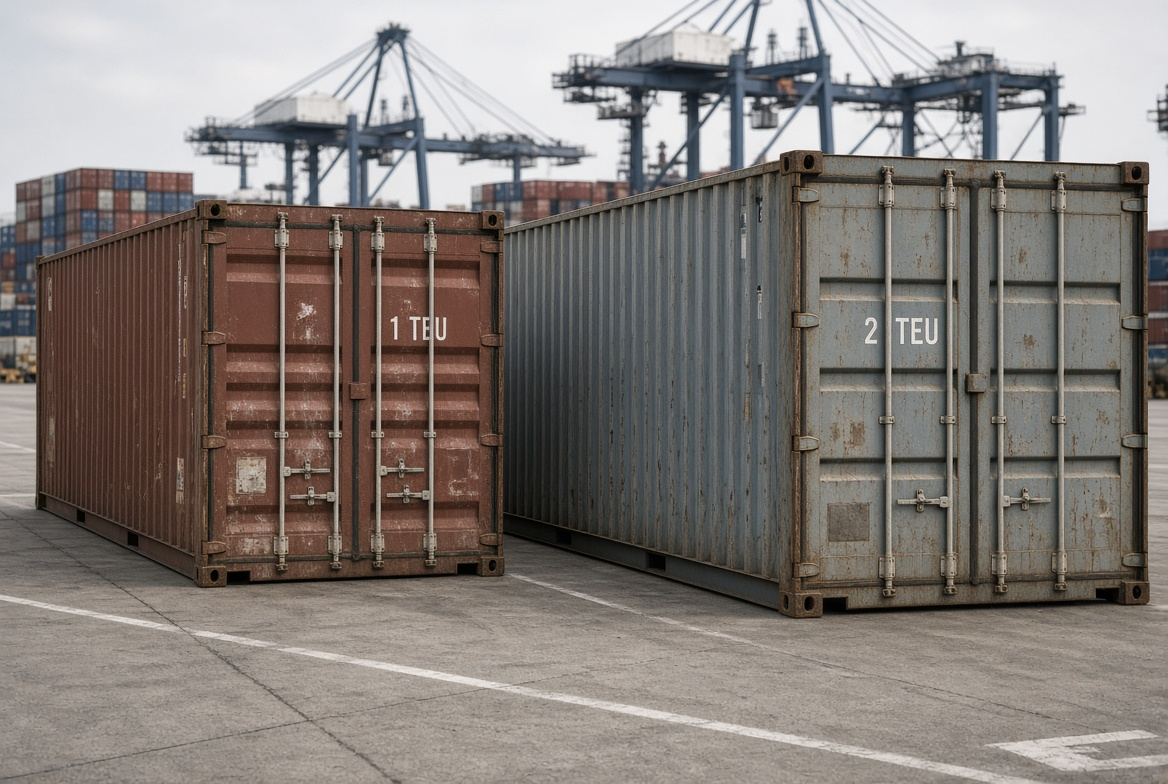
The twenty-foot equivalent unit, also known as TEU, is the industry standard measure for shipping container capacity on a ship, a fleet, through a port or a trade lane. One TEU is the space that one standard 20-foot container takes up. Importers from China continue to get a 20ft, 40ft or 40HC. They do not have “1 TEU” or “2 TEU” of their own. For more information on capacity, please refer to the description in the carrier or port or market report; it is not a bookable category on your quote.
That’s why it seems strange to hear of millions of TEU being added to a lane, or a port having a record year when you are reading the headline in the box you actually need. Some of the terms below are defined in plain English, correlated to the containers you are putting on board, related to how the carriers and ports use the TEU figure when booking and planning, and explained when they use it for a capacity update or when they time the booking.
TEU Defined: The Twenty-Foot Equivalent Unit in Plain Language
At the working level, the capacity of TEU containers explained is simple. The industry demanded a single product that would compare the capacity of a 20-foot box, a 40-foot box, a high-cube, a ship class, and the annual volume of a port without needing to rewrite each data set. That common denominator is the twenty-foot equivalent unit, the measure of importers.
TEU as a Standardized Measure of Container Capacity
One TEU equates with one 20’ container. After this base is established, larger equipment can be counted in the same unit. In cases where a ship is loading a combination of 20ft and 40ft boxes, it may be referred to as 1 TEU shipping. If the port handles all the equipment types, it can publish one number, the throughput. The Asia–US and Asia–Europe capacities can be compared by the analysts, without having to list all the box sizes on all the sails.
The unit is not about the quantity of cargo in a specific container, but rather about space in the system. It is actually possible for two shipments to both fill 2 TEU and be of different weight, cube and configuration on a chassis. With TEU, you’ll learn how the industry counts the slot. It does not provide information on the amount of product you can legally/safely load.
How 20ft, 40ft, and 40HC Containers Map to TEU
The standard public designation of 20ft 40ft 40HC is:
- 1 × 20ft container = 1 TEU
- 1 × 40ft container = 2 TEU
- 1 × 40HC (high cube) container = 2 TEU
A 40ft box is twice the size of a 20ft box, therefore it will be counted as 2 TEU. Although a 40HC has a greater height than a standard 40ft, and more internal volume, it is still considered as 2 TEU based on public statistics. Some operators internally consider high cubes as a bit heavier on the stack/slot planning. This is the same internal adjustment that isn’t reflected in the headline conversion you’ll see in port reports and most market commentary.
The real-world application: TEU is used to balance equipment used to count. It is not equal to useful cubic. A 40HC can offer more cubic meters than a standard 40ft and will be the same 2 TEU on a capacity chart when carrying a light and bulky cargo. Even though the loaded dimensions and weight are not the first point of consideration for load planning, they are nevertheless included and it is important to remember the equipment actually being booked.
How Carriers and Ports Use TEU in Planning and Reporting
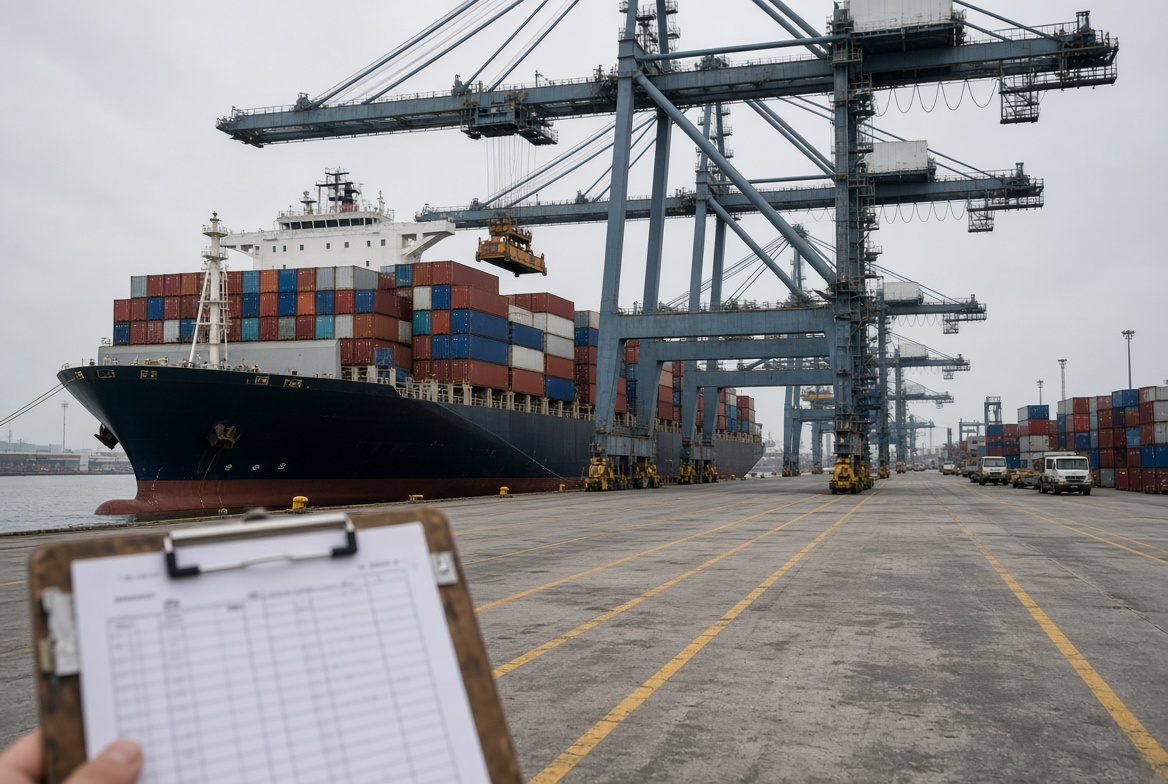
After the conversion, TEU in freight planning and vessel capacity is more understandable. The same unit, at different scales, is adopted by carriers, terminals and analysts: one ship, a fleet, a berth, a port complex and then a trade lane.
Vessel Capacity and Fleet Planning in TEU
Carriers describe ships and fleets in TEU so classes can be compared. A “14,000 TEU vessel” is a capacity statement, not a promise that 14,000 twenty-foot boxes will sail on every voyage. The ship may load a mix of 20ft, 40ft, and 40HC equipment, plus empty repositioning boxes. The TEU figure is the planning envelope.
Fleet decisions use the same language. Adding or removing TEU on a service is a way to say the line is putting more or less container space into that rotation. That decision weighs demand on the lane, which ports can take the ship, how many boxes the terminal can turn in a call, and whether enough equipment is available at origin. For an importer, the useful question is not the ship’s nameplate TEU. It is whether the service you use is gaining or losing space relative to the cargo that wants to move in the same week.
Port Throughput and Infrastructure Planning in TEU
Ports report monthly and annual throughput in TEU. Port throughput in TEU and congestion risk are linked because the figure is used to size yards, berths, cranes, gates, and rail or truck connections. A port that publishes a high annual TEU total is a major hub. It is also a place where a labor action, a weather event, or a surge in arrivals can back up more cargo at once.
Importers should read port TEU as context, not as a quality score. A busy hub often has more sailing options and more connecting services. It can also have longer dwell when the yard is tight. A smaller port may have fewer strings and a calmer gate. Throughput tells you scale. It does not tell you whether your particular container will clear the terminal on the day you need it.
Trade Lane Capacity, Market Reports, and Rate Volatility
TEU market reports and rate volatility travel together because capacity on a lane is usually discussed in TEU added or withdrawn. A note that “new TEU is coming onto Asia–US” is a signal that more slots may appear over a coming schedule cycle. A note that ships are being blanked or redeployed is a signal that space may tighten.
Those headlines are inputs, not booking instructions. Capacity can rise on a lane while your specific week is still tight because of equipment shortages, a delayed vessel, or a cluster of cargo ready at the same time. Capacity can look soft in a regional total while one destination port is congested. Use the TEU figure as a market weather report. Confirm what it means on your origin, destination, and sailing before you change a purchase or inventory plan.
What Is a TEU in Shipping for Your Own Freight Planning?
Macro TEU figures only help if they change how you read a quote, a schedule, or a forwarder update. The booking itself stays at container-size level.
TEU Is Not a Booking Unit: You Still Choose 20ft, 40ft, 40HC
You don’t instruct a forwarder to “book 2 TEU to Los Angeles” just like you would order a product. You tell them what cargo you have packed and how much it weighs and what is your volume, where it comes from, where it’s going and what is inside that will fit into the space – typically a 20ft, a 40ft or a 40HC for dry goods. FCL is sold by container. LCL is offered by volume and weight, within a common container. It’s another system altogether for express and air.
When you understand why space feels tight even when you’ve just got one box on your ship, you’ll be armed with TEU knowledge. If a service is "full in TEU terms", the next 40ft you desire may have to wait for the next sailing. The choice you still have to make is of equipment and which service fits the cargo and the delivery time.
Interpreting Capacity News and Forwarder Updates That Use TEU
The most valuable freight forwarder teu capacity insights from China are when they are turned into lane advice. New TEU on Asia–US may translate to more space and better rates in the long run, but that may not translate to more space this month if the new ships are not stopping by your ports. When the TEU throughput of a destination port declines, this could be due to decreased demand, or it could be due to less cargo volume in the terminal, which may be related to congestion, bad weather, or labor constraints.
Request a translation, but not just the headline:
- What impact does this change to the TEU have on the string you really book?
- Does it affect booking time of the subsequent 4-6 weeks?
- Does it move the more reliable handoff to one of the origin or destination ports?
A good update will include the lane, equipment mix and time. The fact that no such statistics are available for a TEU total is background.
Aligning TEU Awareness with Real Shipment Variables
The space pool is referred to as TEUs. Your shipment still resides on a shorter list: packed cbm, supplier ready date, pickup city, Incoterms, port to port or door to door, document quality and total landed cost. Those variables help to determine if a 20ft is sufficient, if a 40HC is a waste of cube, and if should it wait for a lower cost of a sail or should it sail on schedule.
Consider TEU as context for that list. It can answer the question of “Why are the quotes moving?” or “Why does the carrier care so much about a certain week?” It is not meant to supercede a measurement of the cargo or a clear ready date as supplied from the factory.
Common Misunderstandings About TEU and Container Capacity
There’s very little confusion about the definition of TEU. It is about treating the unit as a product, as a guarantee of the cube or as an autonomous market signal.
Treating TEU as a Direct Booking Category
Making an “all in” quote (per TEU) is a recipe for getting confused quotes. One forwarder is thinking of a 40ft. Another can be spreading cost on a theoretical TEU. The equipment, the origin haul, the destination scope are lost in the unit.
The consequences are practical: if you think the two offers are similar, then you find out that one is a 20ft plan and the other a 40HC, or one ends at the destination terminal and the other lands at the destination terminal and inland delivery. Do not change the container size and the scope of services in the booking language. Only use TEU when discussing the capacity of the markets.
Assuming All 2 TEU Containers Offer the Same Usable Space
The two 40ft’s are both 2 TEU. They don’t have the same internal height or the same cubic meters. There are times when the additional height is required for light and voluminous cargo. Cargo can fill the boxes before the payload limit, if dense. Restacked, left behind or billed on a second container cartons are usually the result of planning “2 TEU of product” without verifying packed height.
Estimating how many cartons will fit on the equipment and calculating the cost per CBM are based on the equipment specification and cargo rather than the TEU label.
Over-Interpreting TEU Headlines Without Lane-Specific Context
The overall TEU picture will be smoothened by the TEU global or regional story.Local picture will be smoothed by TEU global or regional story. A clean industry-wide TEU chart isn’t always the most important factor, as a destination hottest period can be more significant than a blank sailing on one string, or a shortage of chassis inland or a factory cluster all finishing at once.
One of the inputs is TEU data. Compare with your lane, your month and what your forwarder sees on bookings and equipment. A capacity story which can’t be mapped to your ports shouldn’t be a reason to pull a purchase order forward or to delay.
How to Use TEU Knowledge in Conversations with Your Forwarder
The purpose of the unit is to ask better questions. No need to deal with a carrier fleet plan. Some knowledge of when space and rates may be moving on your lane is required.
Asking Better Questions About Capacity and Space
Useful questions sound like operations, not like a glossary test:
- What is my capacity doing for the next few weeks in TEU terms and what does that imply for space and rates?
- What is the TEU addition/removal on this route and should I alter booking lead-times?
- Is there any TEU throughput change on my lane that could impact congestion or dwell?
- Is equipment available as the headline TEU figure implies, if I require a 40ft rather than a 40HC?
Those questions get you to the subject of your origin, your destination and your equipment. This is the only scale that modifies a booking.
Combining TEU Awareness with Shipment-Level Data
Weather your numbers are containers or CBMs, how often you are moving them, which factories supply the cargo, how flexible is the ready date and is it a port drop or a door delivery come into that discussion. A forwarder will have enough information from that shipment profile and TEU-level market awareness to discuss timing, alternative ports and/or whether or not a sailing is worth holding for.
If the shipment data is not provided, then the TEU talk remains generic. With it you are able to choose to book earlier, split cargo, change equipment or to stick with the program.
Summary Guidance – TEU as Context, Not a Decision Rule
TEU is the basis for the industry’s yardstick on container capacity. It allows carriers to describe a ship, ports to describe throughput, and reports to let you know if a trade lane is SHRINKING or EXPANING. The importer’s ruler is context. It doesn’t have to be the unit the customer is booked on, nor is it a rule that dictates what container to go to.
Do not mix two layers. Read capacity news using TEU and to ask a forwarder what a news headline means for your lane. Select the real move based on packed volume, weight, supplier readiness, scope of services, and landed costs. A freight forwarder based in China, which is already handling the pick-up, the warehouse receiving and ocean booking for freight, can handle these three layers without replacing a market statistic for freight planning.