EXW shipping (Ex Works) under Incoterms® 2020 means the seller makes the goods available at their premises or another named place. From there on, the buyer assumes virtually all the costs and risks. If the Chinese supplier states that they will “help” with the import, that typically means that you or your freight forwarder will need to schedule the factory to pick up the goods, arrange for the goods to be loaded onto the vessel, export the goods, arrange for the goods to be hauled inland, and then arrange the onward freight.
This guide takes the EXW cost stack apart, discusses when the risk really passes over and what the buyer should be doing in China and when EXW is a viable term, not an expensive surprise. This is not legal advice and it’s a practical explainer, the official definition is in the ICC rules.
EXW (Ex Works) Defined in Plain Language
Imagine EXW is a “come and collect” term. The seller’s duty is to have the goods at the place named (usually the factory but sometimes a place of trade or a named warehouse) at the time agreed. Seller’s delivery commitment is fulfilled once the goods are in place there. The buyer is responsible for collection, loading (except where provided otherwise in the contract), origin transport, export procedures, main carriage, destination clearance and delivery.
EXW is the least onerous of the Incoterms conditions and the most onerous for the buyer. This is why an EXW factory quotation might appear bargained. The unit price will only be the goods at the gate. All of the space beyond that gate will be an additional investment and effort for the buyer.
Where Delivery and Risk Transfer Under EXW
Delivery and risk transfer takes place at the Seller’s premises or at the designated place. The words “EXW Dongguan factory” are telling you that the handoff is not Yantian, is not Los Angeles, it is not your warehouse, it is that factory.
Once the goods are made available there, if the goods are lost or damaged, it is the buyer’s problem, even if the goods have not moved out of the yard. The typical error is to think that risk only occurs when the container is sealed, the truck exits or the vessel sets sail. With EXW such events are already on the ‘clock’ of the buyer.
When the cargo gets scratched while you’re moving it inside the factory or when it gets damaged during loading onto your truck, then it normally goes with the buyer, unless the sales contract is modified and loading and handling are returned to the seller in writing.
EXW Is Not a Door or Port Term
The EXW term does not cover loading on the buyers vehicle. Does not contain origin trucking, port or airport handling, ocean or air freight, destination clearance, duties or last mile delivery services. It is not FOB. It is not DDP. It is not “We will send it your warehouse.”
If the supplier sees EXW as a ‘favour’ and has to book the container and clear the export, require this work to be reflected in the purchase contract. Until the factory is busy, the driver comes to the gate or the export documents are not consistent with the invoice, informal help is helpful.
The Real Cost Stack Behind an EXW Quote From China
The EXW unit price may be the lowest price in a comparison spreadsheet and end up costing more than the FOB or DDP. Gap is the work that the seller stopped doing. Forwarder, Trucker, terminal, carrier and customs at destination are the costs of that work.
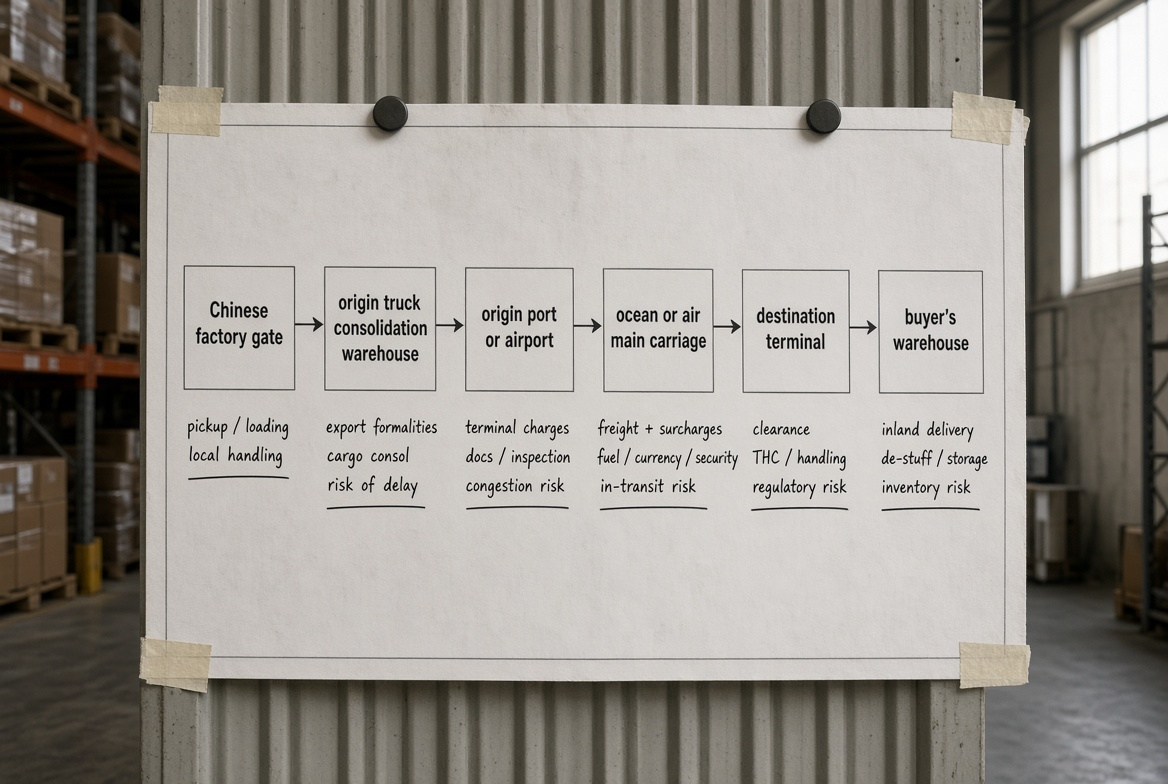
Before accepting the quote, walk the walk from factory gate to your warehouse.
Origin Costs: Pickup, Loading, and Export Formalities
Common charges for EXW type shipments from China are:
- Appointments and access rules for the coordination of factory pick up.
- Charging at the factory or named place of loading of labour and equipment
- Inland movement from factory to a warehouse, CFS or port/airport.
- Documentation for exports including export declaration.
- Origin terminal handling (THC) and documentation fees (bill of lading, air waybill)
- Inspection and labelling, or consolidation if cargo is first sent to a warehouse
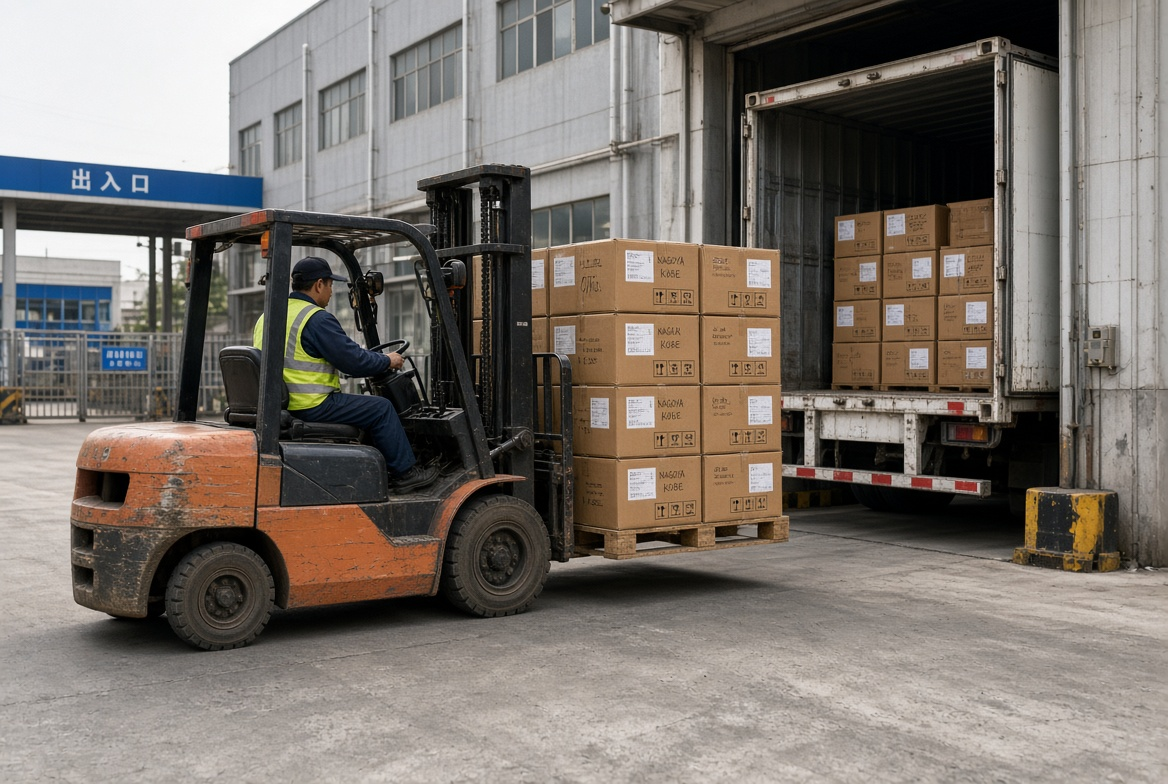
If EXW is interpreted literally, the seller has no responsibility to load your truck or container. In China this information is important. Many factories won’t allow an unknown driver to enter the yard without a name list, loading window and local contact. The unit price does not include forklift, dock space, or overtime. If it is necessary to load, then terms and conditions of the loading should be agreed on in writing or picked up by your forwarder as a managed loading.
Another stumbling block is export declaration. The rules put export formalities on the buyer. In reality, some commercial documents and cooperation of the seller is still required for Chinese export filing. The buyer who books a truck before any paperwork is confirmed may sit at the gate with a load that is not legally on the road.
Main Carriage and Destination Costs
After the goods are taken from the origin yard, the remainder of the chain will also be the buyer’s responsibility under EXW:
- Ocean freight or air freight plus fuel and other carrier surcharges.
- If the lane needs them, security filings will be made.
- Destination terminal handling
- Customs clearance and duties and taxes.
- Inland trucking and last mile delivery
- If you wish to purchase it (recommended, not included under EXW), cargo insurance.
No such lines are included in the factory’s EXW unit price. They are found later under the forwarder invoice, terminal invoice and customs assessment.
After you have mapped that full origin-to-destination path, use country-level shipping from China context to plan mode, routing, and destination handling for your actual market. The term tells you who pays. The lane tells you what those later steps look like.
A Simple EXW Cost Checklist for Importers
Once you have mapped that entire origin to destination, you can plan to route, mode, destination handling for your destination market using country level shipping from China context. The word indicates the payee. The lane will give you a preview of those steps later.
- An EXW simple cost checklist for importers
- When comparing an EXW quotation with a FOB or DDP quotation, copy this list. Record all the lines you will use. Blank line is not a saving. It’s a risk that’s not pricey.
- From factory to the warehouse/port/airport within the range.
- The loading equipment operation and the loading at the origin.
- Export declaration and documentation
- Origin terminal and documentation fees.
- Ocean/air freight and surcharges
Cargo insurance (available in the rules, but strongly recommended during practice)
Risks and Responsibilities for the Buyer Under EXW
In the EXW (Ex Works) contract, the seller provides the buyer with the power of control over the chain. It also provides the seller with the exposure of the buyer, which means the buyer does not need to be responsible for origin logistics. Control can be used only if someone is on your side to collect, load, declare, and move the cargo.
Risk Transfer at the Factory Gate
Risk transferred when goods are offered at the designated location. Once the pallet is dropped in the factory yard, or the carton is crushed while being loaded onto the vehicle, the loss is normally covered by the buyer under EXW, unless the contract provides otherwise.
Don’t wait until the port to consider insurance or condition checks. The EXW risk period can begin much sooner than is thought: in the seller’s premises, during loading, and on the first inland truck.
Export Declaration and Factory Access in China
When it comes to paperwork, the export paperwork is the buyer’s responsibility. The seller typically must still send invoices, packing lists, product specifications, etc. from the ground in China and is required to cooperate with the others to get the declaration done. There are some factories who will not allow a forwarder to unload cargo if they have not been to the factory before. Some will not be loaded after a cut off. Some interior plants don’t have a dock, and assume that the purchaser’s crew will arrange equipment.
Book truck once you have confirmed in writing: manufacture access; loading window; who provides the export documents. A first-order failure is failing to perform that sequence. The driver arrives. Guard will not open the gate. Documents are not complete. The trucking charge doesn’t stay put, the cargo does.
Under EXW, any import clearance, classification and duty payment arrangements are also made by the buyer at the destination. If the invoice, declaration, and term of trade must synchronize with each other, then customs clearance is the process work behind the documents instead of selecting the right Incoterm.
Insurance Is Not Included in EXW
The Incoterms rules do not require either party to insure an EXW shipment. There is no hidden cargo policy in the factory price.
If you skip insurance to “keep EXW cheap,” you are self-insuring from the factory gate onward. That includes yard handling, inland China trucking, terminal operations, the main carriage, and destination haulage. For high-value, fragile, or hard-to-replace goods, that is a poor trade. Arrange cover that starts at the named place, not only when the vessel sails.
When EXW Makes Sense for Importers Buying From China
The insuring of an EXW shipment is not obligatory according to the Incoterms rules. The factory price does not include any hidden cargo policy.
You Have a Trusted Forwarder or China Footprint
EXW works when the buyer has a forwarder that can book pickup, get onto the factory site, load or supervise loading, handle export documents with the seller’s cooperation, and move cargo into a warehouse or onto a vessel or aircraft. A buyer with their own China staff or regular warehouse receiving can do the same.
In that setup, EXW lets you collect from more than one supplier, inspect or relabel if needed, and build one export shipment. The low unit price then has an operational owner behind it.
You Want Full Control Over Freight and Consolidation
Importers who want to choose the carrier, control sailing or flight timing, and consolidate cargo from several factories often prefer EXW for that flexibility. The buyer owns the chain from the first collection.
FOB, by contrast, usually has the seller deliver to the named port and get the goods on board. DDP usually has the seller (or the seller’s agent) carry the shipment much closer to the buyer’s door, with duties in the seller’s scope. Those terms reduce buyer coordination. They also reduce buyer control. EXW is the opposite trade.
When EXW Is Usually the Wrong Starting Point
Be cautious if you are on a first or second import, have no China pickup capability, and are buying a small one-off order. Be more cautious if the factory is inland and access is unclear. Be especially careful with batteries, chemicals, dangerous goods, or oversized machinery, where loading, packaging, and export acceptance are not casual tasks.
A lower EXW unit price does not offset a failed pickup, a refused export filing, or cargo sitting in a yard you cannot enter. In those cases FCA, FOB, or a delivered term the seller can actually perform is often the cleaner start.
EXW vs FOB and EXW vs DDP — Short Decision Guidance
Keep the comparison short. The question here is not “which Incoterm is best.” The question is who should run origin work and who should run the door delivery.
EXW vs FOB: Who Controls Origin and Ocean Freight
Under EXW the buyer handles almost everything from the factory. Under FOB the seller delivers the goods on board at the named port; the buyer then takes ocean freight and the onward chain. For a straightforward sea shipment, FOB often removes the factory-gate coordination that trips first-time buyers. EXW keeps that coordination—and the freight choice—on the buyer.
A full EXW versus FOB breakdown is a separate comparison. Use this article to decide whether you can operate at the factory. Use a dedicated comparison when both quotes are already on the table.
EXW vs DDP: Who Handles Door Delivery and Duty
DDP asks the seller to deliver to a named place with duties paid. EXW asks the buyer to do almost the entire journey. If you want a more predictable landed cost and little origin work, DDP can be simpler—if the seller can actually clear export, book reliable freight, and complete destination formalities. Many “DDP” quotes from factories are informal promises, not a tested door service.
DAP, DDP, and DPU belong in their own door-delivery comparison. Here the only decision point is this: do you want the seller to carry duty and delivery, or do you want to collect at the factory?
Common Mistakes Importers Make With EXW From China
- The insuring of an EXW shipment is not obligatory according to the Incoterms rules. The factory price does not include any hidden cargo policy.
- Insurance is not being provided to “keep EXW cheap”, so if you do not provide insurance you are effectively self-insuring from the factory gate. That includes yard handling, inland China trucking, terminal operations, the main carriage and destination haulage. That is not a good exchange for high dollar, breakable or irreplaceable items. When the boat sails, arrange cover, beginning at the named place.
- While buying from China, it is not always the most cost-effective option.It is not always the most cost-effective option when purchasing from China.
Frequently Asked Questions
What Does EXW Mean in Shipping From China?
The seller places the goods at their place of business or at other place named by the seller is called EXW. The buyer assumes the goods thereafter and takes on the associated cost and risks, such as collection at the origin and export formalities, as well as the main freight and delivery to the destination, unless other duties are placed on the seller due to the contract.
Is EXW the Cheapest Option for Importers?
It can look cheapest on the supplier quote. Total landed cost is a different number. If origin pickup, loading, export declaration, and freight are poorly managed, EXW can cost more than FOB or a delivered term with a clearer scope.
Who Handles Export Customs Under EXW?
The rules stipulate that the buyer is responsible for export formalities. In China, it is almost always the seller who is required to cooperate on documents and product information for the declaration to be filed. Spend time preparing for both buyer and seller arrangements and paperwork.
Does EXW Include Loading the Container or Truck?
No, where read EXW the seller is not responsible for loading. Loading must be mutually agreed in the contract or arranged by the buyer/forwarder.
Should First-Time Importers Use EXW?
Only if a forwarder of sufficient skill can arrange for access to the factory, loading and exporting at the same place, where the risk of loss is transferred. If not, begin with an FCA or FOB term or a delivered term which can be executed by the seller.
Do I Need Insurance for EXW Shipments?
It should be organized. There is no obligation for EXW for insurance. Cover should begin at the factory or named-place and not just at the port.
EXW is a very strong term if you can run the chain from the factory gate. When you can’t, it is a brittle term. Determine the complete cost stack, verify in writing the arrangements for access to the factory and export, and only after this check if the low EXW unit price is really cheaper.