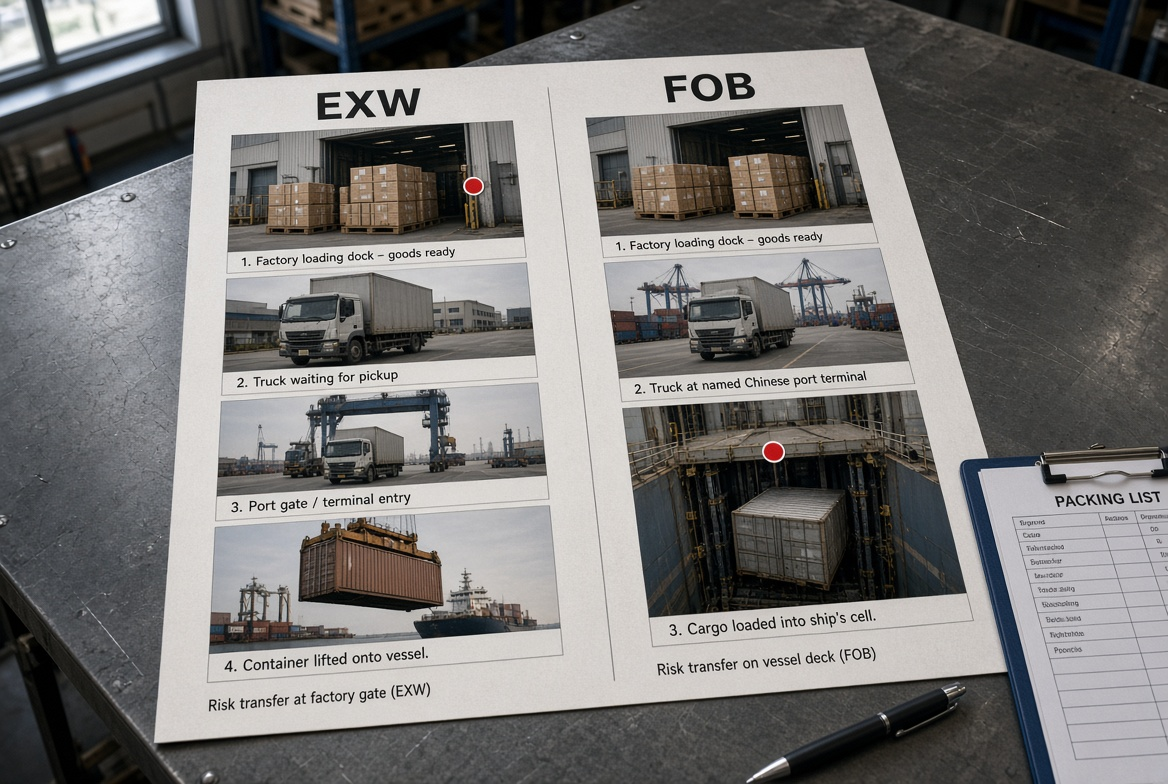
For importers from China, there is no absolute better EXW vs FOB. EXW (Ex Works) under Incoterms® 2020, means that the seller places the goods at his factory or at another named place and does not do much else in terms of origin work. With FOB, you’re supposed to load the goods onto a ship at a port named by the seller, and the risk passes when the goods are loaded.
EXW may appear to be less expensive per unit, but you are responsible for making the factory pick up and loading, export formalities, and freight planning. FOB means that origin coordination is minimized, but you are still responsible for booking and paying ocean freight and name a port. Whether you can do business in China and how complex the goods are, and the degree of control you wish to have over the forwarder and routing, all these factors determine the right term. This guide will discuss the costs, risks, and responsibilities, and provide a practical checklist.
EXW and FOB Under Incoterms 2020 — Core Definitions
The International Chamber of Commerce (ICC) has issued Incoterms® 2020, which divide the delivery, cost, and risk between the seller and buyer. Do not take the place of your sales contract, no insurance, no destination duties and no last mile delivery. The official wording of the rule is with ICC; it is a working paraphrase for importers – not legal advice.
EXW (Ex Works): Buyer Collects at the Factory or Named Place
The responsibility of the seller under EXW is to make the goods available at a named place, which is generally the seller’s factory yard in Dongguan, Yiwu and other production cities. After that, it’s all on the buyer’s shoulders. Strict EXW excludes loading the truck, origin trucking to port/warehouse, export declaration, terminal handling and international freight. In actual practice, the rule places the formalities on the buyer, but they must be cooperated by the seller in China. If you choose EXW you and your forwarder will be responsible for booking windows, loading facilities, documents and onward booking.
FOB (Free on Board): Seller Delivers On Board at a Named Port
Under FOB, the seller delivers when the goods are put on board the ship at a named port where the loading is to occur, e.g., FOB Yantian or FOB Ningbo. Risk is transferred at that point on-board. The seller will generally arrange for the goods to be transported from the factory to the port and complete the export paperwork and loading on to the ship. The buyer arranges and pays the shipment from the ocean up to the end of the vessel. FOB is valid only for sea & inland waterway shipment. It is not the right term for air freight from China, FCA is the correct term.
Side-by-Side Comparison — EXW vs FOB for China Shipments
The comparison that matters is operational, not dictionary-level. Use the matrix below as a scan of who does what on a typical China export.
EXW vs FOB for importers buying from China
| Aspect | EXW (Ex Works) | FOB (Free on Board) |
|---|---|---|
| Delivery point | Seller’s premises or named place (e.g., factory in Dongguan) | On board the vessel at a named port of loading (e.g., Yantian, Ningbo) |
| Risk transfer | When goods are made available at the named place | When goods are on board at the named port |
| Origin trucking and loading | Buyer’s responsibility, usually via a forwarder; loading is not included in strict EXW | Seller typically delivers cargo to the port and handles loading onto the vessel |
| Export declaration | Buyer’s responsibility under the rules; in China this still needs seller cooperation | Seller usually handles export formalities as part of delivering on board |
| Main carriage (ocean) | Buyer books and pays | Buyer books and pays |
| Control over forwarder and routing | Maximum control: buyer chooses pickup, warehouse, and carrier | Buyer still chooses the ocean carrier, but the seller manages more of the origin leg |
| Typical use case | Buyers with China capability or a trusted forwarder; multi-supplier consolidation | Buyers who want the seller to handle more origin work on a straightforward sea shipment |
How EXW and FOB Change Your Cost Stack
EXW often shows the lowest unit price because the quote stops at the factory gate. That number is not your landed cost. You still have to map pickup, loading if the factory will not do it, warehouse receiving if you consolidate, export documents, origin terminal handling, ocean freight, destination charges, duties, and delivery. Miss one of those lines and the “cheap” EXW quote is no longer cheap.
FOB folds more origin work into the seller’s price. That can make the factory invoice look higher while hiding pickup, port cartage, and some documentation inside the FOB figure. Comparing two suppliers—one EXW, one FOB—on unit price alone is a false comparison. Ask each seller which origin charges sit inside the price and which will appear later as extras. Then compare total landed cost to the same destination, not ex-factory price to FOB price.
The term you choose only settles the origin split. Mode, routing, customs, and final delivery still sit downstream. Review shipping from China for how sea, air, rail, and door delivery change the rest of the path from factory or port to your market.
Risk and Responsibility — Where EXW and FOB Differ Most
Money is only half the decision. The other half is who is standing at the factory gate when the truck arrives, and who is responsible if cargo is damaged before it is on the ship.
Factory Access, Loading, and Export Under EXW
On an EXW factory pickup in China, your forwarder has to get onto the site, find the right lot, and load it. Many factories will not let an unknown truck in without a pickup notice, a loading window, and a name the warehouse staff recognize. Some sites have no dock, no forklift for your cargo type, or a rule that the factory only loads its own vehicles. Strict EXW does not force the seller to load. If you assume they will put cartons on your truck “because that is normal,” you can lose a day at the gate.
Export declaration is the next friction point. Under the rules, export formalities sit with the buyer on EXW. In China, the seller still holds the commercial details, packing list accuracy, and often the relationship with the declaration agent. If the factory is slow to share HS descriptions, invoice values, or product names that match the goods, the cargo can sit while documents are fixed. Book the truck only after you have confirmed access, loading equipment, and who will support the export filing.
Named Port and On-Board Risk Under FOB
FOB moves the risk line to the vessel at a named port of loading. That only works if the port is actually named. “FOB China” is not a usable term. Yantian, Shekou, Nansha, Ningbo, Shanghai, and Qingdao are different gateways with different feeder patterns and different origin charges. Write the port into the contract.
Risk transfers when the goods are on board. Until then, damage in the seller’s truck, at the CY, or during loading is still the seller’s problem under FOB. After the goods are on board, delay, seawater, and stowage issues become the buyer’s insurance conversation. The buyer still nominates or at least agrees the ocean booking. Confirm who pays origin THC, documentation fees, and VGM filing so those items do not appear as a surprise after the vessel sails.
FOB is a sea and inland-waterway term. The buyer books the vessel and pays the ocean freight. When you control that ocean leg, compare sea freight from China as FCL versus LCL so the booking matches cargo volume and the named port.
A second FOB pitfall is assuming the term includes destination charges, import duty, or door delivery. It does not. FOB ends on board at origin.
Insurance Gap in Both Terms
Neither EXW nor FOB includes cargo insurance in the Incoterms® rules. On EXW, risk can pass at the factory door, so a gap from that gate to your warehouse is yours to cover. On FOB, you should cover from the on-board point onward, and many buyers still insure earlier if they want one policy for the whole move. Skipping insurance to protect a thin margin is a poor trade on either term. A dropped pallet at a Dongguan loading bay or a wet container after typhoon season will cost more than the premium.
Control, Flexibility, and Operational Workload
Importers often ask which term gives them more control. The honest answer is that EXW gives more control and more work. FOB gives less origin work and less origin control.
EXW Gives Maximum Control — and Maximum Work
With EXW you choose the pickup date, the warehouse, whether cargo from three factories is built into one LCL or one FCL, which carrier sails, and how the goods are inspected or relabeled before export. That flexibility is the reason consolidation programs run on EXW so often. It is also why EXW fails when the buyer has no forwarder who can collect across provinces, talk to factory warehouses, and file export documents without improvising.
If your cargo needs inspection, battery documents, wooden-packing treatment, or a relabel for a marketplace, EXW lets you design that origin flow in one warehouse. You pay for that design with coordination time.
FOB Reduces Origin Coordination for Simple Sea Shipments
FOB is often the quieter option when one supplier is shipping a standard container or a straightforward LCL lot by sea. The seller moves cargo to the named port, completes export formalities, and puts the goods on board. You still choose the ocean carrier and the destination plan, but you are not dispatching trucks to a factory park at 6 a.m.
The trade-off is visibility on the origin leg. If the seller’s truck misses cutoff, you may hear about it late. If origin charges are bundled, you may not see which line item moved. FOB reduces emails. It does not remove the need to watch ETD and document quality.
Who Nominates the Forwarder and Why It Matters
Under EXW, the buyer almost always nominates the forwarder. That is the point of the term: you control origin handling.
Under FOB, practice varies. Some buyers nominate the forwarder and ask the seller to deliver to that forwarder’s warehouse or to the CY under a written instruction. Some sellers insist on their own forwarder and pass through origin charges. Both patterns exist. What causes disputes is leaving the nomination unwritten. Agree in the purchase contract who books the ocean space, whose bill of lading is issued, how origin charges appear on the invoice, and what happens if the seller’s forwarder and your destination agent cannot exchange documents cleanly.
When EXW Is the Better Choice for Importers From China
EXW is not “the cheap term” and it is not “the risky term.” It is the term that fits a buyer who can operate at origin.
You Have a Trusted Forwarder or China Footprint
When you purchase from multiple factories and require one container and/or one LCL shipment, EXW provides you with one receiving location. Cargo may be checked and relabelled prior to export, and can be built before it is exported. This also goes for oversized items, SKUs or items that require inspection before sailing. That cargo can still be transported by FOB, but each seller would be playing on their own schedule for arrival at the port. When you have the source flow it’s easier to consolidate.
For importers from China, the question could be FOB or CIF.The question with importers from China could be FOB or CIF.
You Need Multi-Supplier Consolidation or Special Handling
If you buy from several factories and want one container or one LCL shipment, EXW gives you a single receiving point. Cargo can be checked, relabeled, and built before export. The same logic applies to oversize pieces, mixed SKUs, or goods that need inspection before they are allowed to sail. FOB can still move that cargo, but each seller would be delivering toward the port on their own clock. Consolidation is simpler when you own the origin flow.
When FOB Is the Better Choice for Importers From China
FOB is often the cleaner fit for a sea shipment from one capable supplier.
You Want the Seller to Handle More Origin Work
You want the dealer to do more of the work involved in getting the vehicle ready for you.
FOB shifts the responsibility for access to the factory and origin trucking to the seller, as well as the responsibility for export filing up until the vessel. It helps ease first sea orders and is also helpful to suppliers who are already accustomed to exporting via a known port. Even if you have a good seller is still necessary. If the term changed on the invoice, a factory that is not in a habit of delivering FOB Yantian will not turn into the pro at cutoff dates.
You Are Shipping Full Containers or Standard LCL From One Supplier
A single-supplier FCL (or a standard LCL shipment without additional inspection or re-labeling) is the typical FOB shipment. The seller will come on board at the named port. You arrange the shipping of the ocean freight and then you pick it up from there. No need to operate a pickup network in China, you maintain control over the carrier and the destination side.
Common Mistakes Importers Make When Choosing Between EXW and FOB
- Selecting EXW because the unit price is lowest, without taking into account any costs associated with picking up, loading the unit, export and terminal.
- For the most part, this is what is assumed, i.e., the factory will load the truck or container without the obligation being stated in the contract.
- Using the term "FOB China" instead of the named port of loading – e.g. FOB Yantian or FOB Ningbo.
- If FOB includes destination THC, duties, taxes or door delivery, the assumption is that it does. It does not.
- Converting from EXW to FOB and vice versa after the goods have arrived at the port. All documents, origin charges and booking need to be recalculated.
- Not securing cargo insurance on either occasion in order to save a line item. Risk still transfers. The policy is the way you pay to cover the loss.
Frequently Asked Questions
Is EXW or FOB Cheaper for Importers Buying From China?
Which is More Cost Effective For Importers To Buy From China EXW or FOB?
EXW may work out to have a lower unit price as the quotation only covers the named place. However, if origin pick-up, loading and export work are not well managed and/or their costs are not determined in time, total landed cost may still be higher. FOB includes a lot of origin work into the seller’s invoice, making it easier to origin stack and making the invoice appear more substantial. Before deciding which is cheaper, compare the same destination, showing all the origin lines.
Who Handles Export Customs Under EXW and FOB?
In the rules, under EXW, the export formalities are the buyer’s responsibility. In China, a proper commercial data must still be given by the seller and he must be cooperative with the declaration. FOB is usually the seller’s responsibility to arrange export formalities, and the seller supplies the goods on board at the named port.
Can I Use FOB for Air Freight From China?
No. FOB is for Sea and inland waterway shipments. FCA is the more suitable Incoterm for air freight as the goods are delivered when they are delivered to the nominated carrier at a named place, not when loaded on the aircraft.
Which Term Gives Me More Control Over the Shipment?
If you do have a forwarder who can do all of these in China, then EXW would provide you with the greatest amount of control. FOB has the effect of decreasing origin workload and still allowing the buyer to make his ocean carrier and destination plan. Control and workload go hand-in-hand.
Should First-Time Importers Use EXW or FOB?
For many first-time importers, FOB is easier to use for a cargo that is going from one dependable supplier on a sea shipment. EXW can process a first order when a quality forwarder is committed to the factory for access, loading and export documents. It’s not just about your number of shipments, it’s about your capability at origin.
Do I Need Insurance for EXW and FOB Shipments?
Yes. The terms do not cover cargo insurance. Cover from the risk transfer point forward – from the named place for EXW, on board at the named port for FOB – and whether you want to cover it even earlier.
No one always wins a deal between EXW and FOB. Identify the origin cost stack, record the names of those involved in loading, filing export paperwork, selecting the forwarder and specifying the port; select the term that applies to your China capability, cargo profile and requirement for control.