The best of the two terms FOB and CIF is not set and fixed for the importer from China. For Incoterms® 2020, FOB (Free on Board) indicates that the seller will deliver the goods when they are loaded on the vessel in the name port of loading, while the buyer will arrange for and pay for ocean freight from this point. CIF (Cost, Insurance and Freight) seems less complicated as the seller arranges for the freight to be paid to a named destination port and agrees to offer at least cargo insurance, but the risk does pass on board at origin, just like FOB.
The term you choose depends on how much control you want over the carrier, how comfortable you are with managing freight and whether, destination charges and insurance limits are made visible, the supplier’s CIF quote still appears cheap. There follows a comparison of the cost, risk and insurance and a practical checklist for sea transport to China.
FOB and CIF Under Incoterms 2020 — Core Definitions
The definitions are based on the official International Chamber of Commerce ones. This article should be considered a working comparison, rather than legal advice, for importers. Name a particular port (not a country), and use the text of the current Incoterms® 2020 in your sales contract.
FOB (Free on Board): Seller Delivers On Board at a Named Port
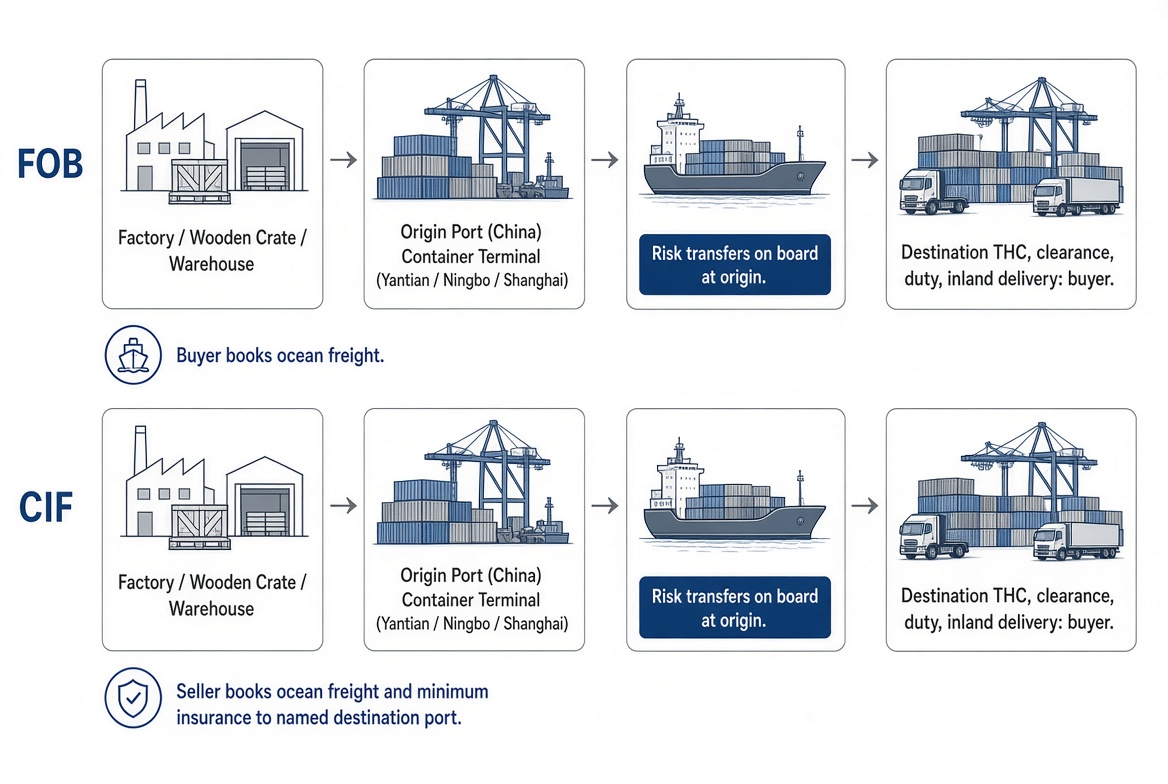
FOB states that the seller is responsible for making the goods available for the buyer’s loading on the ship at a named port of loading, e.g. FOB Yantian, FOB Ningbo or FOB Shanghai. The risk is passed on to the end user once on board at that origin port. The buyer then books and pays ocean freight, cargo insurance (if desired), charges at destinations, import clearance, duties, and inland delivery.
FOB is only applicable to shipments by sea or on inland waterways. It is not suitable for the term of air freight from China.
CIF (Cost, Insurance and Freight): Seller Books Freight and Insurance to the Named Port
CIF – the seller still delivers when the goods are put on board at the origin port. In addition to the seller’s work, the extra work of the seller is commercial and not a transfer of transit risk, the seller books and pays the ocean freight to a named port of destination and must arrange minimum cargo insurance for the benefit of the buyer.
Buyer remains responsible for import clearance, import duties, taxes and inland haulage. CIF is not door delivery or duty paid. The CIF applies to shipments by sea or inland waterways, as with FOB.
Side-by-Side Comparison — FOB vs CIF for China Shipments
In most cases, the quote for exports to China will list the cost of the product as the first line of the quotation. Through the term, it determines who books the ship, who pays ocean freight, who pays insurance and who pays after the vessel arrives.
When the importer is purchasing from China, the terms of FOB vs CIF are a consideration.
FOB vs CIF for importers buying from China
| Aspect | FOB (Free on Board) | CIF (Cost, Insurance and Freight) |
|---|---|---|
| Delivery point | On board the vessel at the named port of loading (e.g., Yantian) | On board at the origin port; seller pays freight to the named port of destination |
| Risk transfer | When goods are on board at the named port of loading | When goods are on board at the origin port (same timing as FOB) |
| Who books and pays ocean freight | Buyer | Seller, to the named port of destination |
| Insurance | Not built into the term; the buyer usually arranges cover | Seller must provide minimum cargo insurance under Incoterms® 2020 |
| Destination charges, duty, and inland delivery | Buyer’s responsibility | Buyer’s responsibility (CIF does not include duty or door delivery) |
| Control over carrier and routing | Buyer chooses carrier and service | Seller chooses carrier and service, often with cost in mind |
| Typical use case | Buyers who want control over freight and timing | Buyers who prefer the seller to book freight and provide basic insurance |
How FOB and CIF Change Your Cost Stack
When exporting, FOB is likely to be at a lower unit price on the commercial invoice since ocean freight and insurance are not part of the supplier’s quote. That is helpful only if you’re mapping the other parts of the stack, which are things that the seller didn’t put there: ocean freight and surcharges, insurance, destination THC, customs brokerage, duty, tax and trucking.
CIF includes cost of freight and minimum insurance. This might appear to be an all-in sea rate. It is not. You are still charged for the destination. A budget CIF ocean booking might also be available that offers slower service and/or transshipment or destination fees higher than the service that you would have booked yourself.
Compare total landed cost, not the FOB or CIF unit price alone. Mode, routing, and destination rules change that total as much as the Incoterm. For country-by-country context on modes, routing, customs, and delivery, start with OriginLink’s hub for shipping from China.
Risk and Responsibility — Where FOB and CIF Differ Most
That’s just half the comparison. The other half is the one that performs the tasks after the merchandise has left the factory and what happens when the goods get damaged during transit.
Named Port and On-Board Risk Under Both Terms
Put the name of the port into the contract. The terms “FOB China” or “CIF USA” are not valid terms. FOB requires a port of loading. CIF must have a named port of destination (not CIF United States or CIF Europe) like CIF Los Angeles or CIF Rotterdam.
In both FOB and CIF, the risk changes hands when the goods are on board at the port of origin. It’s the one thing many novice importers overlook. CIF does not "carry" the risk of transit until to the port of destination. The buyer will rely on the insurance policy, not the Incoterms, if there is a damage to a container at sea.
Freight Control and Carrier Choice
FOB means that the buyer has the ocean booking. The choice of the carrier, the type of service (direct or transshipment), and whether the goods are transported in LCL or FCL. . That matters on China lanes where schedule reliability, equipment availability, and destination charges vary by service, not only by port pair. When you control or pay that ocean leg, compare sea freight from China as FCL versus LCL before you accept the supplier’s default.
The seller is the one who gets the booking from CIF. A good number of factories will take an acceptable cheap service to keep the freight line in the CIF price low. This is may involve additional transshipment, a longer schedule or an arrival agent whose charge seems much higher than anticipated. “cheap CIF freight” is not necessarily a “cheap freight”.
Insurance Coverage Under CIF vs Buyer-Arranged Insurance Under FOB
A CIF seller will be required to provide minimum cargo insurance under Incoterms® 2020. That cover is usually pretty simple: limited perils and a CIF price + conventional cover premium, which isn’t always the full commercial loss you’ll experience if the goods are written off.
With FOB, insurance is NOT included in the term. Most importers will have their own policy and will be able to purchase more extensive cover for high value, delicate or temperature sensitive goods. The pitfall with CIF is that the seller’s minimum policy is taken without reading the clause, insured value, and claims process.
Control, Flexibility, and Operational Workload
Typically, importers will pose the same question in practice: which term provides me the greatest flexibility, and what extra effort is required to achieve that flexibility?
FOB Gives More Control Over Freight and Routing
Under FOB, your forwarder arranges the vessel, monitors the sailing and arranges the handling in the destination port all in a single proposal. This is beneficial when there are time-sensitive cargo, preferred carriers or direct service, warehouse appointments or retailer labeling requirements.
Control is also visibility. Freight, bunker and peak season surcharges and destination fees can be separated from the supplier’s CIF lump sum.
CIF Reduces Booking Work but Limits Carrier Choice
CIF may be able to cut down on the need for origin co-ordination when the factory is utilizing it for booking space and issuing documents. This might be sufficient for a standard (not urgent) FCL shipment of general cargo.
The drawdown is that it is opaque. The actual ocean rate, the routing and the destination agent may not be known until the cargo is underway. Changing the arrangement mid-voyage is a messy process if the seller’s agent at destination is not the same one that the buyers would have selected.
Destination Charges and Clearance Are Still the Buyer’s Problem
In both, FOB and CIF, destination THC, customs clearance, duties and taxes remain with the buyer. CIF is a stop at the named destination port. It is not a DDP or DAP or door to door product. When supplier indicates that they use CIF as “all-in to your warehouse”, request that they place the specific Incoterm and named port into the contract.
When FOB Is the Better Choice for Importers From China
FOB is typically the most favourable term for those who care more about freight quality than factory price.
You Want Control Over Carrier, Service, and Timing
Use FOB when you want to use a particular carrier, direct sailing rather than transshipment, or a date in the warehouse or production. The same goes if you are booking your ocean from different suppliers and you want one forwarder to book the ocean.
You Have a Trusted Forwarder and Want Transparent Costs
A quote that includes origin handling, ocean freight, insurance, and destination costs is sometimes better suited to FOB; if you already use a forwarder who can provide the individual costs for these, this option may be preferable to a CIF quote, which can generate a messier landed-cost file. It is possible to observe the line movement and the reasons behind it.
When CIF Can Work for Importers From China
CIF is not inherently a negative term. Can be used when the goods and supplier correspond with the restriction of the term.
You Prefer the Seller to Book Freight and Provide Basic Insurance
A sea transport of commercial cargo can be considered CIF if the factory makes routine shipments to that port, and specifies a legitimate destination port in the contract.
You Are Comfortable With Limited Control Over the Carrier
If the goods are not fragile or valuable, if transit time is not critical, and you are okay with the seller selecting the service, you will get CIF, which will reduce the number of parties you have to deal with before you sail. Do not place the order until receiving the following: Vessel, routing, insurance certificate and estimate of destination charges.
Common Mistakes Importers Make When Choosing Between FOB and CIF
- Using CIF without checking service level, routing or destination fees.
- CIF terms are assumed by the seller to carry the ocean transit risk. There is still a risk transfer within the ship at origin.
- Using “CIF [country]’” or “FOB China” rather than a named port.
- Covering only Particular Average (PA) insurance on CIF for CIF for high value/fragile items.
- Changing the FOB/CIF arrangements or vice versa, after the goods have been loaded at the loading port. All documents, payments for local charges and booking of the ship have to be redone during the "worst time".
Frequently Asked Questions
Is FOB or CIF Cheaper for Importers Buying From China?
Both are not necessarily more expensive. CIF may be lower due to freight and minimum insurance being included in the supplier’s price. If the ocean rate and destination fees are lower than the seller’s, FOB may appear more expensive on the invoice but it will be less costly to you. Create a landed cost comparison prior to making a decision.
Who Bears Risk Under FOB and CIF?
The transfer of risk occurs under both terms when the goods are on board at the point of origin. The difference lies in the booker and the insurance coverage—whether there is a minimum.
Does CIF Include Customs Duty and Door Delivery?
No. CIF is a covering for freight + minimum insurance to the named port of destination. Buyer is responsible for import clearance, duties, taxes and inland delivery.
What Insurance Do I Get Under CIF?
The seller must offer a minimum cargo insurance in accordance with Incoterms® 2020. That’s frequently basic cover. Those purchasing high value items and/or items of delicate nature should review the policy and consider extra insurance.
Can I Use FOB or CIF for Air Freight From China?
Answer: They are both for sea/ inland waterway shipment. FCA and CIP are the Incoterms that are more suitable for air freight.
Should First-Time Importers Use FOB or CIF?
FOB is generally more transparent in cost and control when you have a forwarder on board who is able to book and describe the ocean leg. If the seller is reliable, names a genuine destination port, and provides you with the insurance certificate and destination-fee picture in advance, then CIF can be used for a standard shipment that does not have an urgent time requirement.
There is no overall general winner in the FOB versus CIF game. Trace the entire cost chain, verify who books the carrier and what type of insurance is really covered and select the term that best suits the control and risk you’re willing to assume on that China shipment.