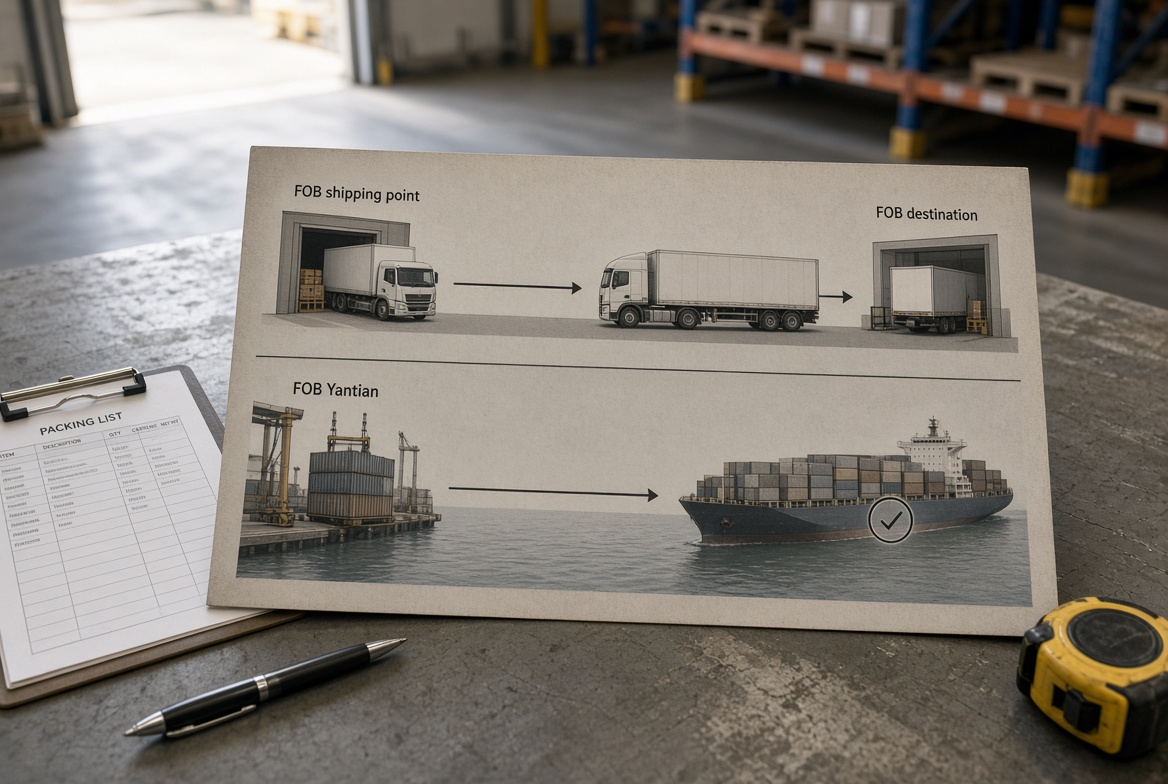
FOB shipping point and FOB destination are domestic terms of U.S. trade and accounting to determine the time of title transfer and who pays the freight. The Incoterms® 2020 FOB (Free on Board) is an international trade term which specifies delivery on board a vessel at a named port of loading and the point at which risk is passed on to an export shipment. They have 3 matching letters. They’re NOT the same rulebook.
Their interchangeability is the cause of buyers claiming their goods were damaged, the wrong insurance, or to record their inventory on the wrong date. Below plain-language definitions, a side-by-side comparison of domestic FOB vs international FOB, two working examples, and mistakes that appear on China proformas and invoices. This is not a legal or accounting advice kind of clarification.
FOB Shipping Point and FOB Destination — U.S. Domestic Terms
FOB typically refers to a buyer’s dock, plant or warehouse—not a seaport—in the U.S. purchase order or commercial invoice. These clauses are seen when moving trucks, rails, LTL and FTL in one country. They advise the parties when ownership is deemed to be passing and who should pay the domestic freight bill. They are not shown in that manner on an international ocean bill of lading.
FOB Shipping Point (FOB Origin)
Title and risk pass to the buyer when the seller places the goods into the hands of the shipping carrier at the seller’s warehouse, plant dock or other specified point, as will be the case under FOB shipping point. The buyer typically pays freight from that handoff and, as far as accounting is concerned, the buyer takes ownership of the goods when they leave the seller.
The trap operating principle is simple. The pallet will still be on a truck that the seller has booked, so if the load gets crushed on the truck, the buyer will take the loss and the seller won’t. An assumption that is often incorrect is if the contract states FOB shipping point. Claims are not made through the “seller pays because they shipped it” clause but through the buyer’s insurance or through the carrier, as per the contract and the bill of lading.
FOB Destination
FOB destination is a term in which title and risk transfer once the goods are delivered to the buyer or to a named destination. The freight is usually paid by the seller and the seller is regarded as the owner during the transportation. When a product is damaged on the road, it is likely to be the seller’s responsibility, and the buyer might not have the inventory recorded until the product is delivered.
The matching trap is reversed. If the buyer wishes to have the stock on the books at the time of shipment, or if the buyer files a claim on the cargo as if he or she owned the stock at that time, the buyer is presumed to be using the term FOB shipping point. The invoice is still FOB destination. The accounting policy and the contract must match otherwise the file will not.
Why These Terms Exist
Domestic FOB language evolved from U.S. commercial practice and accounting habits: who should be credited with the value of the inventory when goods are received; when to credit freight-in, who if a truck is late or a carton is wet. The clauses are not a part of Incoterms® rules published by International Chamber of Commerce (ICC). The cause of most confusion about FOB is reading the U.S. invoice as an ICC delivery term, or reading the China proforma as if it were a U.S. title clause.
This is no substitute for a contract review or an accountant’s analysis of a particular sale. There is a difference between the use of Domestic FOB and Incoterms FOB.
FOB Under Incoterms® 2020 — An International Trade Term
Incoterms® FOB is one of 11 standard terms in use in cross-border sale contracts and shipping documents. It is a different question from the U.S. domestic pair, which is: “when does title pass on a domestic truck?” instead of: “when does the seller deliver on board a vessel at a named port and from where does the risk of transit lie with the buyer?”
Delivery On Board at a Named Port
FOB is a seller’s contract term which specifies that the seller must deliver the goods when they are loaded on board the vessel at the port of loading (FOB Yantian, FOB Ningbo, FOB Shanghai). That is the location on the ship at which risk is transferred. The named place is a port of loading, rather than the seller’s factory or the buyer’s warehouse.
The term is written for sea or inland waterway shipments. It is not the right Incoterm for air freight, and it is not a label for a domestic U.S. truck move. “FOB China” with no port and no Incoterms edition is not a complete clause. “FOB Yantian, Incoterms® 2020” is.
Risk, Cost, and Export Formalities Under Incoterms FOB
On a typical Incoterms FOB sale, the seller handles export formalities and gets the goods on board. The buyer books and pays ocean freight and the onward move. Risk transfers on board. Ownership, or title, is still a matter for the sales contract and the payment terms. The Incoterm does not, by itself, decide who “owns” the goods in a legal-title sense.
That split is easy to miss. A factory in Guangdong can complete its FOB job—export declaration, origin handling, delivery on board at Yantian—while the buyer already carries ocean risk and still does not have title if the contract ties title to payment. After the named-port FOB term is set, mode, routing, destination formalities, and delivery still have to be planned by market; those lane questions sit in shipping from China, not inside the three-letter term.
Side-by-Side Comparison — Domestic FOB vs Incoterms FOB
The two systems can sit on the same buyer’s desk in the same week. One invoice from a U.S. distributor. One proforma from a China factory. The letters match. The job of the clause does not.
FOB shipping point / destination vs Incoterms® FOB
| Aspect | FOB Shipping Point / Destination (U.S. domestic) | FOB (Incoterms® 2020, international) |
|---|---|---|
| Primary purpose | Decide when title transfers and who pays freight in a domestic sale | Define delivery on board a vessel at a named port and where risk transfers in international trade |
| Typical transport mode | Domestic truck, rail, LTL/FTL within one country | Sea or inland waterway shipments between countries |
| What “FOB” refers to | The shipping point (origin warehouse) or the buyer’s location (destination) | A named port of loading (for example Yantian, Ningbo, Shanghai) |
| Risk transfer | At the shipping point, or at destination, as the contract states | When the goods are on board the vessel at the named port |
| Ownership / title | Often addressed directly in U.S. contracts and accounting policies | Not defined by Incoterms; title is set in the sales contract and payment terms |
| Typical documents | Domestic invoices, purchase orders, truck or rail bills of lading | Commercial invoices, packing lists, ocean bills of lading, export declarations |
How the Confusion Happens in Practice
An importer sees “FOB shipping point” on a domestic U.S. invoice from a local distributor and “FOB Yantian” on a China factory proforma, then treats both as the same logic. In the first case the clause is about title and freight billing on a domestic sale. In the second it is about delivery and risk on an international ocean shipment. One names a warehouse or dock. The other names a port of loading. Applying warehouse logic to a vessel, or port logic to a domestic truck, is how files go sideways.
Practical Examples — Domestic vs International FOB
Abstract definitions hold better when the cargo has a city and a failure mode.
Example 1 — U.S. Domestic Shipment With FOB Shipping Point
A buyer in Texas purchases palletized goods from a supplier in California. The purchase order says FOB shipping point. The supplier stages the pallets, the domestic carrier signs for them at the California dock, and the truck leaves. Under that clause, title and risk typically pass at that origin handoff. The buyer is usually the party paying freight and the party that records the goods once they have shipped.
If a pallet is crushed on I-10, the buyer should not assume the California supplier will absorb the loss because “they arranged the pickup.” The contract already moved risk at the shipping point. The claim path is the buyer’s cargo or goods-in-transit cover, or the carrier, as the domestic contract and bill of lading allow—not a default seller-pays-in-transit rule borrowed from FOB destination.
Example 2 — China Export With Incoterms FOB
An overseas importer buys from a factory in Guangdong on “FOB Yantian, Incoterms® 2020.” The factory completes export formalities, delivers the container on board at Yantian, and its delivery job under that term is done. Risk transfers on board. Ocean freight and the onward plan sit with the buyer.
If the container is damaged on the voyage, the buyer bears that transit risk, subject to whatever cargo insurance the buyer arranged from the on-board point. The seller may still have paid origin charges. Paying those charges does not keep ocean risk on the factory. Treating “FOB Yantian” as if it were U.S. FOB destination—“the seller owns it until my warehouse”—is the error that produces the dispute.
Why Mixing These Terms Creates Real Problems
The mix-up is not academic. It shows up as a refused claim, a late inventory entry, or a shipment that sails with no policy attached to the ocean leg.
Disputes Over Who Owns Damaged Goods
If a company treats Incoterms® FOB like FOB destination, it expects the seller to cover transit damage after the goods are already on the vessel. The contract passed risk on board at origin. The claim then lands on the wrong desk, and days disappear while each side quotes a different meaning of “FOB.”
The reverse error is also common. A team treats a domestic FOB shipping point invoice as if it were Incoterms FOB, then assumes the buyer controls the ocean-style carrier relationship and the freight claim from the first mile. On a U.S. truck move the documents, the insurance, and the claim forum are different. Wrong system, wrong process.
Accounting and Inventory Recognition Errors
Accountants use FOB shipping point and FOB destination to decide when inventory and freight costs hit the books. Applying that domestic switch to an international Incoterms FOB shipment can misstate inventory, cost of goods sold, and who still holds a liability during transit. Incoterms allocate delivery, cost, and risk. They do not automatically tell the ledger when title passed. One rule for the warehouse invoice, another check for the ocean proforma.
Insurance Gaps When Terms Are Misunderstood
Incoterms® FOB does not require the seller to insure the goods. The buyer should arrange cargo insurance from the on-board point forward. If the buyer hears “FOB” and assumes the seller covers everything until delivery, the vessel can sail uninsured on the ocean leg.
Domestic FOB terms also affect who is expected to insure, but under title-and-freight logic, not under an on-board port rule. The policy has to follow the actual clause. When commercial invoices, packing lists, and export declarations do not match the Incoterm on the contract, clearance can stall even after risk has already transferred on board. Aligning those papers with the term you signed is the job of customs clearance support, not a relabeling of a U.S. FOB destination clause onto a China ocean booking.
How to Avoid Confusion When You See "FOB" on Contracts and Invoices
A short check before anyone books space or posts inventory saves more time than a later argument about what “FOB” was supposed to mean.
Check Whether the Shipment Is Domestic or International
Check for extra language on title, insurance and freight, and the rule set and named place. It is not the same thing to say “FOB Yantian, Incoterms® 2020” than to say “FOB our warehouse”. A port name and an Incoterms edition implies international delivery and risk. No ICC and domestic title/freight billing is found.Domestic title/freight billing is not found, the warehouse or buyer-dock name is used. If only the three letters, request the remainder prior to any cargo movement.
Read the Full Clause, Not Just "FOB"
Accounting records provide inventory. When all three of these files don’t match up (Incoterms FOB on proforma, FOB destination in ERP, no cargo policy from the on-board point) it is three conversations that will occur for the first damage event. On the contract write the system used and on the shipping instruction and the ledger write the same system. DO NOT consider a sale Incoterms® FOB as domestic FOB destination unless an explicit adjustment is made.
Align Sales, Logistics, and Accounting on Which Rules Apply
Sales writes the contract. Logistics books the carrier and the insurance. Accounting records the inventory. If those three files disagree—Incoterms FOB on the proforma, FOB destination in the ERP, no cargo policy from the on-board point—the first damage event becomes three conversations. Write the system in use on the contract, then use the same system on the shipping instruction and the ledger. If the sale is Incoterms® FOB, do not treat it as domestic FOB destination without an explicit adjustment.
Common Mistakes Importers and Buyers Make With FOB Terms
- Understanding the F.O.B Terms: Common mistakes made by importers and buyers.
- Because they both begin with FOB, they are treated the same way and are considered to be the same clause, namely FOB shipping point.
- Using the term “FOB China” (as opposed to “FOB [named port]”, Incoterms® 2020.”) on an international contract.
- Placing U.S. domestic FOB on an ocean shipment and hoping it would only be risked at the loading port.
- If the seller is responsible for the origin and export formalities, the buyer may fail to pay the cargo insurance cost when making an Incoterms FOB booking.
- Changing the term mid-shipment from a domestic label (FOB) to Incoterms (FOB) or vice versa without changing the contract, invoice and transport documents.
Frequently Asked Questions
Are FOB Shipping Point and Incoterms FOB the Same?
FOB shipping point and FOB destination are U.S. domestic terms that are used to determine when title passes and freight charges are invoiced. The international term for delivery on board at a named port of loading and for the point where the risk of transit passes to the buyer is Incoterms® FOB.
Which One Should I Use for Shipments From China?
Use Incoterms® FOB or other Incoterms with a named port and an edition (e.g. Incoterms® 2020) for ocean shipment from China. Please note that the terms “FOB shipping point” or “FOB destination” are not applicable to an international vessel delivery.
Does Incoterms FOB Decide Who Owns the Goods?
No. Incoterms deliver goods, price and risk. Ownership and title is in the sales contract and the payment terms. Avoid misinterpreting the concept of doze or transfer of risk as a "transfer of title.
Can I Use FOB for Air Freight From China?
No. Incoterms® FOB is for sea or inland waterway shipments. In the case of air freight, FCA is the Incoterm which is suitable to the mode.
Do I Need Insurance for Incoterms FOB Shipments?
Yes. FOB is an Incoterms® without cargo insurance. Cover from the on board point should be arranged by the Buyer. You are under no obligation to pay for origin work when you are selling the vessel, as this is not an ocean policy.
How Do I Know If My Invoice Uses Domestic or International FOB?
Read the context. A domestic truck or rail bill of lading which lists a warehouse or buyer dock and includes FOB shipping point or FOB destination. The name of the port of loading and ideally Incoterms® 2020 should be on an international ocean file. When the document only reads “FOB,” inquire as to the system and place before you ship.
Ensure that the word “FOB” in the document is domestic or international, what place is referred to and which rules the parties actually agreed. If the clause is thin, request from supplier, forwarder or accountant before the goods are unloaded from the vessel.