No one is completely superior to the other when it comes to winning every container load from China, between FCA and FOB. The better Incoterm is determined by the way the goods are transported, by the location of the designated handover point, as well as by the extent of origin work left for the seller. For Incoterms® 2020, the term FCA (Free Carrier) indicates that the seller is supposed to place the goods at a named place which can be a factory, warehouse or terminal and that risk would pass at the point of delivery to the carrier. FOB (Free on Board) is where the seller delivers the goods on board a vessel at a named port of loading, where the risk passes, from that point.
FOB is a Sea Freight term. FCA is available for any mode, such as containerized cargo before arrival of the vessel to the port. FCA is a much more flexible option than classic FOB and is generally well suited to the way in which modern containerized shipments flow from China. This guide will discuss cost, risk and control and provide a practical checklist to determine when each term can be useful.
FCA and FOB Under Incoterms 2020 — Core Definitions
The official definitions are with the International Chamber of Commerce. For the importer it is simpler: each term establishes a delivery point, a risk transfer point and an origin work split. Both are not door-to-door services and both do not come with the insurance of the cargo.
FCA (Free Carrier): Seller Delivers to a Carrier at a Named Place
Once the goods are given to the carrier you have nominated (or to another person you have nominated) at the agreed place, the seller’s duty will be completed under FCA. The location may be a factory gate in Dongguan, an OriginLink-style warehouse, a container yard (CY) or a container freight station (CFS). Risk gets passed forward with that handover. From that time onward, all the things that involve the buyer: inland haul to the port, terminal handling (outside the named place), ocean or air carriage and destination work are out of your hands.
FCA does not just apply to sea freight. It may be by truck, rail, air, ocean or any combination of these. That’s why it is well suited to shipping in containers – the container itself is typically provided by a carrier or forwarder before it is loaded onto a ship.
FOB (Free on Board): Seller Delivers On Board at a Named Port
FOB is when the seller delivers the goods on board the ship at the named port of loading, e.g. FOB Yantian / FOB Ningbo. Risk does not pass at that on-board point; it does not pass on delivery of the truck; it does not pass on delivery of the container at the terminal gate.
FOB only applies to transport by sea or inland waterway. It was not made for the world of today in which cargo and ship were delivered at the same time and then loaded on the ship. Nowadays, containers are frequently stored at a CY or CFS, waiting for a vessel window, and then they are picked up by the terminal and loaded onto the vessel. If the contract is still FOB, but the actual risk point is two days back, at a warehouse, then the paperwork and the actual risk point are not matching.
This is not a legal, but practical, article for importers. In case of a disagreement, the ICC rules are in effect and the terms of your sales contract dictate proper distribution of duties.
Side-by-Side Comparison — FCA vs FOB for Container Shipments From China
This matrix is a working snapshot. Cell wording is active and not an alternative to the ICC text.
| Aspect | FCA (Free Carrier) | FOB (Free on Board) |
|---|---|---|
| Delivery point | To a carrier at a named place (factory, warehouse, CY/CFS, terminal) | On board a vessel at a named port of loading |
| Risk transfer | When goods are handed to the carrier at the named place | When goods are on board the vessel at the named port |
| Typical mode | Any mode (sea, air, rail, road, multimodal); well suited to containers | Sea or inland waterway only; designed for traditional breakbulk |
| Origin trucking and terminal handling | Seller delivers to the named place; buyer arranges onward movement from there | Seller typically moves cargo to the port and handles loading on board |
| Export declaration | Seller usually completes export formalities as part of delivery | Seller typically completes export formalities as part of delivering on board |
| Control over forwarder and routing | Buyer often nominates the carrier or forwarder at the named place | Buyer books the vessel, but the seller manages more of the origin leg to on-board |
| Typical use case | Containerized cargo (FCL/LCL), air freight, multimodal shipments | Straightforward sea freight where on-board delivery is clear and practical |
How FCA and FOB Change Your Cost Stack
The unit price on a proforma invoice is not the landed cost. FCA usually draws a cleaner line: the seller prices goods plus origin work up to the named place, and the buyer sees inland haul, terminal charges after that point, ocean or air freight, insurance, destination clearance, and last-mile delivery as separate items. That split makes it easier to compare forwarder quotes against the seller’s invoice.
FOB often folds more origin work into the seller’s price—factory to port, export documents, and loading on board. That can look simpler on paper. It can also hide trucking, terminal handling, documentation fees, and last-minute port extras inside a single “FOB price,” which makes two supplier quotes hard to compare.
Think in total landed cost from factory to your warehouse or fulfillment center, not only in an ex-factory or FOB unit price. Once you separate seller and buyer charges, map the rest of the lane—mode, routing, customs, and delivery—through shipping from China so the named place or named port is not treated as the end of the cost story.
Risk and Responsibility — Where FCA and FOB Differ Most for Containers
Cost is only half the decision. The other half is where things break: a missed cutoff, a rejected export document, cargo sitting at a CFS, or damage that appears after someone thought risk had already moved.
Container Handover vs On-Board Risk
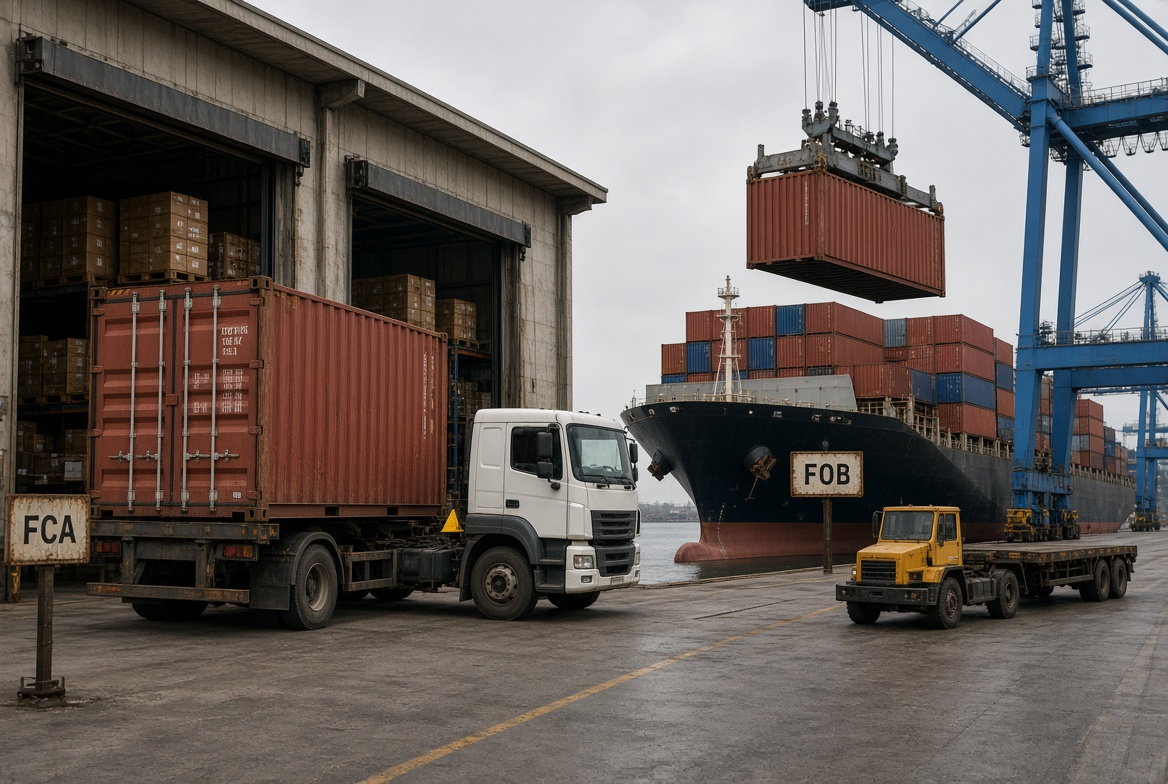
Picture a typical FCL from a factory in Dongguan. Under FCA Shenzhen warehouse or FCA Yantian CY, the seller’s risk usually ends when the sealed container is accepted by the nominated carrier or terminal at that named place. If the box later waits for a vessel, is rolled to a later sailing, or is damaged in the yard, the buyer is already on risk from the handover point—unless the contract or insurance says otherwise.
Under FOB Yantian, the seller stays on risk until the container is on board the vessel. That sounds safer for the buyer. In practice it only works if everyone treats “on board” as the real delivery event: export release completed, container gated in, loaded, and evidenced. If cargo is sitting at the CY and the sales contract still pretends the seller has not delivered, you get arguments about who pays storage, who owns a missed cutoff, and whose insurer responds.
LCL makes the mismatch more obvious. Cargo often arrives at a CFS, is checked, and is stuffed with other shippers’ freight. An FCA CFS named place can track that physical handover. Forcing an FOB on-board concept onto LCL cargo asks the seller to stay responsible through consolidation and loading even when the seller no longer controls the box.
FOB is limited to sea or inland waterway shipments. The buyer typically books the vessel, so the ocean leg is where FCL versus LCL planning matters. When you will pay or control that ocean move, compare FCL and LCL options on sea freight from China before you lock the Incoterm.
Export Declaration and Carrier Nomination
In both cases the seller usually will take care of Chinese export formalities as part of delivery (FCA) or on board (FOB). This doesn’t mean that the buyer can remain silent. The description of the commodity, HS classification, accuracy of the packing list, and if the goods require additional licenses still need to be accurate.
Services go astray when they are nominated by the wrong person. In FCA, the buyer of goods is generally the forwarder or the carrier and he/she names the forwarder or the carrier at the named place. This provides you with control over cutoff, routing and origin charges. In the FOB arrangement, the buyer will typically take out the booking for the vessel on the night that the booking is made, but the seller will continue to run pre-carriage to the port. These charges appear in a post-cargo scenario because they are not entered upon the bill of lading – such as terminal handling fees, bill of lading fees, AMS/ENS filings, and inland trucking.
In writing, agree the following: whose named place or named port the charges are to be paid at, who is to name the carrier, the origin charges to be paid in the seller’s invoice, and the forwarder to bill you directly for the origin charges.
Insurance Gap in Both Terms
The Incoterms rules do not contain the cargo insurance in either FCA or FOB. The buyer to provide cover from the risk-transfer point onwards – handover to the carrier under FCA, on board the vessel under FOB. The test is whether you would be willing to abandon insurance for a line item in the quote that would pay for the longest, least obvious, and most unpredictable part of the trip.The question is, would you give up insurance for that line item in the quote for the longest, least obvious, and most unpredictable part of the trip? If the seller has an existing policy, check that it reflects your risk point and that your name is entered as you would like. Please don’t take "we will take care of it" as cover for the ocean or air leg.
Control, Flexibility, and Operational Workload
Many importers will ask which term will allow them more control. The truth is that each term gets a different type of control for a buck.
FCA Gives Clear Handover Point for Containerized Cargo
FCA allows you to write the handover in the language you accept: FCA factory Dongguan, FCA warehouse Yiwu, FCA Yantian CY. This reflects the way the container logistics work in reality. Cargo is picked up, accepted, possibly checked, possibly labeled and delivered to a carrier or terminal. The loading of the vessel is deferred. Where a China warehouse or consolidation point is already being used, FCA at that location will generally be easier to handle than an FOB clause that assume the delivery takes place only on the vessel.
FOB Reduces Origin Coordination for Simple Sea Shipments
FOB can alleviate the work burden at origin when the merchant is willing and capable to manage factory to port trucking, export declaration, and loading on board. This might be easier for a lean import team for a single-supplier FCL with a clear named port. In many FOB transactions, you select the ocean carrier, but you will not be running after the truck from the factory to the terminal every day.
The compromise is transparency. The origin leg is longer than the origin leg into the seller’s process. If the seller delays to the port, it’s not the trucker you expected, or if the seller takes “FOB China” as an informal term, you pick up the delay without having arranged for the steps.
Who Nominates the Carrier and Why It Matters for Containers
FCA: buyer nomination is the implicit method – your forwarder takes over the cargo at the named place, books the onward move and holds the cutoffs at one place. There is some variation in practice in relation to FOB. Some buyers make the request that the seller deliver the vessel on board after it has been nominated. Some sellers reserve "their" carrier and forward ocean charges through. Both can work. Silence is all that fails.
For containers nomination also determines who’s in control of the bill of lading instructions, who can request a roll to the next sailing and who gets Terminal messages first. Add the nomination rule to the purchase contract and also restate this on the shipping order. If origin charge is included in the commercial invoice request that the seller provide them separately rather than included in the unit price.
When FCA Is the Better Choice for Container Shipments From China
FCA is not to be construed as the “modern term.” It’s better if physically transferred before the vessel and you’d like that location named.
You Are Shipping FCL or LCL Containers
If the cargo is loaded into a full container, or in a CFS, loaded as LCL, then FCA can see the actual handoff. Cargo first received at a warehouse, FCL handed at a CY, LCL received at a CY, etc. fall in a more logical place than on-board events which occur later.
You Want a Clear Named Place for Handover
Specify the location including city, site type and, where possible, the identity of the yard/warehouse that the trucker and warehouse clerk can use: “FCA China” is equal to “FOB China.” “FCA Dongguan warehouse” or “FCA Yantian CY” reveals the end of the seller’s job.
You Use Multimodal or Air Freight for Part of the Journey
FOB is not applicable to air freight or to a true multimodal plan which is not sea or inland waterway. When part of the shipment is truck and ocean, rail and ocean, or air shipments of some of the quantities, then the term that matches is FCA. One of the quickest methods for befuddling carriers and insurers is to throw an FOB clause into an air or multimodal booking.
When FOB Can Work for Container Shipments From China
There is still room for FOB. It serves when delivery is real, not ceremonial, and when the seller knows his origin leg, doesn’t need to improvise.
You Are Shipping Simple FCL by Sea From One Supplier
The cleanest FOB case is a single factory with one FCL with one named port, where a seller already trucks to that port. The seller arranges for loading the goods at Yantian or Ningbo and handles the export procedures and delivers to ship on board. Once you’ve booked the vessel, you’re on your own. If you don’t change the term, do not include LCL, multi-supplier consolidation, and air add-ons in this pattern.
Your Supplier and Forwarder Are Experienced With FOB Containers
In the Chinese trade, the practice of FOB is quite common, but it does not mean that it is clean. It will be successful if the seller is familiar with the named port, the on-board documentation, the export file, and who is paying the terminal handling. If both sides use FOB as an assumption that all PIs are labelled as that, then return to the real handover point where the goods are being handed over before they leave the factory.
Common Mistakes Importers Make When Choosing Between FCA and FOB for Containers
- When making decisions and choosing between FCA and FOB for containers, many importers make common mistakes.
- Applying FOB by default on all sea consignment transactions regardless of whether it is handed over to the warehouse, CY or CFS days before loading as “that’s what we always put on the PI”.
- Uses the term FOB China rather than a specific port of loading (e.g. FOB Yantian or FOB Shanghai).
- The assumption of the FCA implies the seller will do everything to the vessel. The time for FCA is based on the named place, not on on board delivery.
- Withholding cargo insurance on either of the two terms for a line item. There is still risk transfer, the insurance gap still exists.
- After the cargo has been transported to the terminal, changing FCA to FOB or FOB to FCA. Now there are two different stories pointed to in the documents, charges, and risk points.
- Not having carrier nomination or origin-charge splits written; then tossing around a discussion after the deadline on trucking, THC and documentation fees.
Frequently Asked Questions
Is FCA or FOB Better for Container Shipments From China?
FCA frequently parallels the contemporary containertransport method, where cargo is delivered to the carrier prior to the vessel at a designated location. FOB can apply to the smooth delivery of FCL sea shipment, in which the delivery is clearly defined and the seller can handle the origin leg to the named port. Select the term that corresponds to the actual handover and not the one that is more familiar.
Who Handles Export Customs Under FCA and FOB?
With both terms the seller usually takes care of the Chinese export formalities (to the carrier under FCA, on board under FOB). Buyer must provide a cargo description which is usable and verify if any licenses are in place.
Can I Use FOB for Air Freight or Multimodal Shipments?
FOB is to be used only for sea & inland water way shipments. FCA is a more suitable Incoterm for air freight or multimodal moves.
Which Term Gives Me More Control Over the Shipment?
Typically, FCA affords the named handover site more control over the named handover site and over who is nominated as the carrier at that site. FOB can decrease the origin coordination requirements for simple sea FCL, without the buyer having to pay to book the vessel. There is an inverse relationship between control and workload, so choose the side which you can staff.
Should First-Time Importers Use FCA or FOB for Containers?
For some, the first-time importer, FOB is easier to deal with for a sea shipment with a single supplier, provided that he or she is reliable and the named port is clearly identified. It’s usually cleaner for LCL, warehouse handover, multimodal plans or any move where you want the seller’s job to stop at a location you can point at on a map.
Do I Need Insurance for FCA and FOB Container Shipments?
Yes. This is because cargo insurance is not covered in either term. Cover risk transfer point onwards – handover to the carrier under FCA, on board the vessel under FOB.
No one-size-fits-all answer to the question of FCA or FOB containers. Define the cargo flow, name the place or name the named port, agree who nominates the carrier, and determine the term that is applicable to the actual handing over and how much origin work each should expect the seller to make.