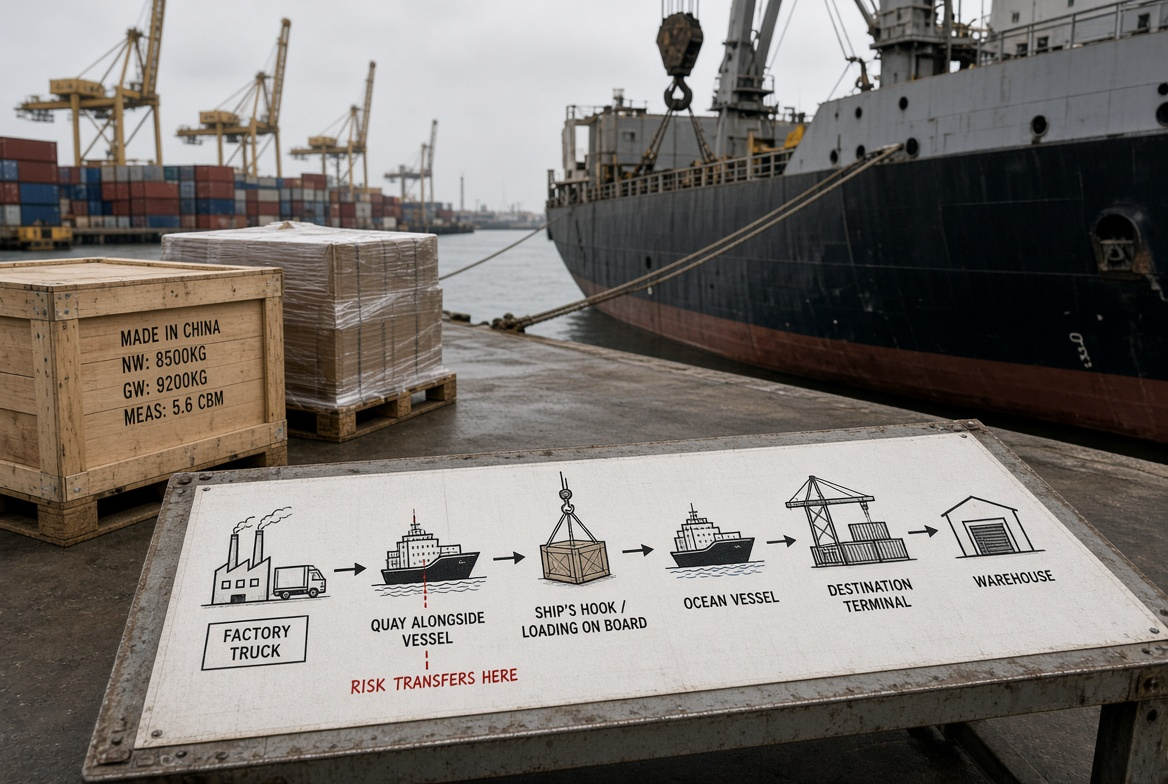
FAS Incoterms® 2020 – Free Alongside Ship – explained in simple terms: Under FAS Incoterms® 2020, the seller delivers the goods when the goods are placed alongside the ship in a named port of shipment and the risk passes at that time. That typically refers to overseas importers from China who have the supplier arrange the shipping details, and then wait for the shipment at the port where they arrive, like Yantian, Ningbo or Shanghai. You assume responsibility for loading on board, ocean freight and all that comes after.
This article explains risk transfer locations, what happens to the real cost stack at the port and what each party has to do when they choose the FAS term – and when it is suitable versus when an alternative term is more appropriate. It’s not a legal guide, it’s a practical one. The official definition of FAS is regulated by the International Chamber of Commerce rules.
FAS (Free Alongside Ship) Defined in Plain Language
The term FAS is used in the sea and in the inland-waterways. The seller’s duty ceases when the goods are with the named vessel at the named port of loading. The delivery point is with the quay, a barge, or another place at that port where the ship will load the cargo, “alongside”. It is not on board. It is not on the factory gate. This is not in your warehouse.
It is this distinction which is what gets people wrong. FAS is similar to other port terms on a proforma. It is not. Loading on board, stowage and ocean freight remain the responsibility of the buyer. FAS does not apply to air freight and express parcels. If the cargo is going to fly, the wrong rule set is FAS.
Where Delivery and Risk Transfer Under FAS
Delivery and risk transfer occur simultaneously under FAS: when the goods are delivered to the vessel at the named port of loading. Insert port in the contract. “FAS Yantian” or “FAS Ningbo” is used to indicate both sides where that handoff happens.
Thereafter, loss/damage, even if the cargo has not been loaded on board, falls to the buyer. Unless specified to the contrary in a separate contract or insurance policy, a failure of the sling during loading, damage caused by water during waiting on the quay or a shortage after stowage will be the responsibility of the buyer. One of the most common pitfalls is to consider risk as transferred until an on-board bill of lading is issued. The FAS adhered to the principles of starting the clock at the quay.
FAS Requires a Named Port, Not “FAS China”
FAS China is no use as a term. There are numerous loading ports in China, and each of them may have different trucking, terminal practices and vessel schedules. If a port of loading is not named, neither side can prove that the delivery took place, book space or price inland haulage.
Avoid a “FAS” line on a proforma or purchase order. Use the same sentence to request the port: FAS Shanghai, FAS Yantian, FAS Qingdao, or whatever port name is suitable to the factory and the ship. If the seller is later found to be interested in changing ports, consider it a change in the contract and not a courtesy.
The Real Cost Stack Behind an FAS Quote From China
The FAS unit price is attractive, as it does not proceed further than the quay. Landed cost does not include: In FAS, the number of the seller is used to cover the journey from the factory to next to vessel. There is an extra charge for loading, main carriage, destination charge, duty and delivery which sits with you.
Only compare quotes after completing those lines. A lower FAS price may be just the loading and freight omitted.
Origin Costs Covered by the Seller Under FAS
The typical seller costs for FAS are:
- Inland transport of goods from the factory/warehouse to the named port by road transport.
- Standard packing for export as agreed in the sale contract
- Export declaration, and the necessary export documents to accompany the goods on the vessel.
- Transportation to the quay or barge at that named port, for the loading of the goods.
You don’t have to count loading on board, stowage and trim. The sale does not necessarily constitute the seller’s bill if a crane, barge or stevedore must place the cargo on the ship. Verify in writing prior to the truck leaving the factory.
Loading On Board, Main Carriage, and Destination Costs Paid by the Buyer
Typically, the buyer’s cost path once the cargo is alongside the ship is likely to involve the following:
- The loading on board, stowage and special handling required to the cargo.
- All ocean freight, surcharges (bunker/fuel) and extras that apply to the booking.
- Security fees (as required by the trade lane) and filing fees
- DTHC – charges levied by the destination terminal at the point of sale.
- Import customs clearance
- Duties and taxes
- Inland transport from the terminal to the final destination and last mile delivery.
Those lines vary by commodity, destination, and how you book the vessel. They do not disappear because the supplier quoted FAS. After you map that origin-to-destination path, review shipping from China by market so mode, routing, and clearance sit in the same plan as the FAS port handoff.
A Simple FAS Cost Checklist for Importers
Make a copy of this list on the quote comparison sheet:
- Seller’s FAS (factory to alongside the vessel at the named port)
- On board loading and stowing procedure.
- Ocean freight and fuel surcharge.
- Origin and destination security and documentation fees (as applicable)
- Cargo insurance (not required by the rules but highly advisable in practice).
- Destination THC & clearance fees
- Customs duties and taxes
- Inland trucking & last mile delivery
If you can’t fill a line you don’t yet have a similar number. FAS vs FOB – or FAS vs another term – is not a unit price comparison.
Risks and Responsibilities for the Buyer Under FAS
It’s control from the quay onwards with FAS. It also provides you with exposure from a common angle. The compromise is why there is still a term in use for some breakbulk and specialized cargo, and why it is a bad standard-bearer for an initial container order purchase.
Risk Transfer Alongside the Vessel at the Named Port
Risk transfers as soon as the goods are put next to the vessel at the named port. A shortage only discovered at the destination, or a loss suffered when the ship is being loaded or when the cargo is damaged by the weather while awaiting loading on the quay, are examples of cases where FAS will point the loss at the buyer, unless the loss is covered by insurance or a separate agreement.
Please note that the date that’s on the board is not the risk date. On-board date is later under FAS. It has already been transferred at the quay.
Export Declaration and Loading Coordination
Generally the seller will assist with the export formalities as part of delivery with the ship. Clean reading of the term for export to China is the seller’s getting the product out of China and to the named berth or barge.
The implementation of loading co-ordination is more complicated in practice. The terminal and carrier are involved in the crane/barge/quay slot/ship cutoff operations, and typically the two trading parties are also involved. The loading appointment and stevedore invoice are not assigned as a matter of course to the seller by FAS. Those who think that the factory will load it find out the difference when the ship is at berth and nobody has booked the hook.
Document the loading arrangement, payer and communicator with the terminal. If the above sentence is not included in the terms of the sales contract or the booking note, correct it before the cargo arrives at the port.
Insurance Is Not Included in FAS
The term FAS does not impose any insurance liability under the Incoterms. No Policy has to be purchased by either party as a condition of the term. It’s not ‘insurance is not needed’.
After the alongside point, the cargo is at your own risk. High value machinery, breakable equipment, bulk product or anything that can move while loading is a bad choice for a no insurance experiment. If you do not have a total loss insurance in place from the quay to your warehouse, then you don’t have the money to afford skipping the cover on an FAS shipment.
Because FAS is a sea and inland-waterway term, and because you control loading and the ocean leg, compare sea freight from China options—FCL, LCL, or breakbulk—when you plan the booking that starts at that named port.
When FAS Makes Sense for Importers Buying From China
FAS is not an automatic “port term”. It’s a place for delivering. Apply it when this aspect is the same as the movement of the cargo.
You Are Shipping Breakbulk, Bulk, or Specialized Cargo
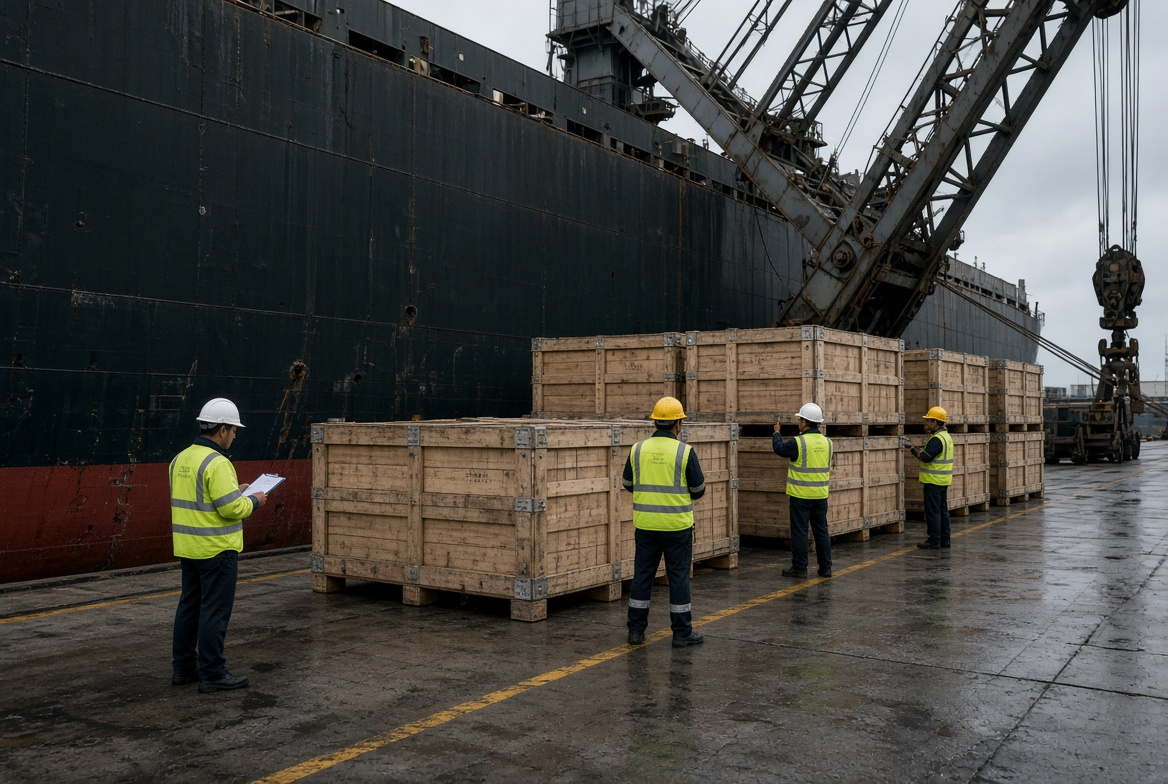
FAS is used for goods delivered on board the ship/barge and not packed in a standard container at an inland yard. Breakbulk, bulk and oversized goods, and some project goods already reside on quay prior to being loaded. That’s the same match that occurs physically.
When the goods are to be loaded in a 20ft or 40ft box in a factory or CFS, then FAS is likely to mean the wrong place.
You Want to Control Loading and Freight From the Port
Some importers have their own ocean contract, preferred carrier or need to control stowage. The loading of FAS is left to the buyer, which can be helpful if that control is real and manned. It has little or no value if the buyer does not have a booking relationship and no one else with whom he can communicate with the terminal.
There’s no such thing as control without a plan, it’s just more cut-off email.
When FAS Is Usually the Wrong Choice
Standard containerized cargo (FCL or LCL) typically works more to FOB or FCA than FAS. Containers are received and loaded without clean and orderly processes of terminal/carriers that are "place the goods alongside the ship". For first time importers of boxed cargo, ask yourself why you were quoted FAS. It’s frequently something that comes from the old breakbulk tradition and not one that was picked up for this load.
If the supplier cannot identify the port, cannot explain the alongside point, or has assumed that they will be loading the vessel, stop and edit the term before the production is completed.
FAS vs FOB — Short Decision Guidance
Be brief in the comparison. The two terms are not twins, but neighbours.
FAS vs FOB: Alongside vs On Board
FAS is a contract where the seller arranges to deliver the vessel together with a set of goods at the port specified in the contract. FOB means the seller will put the goods on board the ship at the specified port. The only structural difference is additional step (later risk transfer point) with the seller under FOB.
The most common and convenient option is FOB or FCA for the majority of Chinese export cargo in containers. FAS FOB for importers is not a choice of the cheapest acronym on a piece of paper; it’s a choice of where you’re taking the risks to flip, at the quay or on the vessel. If you need the full comparison, make sure to use a dedicated FOB comparison.
Common Mistakes Importers Make With FAS From China
- Avoiding any port of loading to be specified instead of writing “FAS China”. The port is the address to which the product is sent. If it were not for costs and risk there would be no place.
- It’s assumed that FAS includes loading on board. It needs to be delivered along with. Unless you contract them, the hook, the stowage and the on-board process are separate.
- If the cargo is considered FOB, it is done only when placed on board the vessel and the risk of loss is passed to the buyer. The risk already travelled to the quay for FAS.
- Not taking cargo insurance for origin “the seller.” Origin under FAS is terminated at the end of the vessel. The high-priced segment of the trip is yet to come.
- Change of FAS to another terms after cargo has already arrived at the port. All the papers, all the bills, who pays the ends up have to be ironed out at the last minute.
- When loading arrangements are not designated. Double check the booking and the load payment arrangements before the truck is dispatched by the operator.
Frequently Asked Questions
What Does FAS Mean in Shipping From China?
FAS is Free Alongside Ship. With Incoterms® 2020, the seller delivers the goods when they are ready to be put alongside the vessel at the named port of loading and the risk passes to the buyer at that time. The buyer is then responsible for loading on board, ocean freight and onward shipment.
Is FAS the Cheapest Option for Importers?
Not automatically. An FAS price may appear cheaper due to loading and freight and the destination charges and duty not being included in the seller’s price. Those lines are still a major factor in total landed cost. Complete the checklist before calling any term the lesser of two evils.
Who Handles Export Customs Under FAS?
FAS is known as a seller dominated contract, with the seller generally responsible for export paperwork, delivery of the goods and the vessel to the named port. Check the list of documents in the sales contract to ensure that the export declaration, packing list, and commercial invoice agree with the documentation required by the port and the carrier.
Does FAS Include Loading On Board and Ocean Freight?
No. Vessel is delivered with the seller. Unless otherwise provided in a separate written agreement, the buyer shall be responsible for loading and ocean freight and the remainder of the journey.
Can I Use FAS for Container Shipments or Air Freight?
FAS is used for shipping via sea or inland waterway. It is more likely to be part of break-bulk or special cargo. Typically, the cleaner fit is FOB or FCA for standard containers. Use FCA for air freight, avoid using FAS.
Should First-Time Importers Use FAS?
Only with a reason. Ordinary shipping to containers is less likely to be facilitated by FAS. Boxed commercial cargo typically is easier to import for a first time importer when it comes to FOB or FCA terms of sale. Where cargo is to be shipped with a ship and you are ready to assume the loading, freight and insurance responsibility from there, use FAS.
FAS is a special type of port term for sea and inland waterway transport in which the delivery is the actual handoff along with shipping. Draw the entire cost chain, identify the port, ensure the people will load the vessel and arrange insurance before the goods depart the factory.