
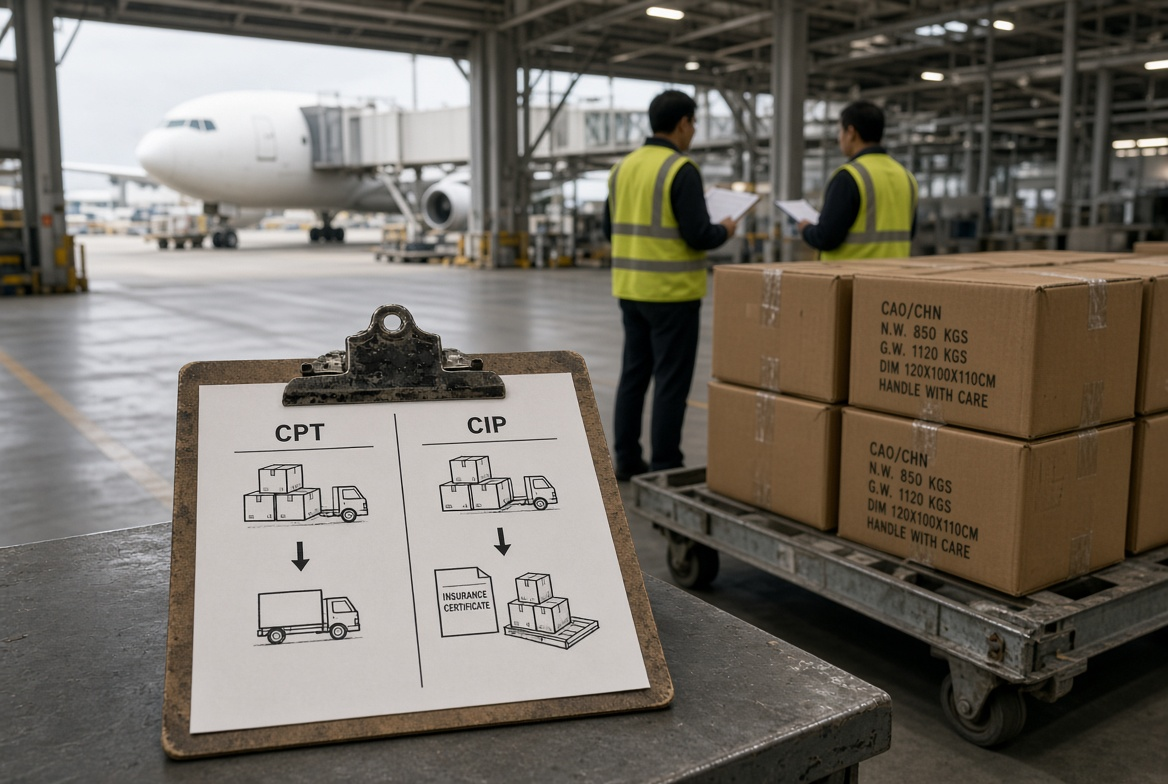
CPT (Carriage Paid To) and CIP (Carriage and Insurance Paid To) under Incoterms® 2020 are essentially the same except for one aspect: CIP requires the seller to have cargo insurance to the named place of destination, CPT does not. Beyond that named place, the risk continues on to the first carrier and the buyer continues to be responsible for destination clearance, duties and inland delivery. In comparing CPT vs CIP, the issue at hand is whether the seller’s policy is sufficient for the cargo or whether you should make your own policy anyway. The definitions and what that insurance actually covers are listed below, along with how to figure quotes and a practical method for selecting.
The following is a working comparison and not legal or insurance advice to the overseas buyer. The official rules of Incoterms® 2020 are issued by International Chamber of Commerce.
CPT and CIP Under Incoterms 2020 — Core Definitions
Both terms fall in the “C” group – the seller pays for main carriage to named place of destination. Both terms are ex-works (duty included or not). They are used for all modes of transport: sea, air, rail, road or multimodal and can therefore frequently appear on the air and rail quotes from China and sometimes on the ocean quotes rather than the CFR or CIF quote.
CPT (Carriage Paid To): Seller Pays Freight to the Named Place
Under CPT the seller books and pays freight to the named place of destination. It should be specific, for example “CPT Los Angeles airport”, “CPT Berlin rail terminal”, or “CPT Rotterdam warehouse”—not a country name. Risk passes when the goods are given to the first carrier at the origin (usually a trucker who picks them up from the factory, an origin warehouse or the air/rail/ ocean terminal). The seller’s commercial risk increases from the handoff onward even as he is continuing to pay the freight bill.
Buyer to clear for destination customs, duties and taxes and any inland transportation from the named place. The seller is not responsible to purchase cargo insurance under CPT. Most buyers either get their own policy or are covered by an existing open cargo policy.
CIP (Carriage and Insurance Paid To): Seller Adds Cargo Insurance
In addition to the CPT structure, CIP imposes one duty on the seller, namely, that the seller takes out cargo insurance on the buyer’s behalf from the time of delivery to the named place of destination at least. Risk still passes at the initial point of transfer at the first-carrier handoff. The buyer remains responsible for duty, destination clearance and onward trucking.
Use the same place name as you would use under CPT. No named places with the name “CIP United States” are usable. The phrase “CIP Chicago O’Hare cargo terminal” is.
What Actually Changes Between CPT and CIP?
It’s not risk transfer and it’s not destination work, it’s structural difference, which is insurance. Be careful not to assume that a quote is “safer” just because it contains CIP!
Risk Transfer Is the Same; Insurance Is the Difference
For both CPT and CIP, the risk passes to the buyer as soon as the goods are handed over to the first carrier at the origin. The additional obligation imposed on the seller under CIP is to cover the buyer’s risk on the way to the named place, through insurance. CIP will not retain transit risk with the seller. In case of carton damage during transport from Shenzhen to the destination airport, the claim path is the insurance policy, and not an automatic-shopping refund from the factory.
That’s the most frequent reversal mistake of China quotes. When the buyer hears “insurance paid to destination” he assumes that the supplier still has the cargo until it reaches his destination. They do not.
Destination Charges, Duty, and Inland Delivery Are Still the Buyer’s Problem
CIP is NOT DDP/DAP/door delivery. Under both terms of sale, the buyer is still responsible for the import clearance fees, duties and taxes, terminal fees at destination, and trucking beyond the named place. Even if you send a CIP shipment to “Los Angeles airport”, you may still be responsible for the airport handling, customs brokerage and the truck to the warehouse. Consider those lines separate from the unit price (CPT or CIP).
A Simple Cost Checklist for CPT vs CIP
Be careful not to compare a bare unit price with a bundled one as you will use the same list for both quotes:
- Product price (if all factors are equal, will not differ between the two terms)
- Freight to the named place (seller pays under CPT & CIP; under CIP, it is frequently included in the unit price)
- Insurance:
- CPT: the buyer is responsible for arranging and paying for the treatment
- CIP (Cover by seller): premium often included in the quote; the seller will be responsible for supplying the cover.
- The duties and taxes are paid by the buyer.Duties and taxes paid by buyer (buyer
A useful comparison is total landed cost plus the actual insurance wording—not the difference of a few cents on the unit price. When you map that path by market, mode, customs, and final delivery, shipping from China is the place to line up those destination-side costs against the Incoterm on the supplier’s invoice.
Understanding the Insurance Component in CIP
This is what differentiates CIP from CPT and will determine if the additional line item on a quote is beneficial.
What the Default Cover Means Under Incoterms 2020
Subject to the provisions of the rules, where there is no other terms, the buyer shall bear the expense of obtaining cargo insurance in accordance with Institute Cargo Clauses (A) or at least as good as this standard, subject to the mode of transport utilized, at least 110% of the contract price in the contract currency. The CIP floor is narrower than the CIF floor, which was used in Incoterms® 2010.
“All risks” is another way of referring to Clause (A). This label is one that can be over-read. It applies to physical loss or physical damage caused by any external incident, subject to any exclusion of the policy. As always, the following are usually excluded: delay, ordinary wear, inherent vice, insolvency of the carrier, and often war and strikes, unless those are incorporated. Request a valid policy or certificate. Note that the word CIP on a proforma does not mean the same as the default in 2020.
There are still some contracts from China that refer to an older version of Incoterms, or they just don’t mention the clause at all. If that is the case, then the seller could be purchasing a narrower cover than you realize. The certificate—not the three-letter term—is what a claims handler will read.
Insured Value and Claim Process
Under CIP it is the practice of certain trades to insure 110% of the contract value. The additional 10% is supposed to make up for the anticipated profit on goods that arrived in good condition. Normally, the party having insurable interest, i.e. the buyer, is the party that should be able to claim against the insurer, however, there are still many claims that go through the seller as the policy was placed in China, the documents are in the seller’s file, and the insurer wants the original certificate.
The additional handoff is the reason why a claim under CIP may take longer to appear as a claim under the buyer’s open policy. Documents, packing photos and arrangements of a survey may require the co-operation of the seller. That process becomes more difficult if the seller is languid or if the quality issue is already a matter of contention.
When CIP Insurance May Be Enough
If the goods being transported are not fragile, have low value, are short and regular in nature and if you have read and understood the clause and exclusions, then cover may be acceptable. The typical scenario is when you’re moving a standard carton of durable goods, either by air or by rail. Even so, validate the identified place, insured value and need to incorporate war/strike extensions on that lane.
When You Should Arrange Your Own Insurance Anyway
Purchase a dedicated cover for the goods or maintain an open cargo policy for electronics, fragile, machinery, water sensitive, theft-prone, or goods that cannot be sold quickly. Your own carrier may be the carrier that matches the cargo profile, that names you as the insured and that serves claims in your language and time zone.
It’s possible to have both a CIP policy and your own policy. That doesn’t necessarily equate to wasted money, but it can certainly lead to an argument after a loss over which policy to dedicate the first funds to. Instruct your broker to notify the seller of what you have already put in so that you do not have two, fighting, covers.
Both CPT and CIP work with any mode, ocean included. When the China lane is containerized, and when the insurance wording will be on an FCL or LCL booking, compare sea freight from China first and then consider a CIP unit price that is too thin.
Cost Implications — Is CIP Really More Expensive Than CPT?
On paper CIP should cost more than CPT by the insurance premium. The difference in supplier quotations is frequently trivial, dirty or unnoticed.
How Sellers Price CPT vs CIP
Under CIP, many Chinese factories quote in the unit price of goods including freight and insurance. The price of CIP might be just slightly higher than CPT. The small gap is not proof that the cover is Clause (A), that the insured value is 110%, nor that claims will be easy. It might just be a case of the seller putting a low local premium and a nice round price for the unit.
Request a split of the bill: the product bill, freight to the named place and insurance. If they don’t agree on how to split it, deal with the CIP price as if it is a bundle that you still need to unbundle before comparing it with a CPT-plus-your-own-policy number.
Comparing Total Landed Cost, Not Just Unit Price
Show the entire route: product, origin handling (as applicable), freight, insurance (included or separate), destination terminal charges, clearance, duty, tax and inland delivery beyond the named place. If you end up paying a high fee to the destination airport, paying for a second policy, or if a claim is disallowed due to an exclusion, a cheap CIP quote can be costly.
The less expensive term is the one that gives you a line on the proforma that you can predict your landed cost on, and leaves you with an acceptable cover.
Decision Framework — When to Choose CPT vs CIP
Select the term that reflects the parties who should have jurisdiction over the policy, rather than the term that appears to be more comprehensive.
Choose CPT When You Want Control Over Insurance
CPT is suitable for those who have an open cargo policy and need to select their insurer, the clause, or don’t want the second insurance on the same shipment. There is still a need for cover from first carrier handoff, as this is where risk moves. If you don’t have any insurance process at all, then CPT is additional work.
Choose CIP When You Want the Seller to Handle Basic Cover
If there is no existing policy, the cargo is standard, relative low value and the seller can provide a certificate that is comparable with Incoterms® 2020 (or higher cover as you indicated). You are purchasing convenience not custom program.
Questions to Ask Your Supplier About CIP Insurance
Before you accept CIP on a China order, get written answers:
- What is the version of the incoterms that is used in a contract (2020 or earlier)?
- How does the clause/standard in the insurance policy read?
- What would be the insured value (expressed as a percentage of the invoice or contract price)?
- Who is named as the beneficiary and how do claims get in?
- What perils are insured and what are they not?
- Are there extensions that can be added to war or strikes—at what price?
If the answers are not specific, the chances of CPT and his own policy would be better than making a guess.
Common Mistakes Importers Make With CPT and CIP
- When a seller assumes the CIP, the risk of transit is on that seller. There is still risk at 1st carrier.
- Assuming that CIP insurance is “all risk” coverage without reading the exclusions.
- Selecting CIP because “insurance is included” and then realizing that your own insurance policy is more extensive and more likely to cover.
- Using “CIP [country]” rather than a specific location to which the letter is being sent.
- Having two policies and not informing either one, and then playing the "first in time" card.
- Once goods have been loaded into the ship, changing from CPT to CIP – or vice versa – causes chaos over who pays what, documents and certificates are scrambled.
Frequently Asked Questions
What Is the Main Difference Between CPT and CIP?
Insurance. Under CIP the seller must provide cargo insurance to the named place of destination. Under CPT they don’t. Otherwise risk transfer and destination responsibilities are the same.
Is CIP Insurance Enough for High-Value Cargo?
Often not: Incoterms® 2020 establishes a default floor (Clause (A) or equivalent), it is not a programme designed for the cargo. Generally, high value, fragile or specialized items require a specific policy to cover that risk even if the policy is included on the invoice.
Who Handles Claims Under CIP Insurance?
The insurable interest is usually held by the buyer, but a claim is likely to require the seller to provide a certificate of insurance and work in cooperation with the insurance company that issued the certificate. This may take longer than a claim on a policy that you have placed.
Does CIP Include Customs Duty and Door Delivery?
No. CIP includes insurance cover and freight to the named place. From that point, import clearance, duties, taxes and internal delivery are the buyer’s responsibility.
Can I Use CPT or CIP for Air Freight From China?
Yes. They are both applicable to all modes of transport, such as air, rail, road, sea and multimodal. When the first carrier is an airline or a trucker, rather than a ship at the load port, they tend to be a better option than FOB or CIF.
Should First-Time Importers Use CPT or CIP?
If proper cargo insurance can be placed, CPT will retain control of the cargo insurance. CIP can be considered if the goods are low-value and normal goods and the seller can present a clear certificate. Don’t choose a CIP because its name includes the word “insurance”.
CPT and CIP are extremely alike, with only insurance details differing. See what cover you receive under CIP, compare with your own policy, and select the term that you can afford with respect to the claim process you can endure along with the value of the cargo.