Once a Chinese factory has quoted delivery to a named place, overseas importers have to make a decision between DAP vs DDP vs DPU. Three of the Incoterms® 2020, “delivered,” put the goods as close to your warehouse, fulfillment center or job site as possible: DAP (Delivered at Place), DDP (Delivered Duty Paid), DPU (Delivered at Place Unloaded). In all three, the seller’s payment is to that named place for the main carriage. There is disagreement about who bears the burden of clearance and pays the duty, and whether or not unloading is included.
This is the best word that could be used. This will depend on whether or not it’s legal for the seller to import into your country, who is paying duty and if you need the seller to unload at your destination. This guide is designed to make a comparison of cost, risk, duty and delivery for China shipments and provide a practical decision checklist. It is not an actual legal or tax opinion. Official definition is in the hands of the ICC, import clearance and duty is by local law.
DAP, DDP, and DPU Under Incoterms 2020 — Core Definitions
Consider these three terms as delivery packages, not slogans which are written on a proforma invoice. The individual questions that are answered by each of these are operational questions such as: Who takes the goods to the named place, who will take care of the import, and who will take off the goods from the truck.
DAP (Delivered at Place): Seller Delivers to a Named Place, Buyer Clears Import
Under DAP, the seller delivers the goods at the buyer’s disposal on the arriving means of transport, where the goods should be unloaded. Main carriage is paid by the seller at that place. Usually, the buyer bears the cost of import clearance, import duties and taxes. Unless otherwise agreed to in the contract, the buyer’s responsibility is to unload. It could be your warehouse dock, the gate of an Amazon fulfillment center, or a city terminal, etc., for a shipment to China. The cargo arrives. It’s still a process of getting it through customs and off the car.
DDP (Delivered Duty Paid): Seller Delivers With Import Clearance and Duty Paid
At first sight, it might appear to be the same as DAP; goods will be delivered at the named place on the arriving transport ready for unloading. The difference is the import file. Import duties and taxes will be the responsibility of the seller. That transfers the cost and risk to the seller to the specified place. Only works where the seller (or agent on his behalf) can legally serve as the importer of record. Where there is no such thing as a “DDP” clause in your country, a “DDP” label on a quote is not a viable option.
DPU (Delivered at Place Unloaded): Seller Delivers and Unloads at the Named Place
Seller delivers in DPU when goods are unloaded at named place of destination. All carriage and handling of unloading is the responsibility of the seller. Generally, import clearance and duty is the responsibility of the buyer. Unloading is the only Incoterm where it is an explicit obligation of the seller. This is important if you have heavy cargo, palletized loads, or if you deliver to a site that doesn’t have a forklift or dock staff on your own.
Side-by-Side Comparison — DAP vs DDP vs DPU for China Shipments
Scan the matrix below and then read the cost notes below that. Avoid using the table in lieu of the language in the contract in your purchase order.
DAP vs DDP vs DPU for importers buying from China
| Aspect | DAP (Delivered at Place) | DDP (Delivered Duty Paid) | DPU (Delivered at Place Unloaded) |
|---|---|---|---|
| Delivery point | Named place of destination, ready for unloading (on arriving transport) | Named place of destination, ready for unloading (on arriving transport) | Named place of destination, after unloading |
| Risk transfer | When goods are placed at the buyer’s disposal at the named place, ready for unloading | Same as DAP: at the named place, ready for unloading | When goods are unloaded at the named place |
| Who pays main carriage | Seller | Seller | Seller |
| Import clearance and duty | Buyer (typically) | Seller (must clear import and pay duty and taxes) | Buyer (typically) |
| Unloading at destination | Buyer’s responsibility | Buyer’s responsibility (unless otherwise agreed) | Seller’s responsibility |
| Typical use case | Buyers who want delivery to a named place but will clear import themselves | Buyers who want the seller to handle delivery, clearance, and duty | Buyers who need the seller to handle unloading at destination |
How DAP, DDP, and DPU Change Your Cost Stack
The reason this is sometimes the case is because duty, import brokerage and unloading charges are not part of the seller’s number. Those lines are still paid for. Know where they are located first before comparing quotes. When freight, clearance and duty are all combined in one figure, DDP can appear to be simpler. That bundle may include assumptions that are not strong: a guessed HS code, an agent who can’t file as the importer of record, or a “duty paid” claim that ends at the port, rather than at the named place. DPU is added to the scope of the seller. That line is not a courtesy line for machinery, building materials, or dense pallets, but a work and money line.
Think in total landed cost to the named place, not in the DAP, DDP, or DPU sticker on the commercial invoice. Mode, routing, customs, and final delivery still change the bill after the Incoterm is chosen. Country and mode context for shipping from China belongs in that landed-cost map, because a DAP warehouse delivery to Los Angeles is not the same cost path as a DDP delivery to an inland EU site.
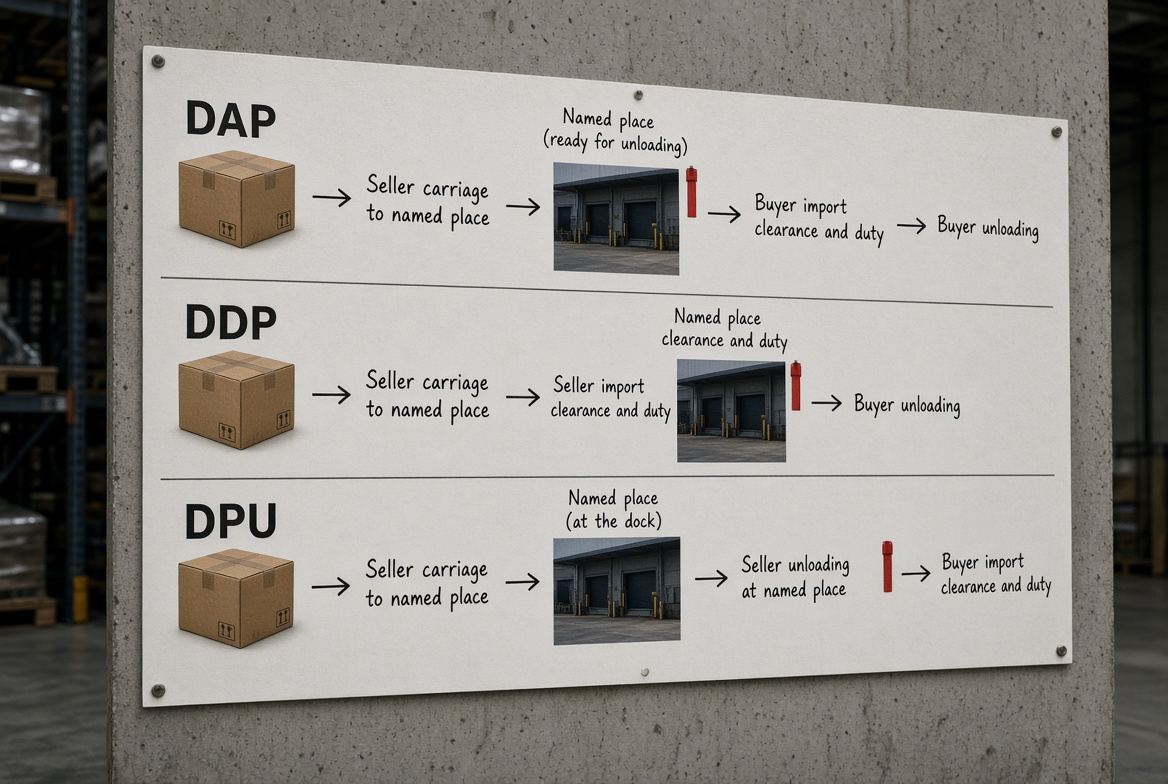
Risk and Responsibility — Where DAP, DDP, and DPU Differ Most
The comparison is just half in terms of money. Every term influences what you need to do on the day of the cargo’s arrival and what document error ends up in.
Named Place and Risk Transfer Under All Three Terms
Under DAP, DDP and DPU, the seller makes payment of main carriage to a named place of destination. Provide that address, as a warehouse address, a fulfillment center address, a job site, or a clearly identified facility, not as “DDP USA” or “DAP Europe.” Risk passes once delivered to you: ready for unloading under DAP/DDP after unloading under DPU.
One of the most often made mistakes is that of risking only after customs clearance or when the truck is empty. Even if the goods are still being worked by your broker, and risk has already passed to the arrival vessel if the goods are being shipped under DAP or DDP, risk may have shifted already. If you want the seller to bear the risk with unloading, it is a DPU topic and not a promise in a WeChat thread.
Import Clearance and Duty — The Big DDP Difference
Generally, under DAP and DPU, the buyer is responsible for filing import clearance and paying duty and taxes. The seller is responsible for the importation and payment of import duties under DDP. It is the actual split that most importers are looking for.
DDP fails when the seller cannot legally act as importer of record in the destination country, or when the seller’s agent cannot obtain the filings, bonds, or tax registrations the destination requires. Some markets allow a foreign seller or nominated agent to clear. Others expect a local importer with a tax ID. If that legal path is missing, DDP is not available no matter what the quotation says. When you are evaluating duty-paid delivery as an execution model rather than a line on a PI, review how DDP shipping from China is scoped: freight, customs responsibility, and final delivery under confirmed terms.
Unloading: Who Handles It Under DAP, DDP, and DPU
The general rule with DAP and DDP is that the unloading is usually the responsibility of the buyer, unless the contract specifies otherwise. DPU is a situation where the seller is responsible for removing.DPU is a situation where the seller shall take out. Never presume a DAP or DDP truck comes equipped with a liftgate, forklift or crew to load pallets into your racking. Wherever the destination is – whether a job site without a dock or a warehouse that will not accommodate a live unload – the unloading method is to be written into the term or the booking, not an afterthought in a follow-up email.
Control, Flexibility, and Operational Workload
Importers frequently question: which is preferable, giving them more control? The control and workload are coupled. The one that works more for you also relies more on the sellers’ performance in your country.
DAP Gives Delivery With Buyer-Controlled Clearance
By keeping import clearance, duty payment and unloading in your own broker, tax ID and cash-flow plan, you can take advantage of DAP. This can come in handy when you have a preferential duty program, a specific classification position or want to time the entry based on your own inventory and tax calendar. You still receive seller paid carriage to named place. You don’t give the import file to a factory that doesn’t know the rules for entering your market.
DDP Reduces Work but Requires a Seller Who Can Clear Import
When you are dealing with the seller (or an able agent), who can legally remove the import and pay your duty, then DDP is going to ease your operational burden. For ecommerce sellers and buyers who don’t have a local import, this is the model they may desire. This is no luxury. Where the seller is unable to file, DDP is a delay at destination with disputed charges. Don’t agree to importer of record unless confirmed prior to container arrival.
DPU When Unloading at Destination Is Critical
When the physical unload is the tough part, select DPU. Typical cases are heavy machinery, long building materials, and a mixed up load of pallets coming in without equipment at the site. If you already have a broker, but can’t staff the unload, you can keep DPU import clearance on you, which can be the right split. It does not fit if you were only concerned with “delivery to the door” without considering who would be responsible for customs.
When DAP Is the Better Choice for Importers From China
But it does not mean that DAP is always less expensive. It is the cleaner fit when you wish to import the file when you are sold carriage to a named location and ready.
You Have Your Own Broker and Want to Control Clearance and Duty
When using a customs broker, you have the required importer numbers, and you wish to manage the classification, duty payments, and release times, then use DAP. It’s a standard practice for regular importers who import consumer goods, electronics or apparel to existing markets where they submit entries. You don’t have to classify something as a different type than what it is in your product database.
You Want Delivery to a Named Place but Will Handle Unloading
DAP is also applicable when the seller must deliver goods to your warehouse, fulfillment center, or job site for the team or your 3PL to unload. Spell the proper name of a place correctly. The “to Chicago” delivery code does not imply the same delivery as the “to dock” delivery code.
When DDP Is the Better Choice for Importers From China
Only if a duty-paid delivery is desired and legally allowed will DDP be preferred.
You Want the Seller to Handle Freight, Clearance, and Duty
DDP can be used for people buying ecommerce businesses, or for Amazon FBA-style inbound buyers who do not want to set up a local import process for one shipment. The seller’s quote should include the named place, duties and taxes being sold, and whom the entry will be filed by. Those points are not there if it is a marketing phrase, it’s a DDP shipment.
Your Destination Country Allows Foreign Sellers to Clear Import
The DDP depends on the destination law and the agent network of the seller. In some countries, the importer (or nominated agent) may be a non-resident who clears and pays the duty. Others don’t, or it’s no longer practical. Always verify that path prior to moving a factory from DAP to DDP. You will learn on a seller’s cargo who has not previously cleared in your market.
When DPU Is the Better Choice for Importers From China
DPU is the expert of the three. Use it during a situation where you’re required to move the unloading job.
You Need the Seller to Handle Unloading at Destination
Heavy, palletized, or awkward load requiring equipment and/or crew at the named site. A dockless crate of industrial gear coming to a plant is a DPU conversation. Typically, a warehouse team can pull a carton shipment off a trailer with a pallet jack.
You Will Still Clear Import and Pay Duty Yourself
DPU retains the clearance and duty to the buyer. This split can come in handy if you are looking for seller unloading without risking the import file. Make a written agreement with the seller: you pay duty and make an entry; seller unloads at the place. Disputes begin when DPU language is combined with a DDP price.
Common Mistakes Importers Make When Choosing Between DAP, DDP, and DPU
- The assumption is made that DDP is available at all locations. Availability is subject to whether the seller/agent can legally clear availability in the destination country and be able to pay duty.
- Unloading is considered part of DAP or DDP. Unless you include a separate unloading contract, both terms provide goods for unloading. Only DPU makes unloading the seller’s default duty.
- Substituting the name DDP (country) or DAP (country) for a place name. A country is not a delivery point. Use any warehouse, fulfillment center, job site or full address.
- Selecting DDP because it includes DUTY. No duty value when seller is not able to make the entry or if the HS code is incorrect.
- Causing confusion between DPU and DAP and not planning the unloading. Under DPU the seller offloads. Under DAP you do.
- Confusing DPU with DAP and leaving unloading unplanned. Under DPU the seller unloads. Under DAP you do.
- Changing from DAP to DDP, or the other way around, after cargo is already in transit. Documents, who files, and who pays duty have to match the goods in motion. A mid-voyage rewrite creates two versions of the same shipment.
- Switching from a DAP to a DDP arrangement and vice versa after the cargo has been loaded. Duty must be paid to the correct person, on the rights of the correct people and in the documents that are moved. A mid voyage rewrite results in two copies of the same shipment.
Frequently Asked Questions
What Is the Main Difference Between DAP, DDP, and DPU?
The most prominent differences are import clearance, duty and unloading. DAP applies when the buyer usually takes care of import and unloading. Under DDP the seller clears import and pays the duty and the buyer usually unloads. Generally under DPU the buyer arranges import clearance and pays duty while seller will do the unloading job.
Is DDP the Simplest Option for Importers?
When it is possible to clear the goods for import and pay duty at the point of importation, the most simple operating model is DDP. It is impractical in all countries and not all Chinese suppliers are able to do it. That’s the legal and operational strength required for simplicity.
Does DAP Include Unloading at Destination?
No. Under DAP the goods are delivered ready for unloading on the arriving means of transport. Unless otherwise agreed, the unloading is generally the responsibility of the buyer.
Does DPU Include Import Clearance and Duty?
No: The seller provides delivery and unloading at the appointed place with DPU. Usually, the buyer will be responsible for import clearance and duty.
Can I Use DAP, DDP, or DPU for Air Freight From China?
Yes. DAP, DDP and DPU are applicable to all modes of transport, such as air, sea, rail, road and multimodal transport. Named places and the rules for the clearances must still be clearly written. An air shipment to an airport cargo shed is NOT an air shipment to the dock in your warehouse.
Should First-Time Importers Use DAP, DDP, or DPU?
Use the term that is appropriate for the person who is actually doing it. DAP is available when you have or can get a broker and when you self handle and unload. If the seller is able to import in your country, then DDP can work. Where the gap you need to be filled by the seller is unloading at destination, DPU will be useful. The term alone is not considered first time status.
None of DAP, DDP, and DPU are necessarily the winner. Confirm who pays duty, who unloads at the name place and who will clear import, then select the term you are capable of and that is applicable to the rules of the destination.