
Typically the customs duty and import taxes on products from China are based on a rate per dutiable value, which is often greater than the unit price on the supplier’s invoice. What are the calculation methods of customs duties and import taxes on goods imported from China in daily business? Assign product to an HS code, determine dutiable value, apply duty rate and finally add VAT, GST or any other import taxes and local charges.
Many first time importers estimate the duty on the COI and get a bigger bill for duty. Some handling charges and freight, charges for insurance, depending on the rules of destination and incoterms, can be included in the dutiable value. The rate can also vary if two products appear similar, but have different HS classifications. This article is written for overseas buyers, who are looking for a working method that could estimate those layers before cargo leaves China.
How Are Customs Duties and Import Taxes Calculated on Goods from China? The Basic Framework
Even though customs rates vary across countries and customs laws have different definitions, the general framework for calculating customs for imports from China is the same across many markets. Consider the following in terms of three buckets: HS code and duty rate that unlocks, dutiable value that is the base, and additional taxes and fees imposed on top of the duty rate. It is multi-story. It’s not 10% of the product price the first time and 10% again the second time.It is not 10% of the product price applied twice.
This is one of the reasons why two quotes might seem considerably different when they are the same carton. One broker may be referring to the duty. Another could be referring to duty plus VAT/GST and/or entry fees. Make sure you ask questions about a landed-cost plan before locking it in place.
HS code and duty rate
The duty rate is identified by use of a key (the Harmonized System (HS) code). Customs and brokers identify the material, purpose and design of the product and match this to a tariff heading in the destination tariff. It can be fixed (ad valorem—a percentage of the value), fixed per unit (kg, litre or other units), or a combination of both.
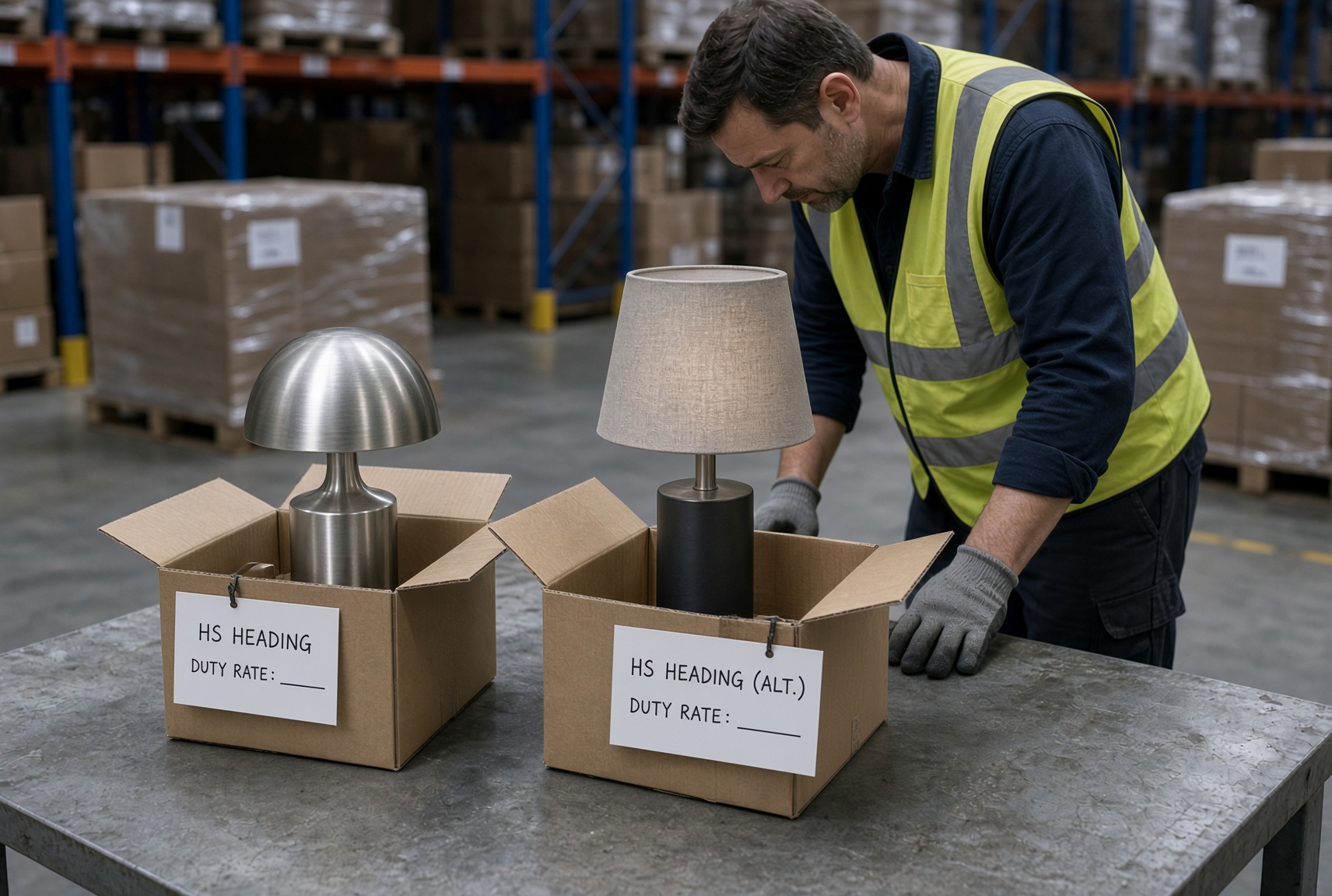
A real-life scenario: Two lamps are produced in the same carton style from the same factory. One is a household table lamp. The other is a light fixture that is not required to be used in the same way or constructed. On the product photo, they appear to be near each other. They might not be the same HS heading, and duty rates for Chinese imports can also vary significantly, as can change the budget. Classification is NOT an invoice detail. It is the first cost decision that is made.
Dutiable value: more than just the product price
Numerous countries have a CIF-type concept, or a near equivalent, as their underlying concept for the duty. These costs – product cost, international freight, and insurance – may be part of that base. Packing or some origin charges are also hauled in at some destinations. The test is the valuation rules of the destination country, and not how the supplier divided up the paperwork.
This is a mistake: assuming that the duties are always EXW or FOB only. If the local rule has a wider base, then not having freight on the model will underestimate duty. It is the changes in who pays the origin cost that are caused by Incoterms. They don’t automatically exclude all numbers.
Adding VAT, GST, or other import taxes
VAT/GST/live sales tax may be applied on top of the duty on imports rather than in place of it. A typical formula is: Tax will be charged on the dutiable value plus the duty. This is why the VAT GST on imports from China can significantly exceed the duty line on low duty consumer goods.
Work in layers:
- Product value then freight & insurance as required by rules.
- Duty on such value for duty.
- Tax on combined base (Destination tax): Tax is imposed on the combined base with the destination tax.
- Landed cost items not duty but also charged by the broker, terminal, and processing costs.
What Counts as Dutiable Value?
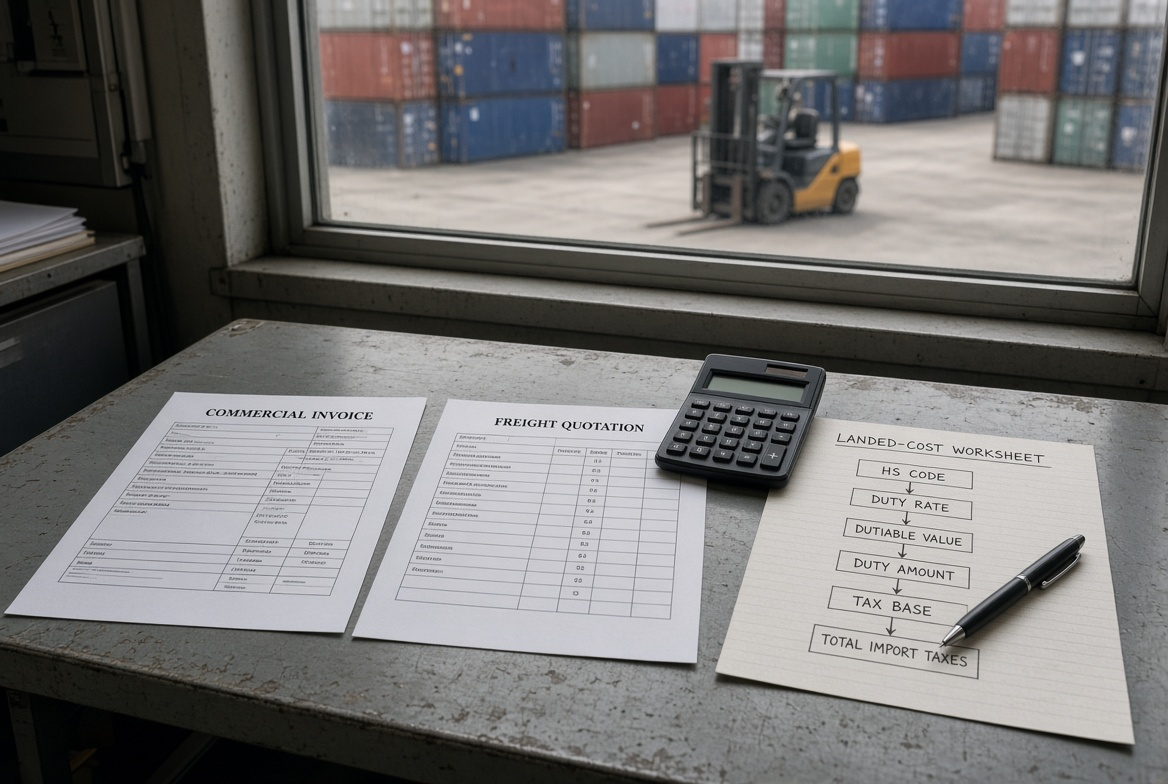
The figure customs uses for duty is not necessarily the amount which the buyer can see on one commercial invoice. Customs valuation question: which amounts are part of the imported goods under destination law? (dutiable value CIF). It is crucial to get that definition right – then all subsequent percentages will be based on the incorrect base.
Product value and currency
The usual starting point is usually transaction value (the price actually paid or payable for the goods). Do not use the currency from the invoice; use the currency from the invoice as determined by the rate of currency required by the destination authority for that invoice, and not at a rate you chose from a travel application.
Be aware of the paperwork pattern. The proforma bookings may differ from the commercial invoice. There are some suppliers who send one invoice for “goods” and another for “shipping” or “service”. Customs may still consider related payments to be part of the value of the goods. Update the valuation file if the price of the product changes after the cargo is booked. Do not use an old low figure on the declaration as a means of saving money. It’s a risk to delay and adjust.
Freight, insurance, and certain charges
In a system akin to CIF, in some cases international freight and cargo insurance may be included in the dutiable value. Depending on the rule set, packing, inland haulage to the load port or origin handling may be included. If you separate “goods” and “freight” onto separate PDFs, this is not sufficient to prevent freight from being in the base.
If you purchase EXW and make all arrangements to pick up and pay for the costs of warehouse handling and ocean or air freight, all such costs are still incurred. They will enter the duty base or not based on the destination valuation rule. Tap a budget as they may, and then verify with a local broker for that country. To consider origin logistics as “not part of the product” is the way that landed-cost models appear.
Assists, royalties, and related-party adjustments
However, some jurisdictions include assists, such as materials, tools, molds, or design material provided by the buyer, free or at a reduced cost. Additional revenues from royalties and license fees for the imported goods may also be included. If an invoice appears to be an arm’s length transaction, the related party pricing could be examined.
It’s not your ordinary purchase of a finished good from a factory that you don’t know. It applies when you send tooling to China, pay a brand royalty for each piece or purchase it from an affiliated company. Avoid guessing those adjustments based on a blog formula.
How HS Classification Drives the Duty Rate
With a fixed value base, the rate remains dependent on the heading. The code may be moved by small wording changes to a product description. This is why two “similar” SKUs from the same supplier may yield different duty results.
From product description to HS code
The first step in classification is to have a useful commercial description, such as what the item is, what it is made of, and what it does. However, the following items cannot be classified: “Mini excavator,” “LED strip,” and “textile tote.” Typically, they cannot be “gifts,” “samples” or “parts.” Brokers and customs officers operate based on the material, function and form, and then read the legal comments in the destination tariff.
Provide enough detail to those doing that work. The content of fibre in textile, the voltage and type of use in electrical goods, and whether a machine is entire or spare part, are all important. The label “short English name” is used by a supplier who has several names. It is not a classification memo.
When similar products have different rates
All the time all lookalike products split. The outer materials of textile bags can be classified as one textile bag. There may be another that can be described in terms of another essential quality. Lighting products can be divided in terms of type and use. Parts of machinery may be separated from the machine part heading to a separate “other parts” heading.
It is a common error to simply copy the supplier’s HS code, without verifying the destination tariff. The first six HS digits are in principle the same for Chinese export codes and codes for codes of importation from which countries. The national tails and legal notes are different. The export declaration is not an import ruling. Check the heading with the product and country of entry.
Binding rulings and classification risk
Some importers obtain a binding classification ruling in the destination country for high value or repeat SKUs. The purpose is to freeze the headings before volume increases, NOT to decorate a spreadsheet. See classification as a ‘question never to be finalized’. The heading might change as the product changes, for instance, from a new material, to a new function, to a kit versus a spare.
Beyond Duty: Other Import Taxes and Charges
You are on duty only in one line. Import taxes for goods from China may include VAT/GST and for some products there may be excise duties or special duties. Then there are the broker, terminal and processing fees, none of which can be found in a tariff schedule but which still bleed the bank account.
VAT, GST, and sales tax on imports
VAT, GST or sales tax is charged in many countries on goods being imported. Base is commonly dutyable value plus duty. That tax line can be the biggest tax line on the entry, when you have a low duty consumer shipment. Recovery or credit rules vary. Certain enterprises are allowed to reclaim input tax at a later stage. Others consider it as a border cash cost. Prior to pricing the SKU, be aware of the type of case you are looking at.
Excise, anti-dumping, and special duties
Some fuels, chemical or steel products and alcohol may be subject to excise duties or other trade remedies (anti-dumping and countervailing duties). Those levies are in addition to “ordinary” duty. A shock invoice occurs when a first shipment of a sensitive product is budgeted only on the basis of the standard heading rate.
When the product belongs to a category which is known for trade-remedy cases, obtain the broker’s opinion on the measures taken at that destination for that category and origin. A general duty table is not the whole picture.
Broker, terminal, and processing fees
Entry processing, customs brokerage fee, terminal handling fee, document fee and disbursements to carriers are not customs duties. They should still be included in landed cost. “Duty and tax” without those lines is not a complete quote. Have a breakdown of the fees, one column for government fees, the other for commercial service fees. The first column is based on the tariff and tax rules. The second column outlines the service coverage that you purchased.
A Practical Way to Estimate Duties and Taxes
The entry does not replace budgeting exercise to estimate customs duties and taxes. Utilize it to establish a range prior to confirming a selling price or a cash plan.
Start with a realistic HS code and rate range
Point to a probable title from the real product, not from a generic catalog title. Search the tariff for that heading, or get a broker to search it. If there are two possible headings, then both rates should be included in the model. A range is better than a single positive number.
Record the reasons for your choice of heading: material, function, form. This note will be useful if there is a change in the product or a packing list.
Build a simple landed-cost model
A small landed cost calculation for imports from China is:
- Use Invoice Product Value in invoice currency.
- Include international freight and insurance for destinations that include CIF or similar base.
- If the local valuation rule contains other origin charges, then only other origin charges should be included.
- Change to the currency used in the country, according to the method they use to do it.
- Work with the duty value indicated on the tariff on that dutiable value.
- If there is VAT or GST on value plus duty, then include the tax on the value plus the duty.
- Include an estimated amount for broker, terminal and processing fees on a separate line.
Use the output as a guide or planning number. Classification, valuation and exchange rates can change and the entry assessment can still move.
Stress-test your assumptions
Run the same model three ways: base case, higher freight, and a higher plausible duty rate. A higher duty rate will also raise the tax line if it is a duty on value plus duty. It’s the test’s purpose. If the budget is only rolling because of the very best of circumstances, there is no room for a classification question or a freight spike!
Have some wiggle room for documentation corrections and any unexpected local fees. The point is to understand which assumption would cause the margin to be violated and not to forecast the last unit of currency in the custom receipt.
Frequently Asked Questions
Are customs duties calculated on the product price only or including freight?
Not necessarily based on the price of the product. Many places have dutiable value similar to CIF, which may include international freight and insurance, and may even include some other origin charges. Inquire about valuation rule, rather than assuming EXW or FOB value is the base.
Why do two similar products from China have different duty rates?
The duty for each product is indicated by the HS heading, not the product photo. Material, function, and form may be listed as separate categories of look-alike items. The supplier export code does not necessarily equal the destination import code.
Is VAT or GST charged on top of duty?
Yes, in several markets. The dutiable value plus duty is the basis for calculating VAT or GST on imports. That tax may be higher than the duty, particularly in the case of low-duty consumer goods. Make sure to double-check the local base and if tax can be recovered later.
Can I use my supplier’s HS code for my import declaration?
You can use it as a starting reference. Don’t see it as a final. The actual import heading is determined by the destination tariff, national legal notes and by the actual product. Any SKU that comes up frequently or has a high dollar value should be classified locally.
What other charges should I budget for besides duty and import tax?
Brokerage fees, terminal or handling charges, entry processing, carrier disbursements, excise or special duties (for some products). Request a breakdown of government charges from commercial service fees.
How accurate are online duty calculators for imports from China?
If the HS code, value base and destination are accurate, they can be used for a first range. They are not able to take advantage of local fee schedules, valuation adjustments, and special duties with thin inputs. Estimate using a calculator, then check classification (and duty base) with a broker before considering the number a buying decision.