
International shipping documents are not an afterthought you staple on after the cartons leave the factory. They are the records that let a bank pay, let customs examine the goods, and let the carrier or destination agent release the cargo. For most imports from China, holds start when the invoice, packing list, and transport document describe different goods, values, or parties—not when the physical shipment is late.
A common assumption is that the supplier will handle every form. The supplier issues some of them. The carrier, chamber of commerce, insurer, inspection body, or your own side issues others. If you cannot name who produces each paper and what to check before cargo leaves China, you are guessing at payment and clearance.
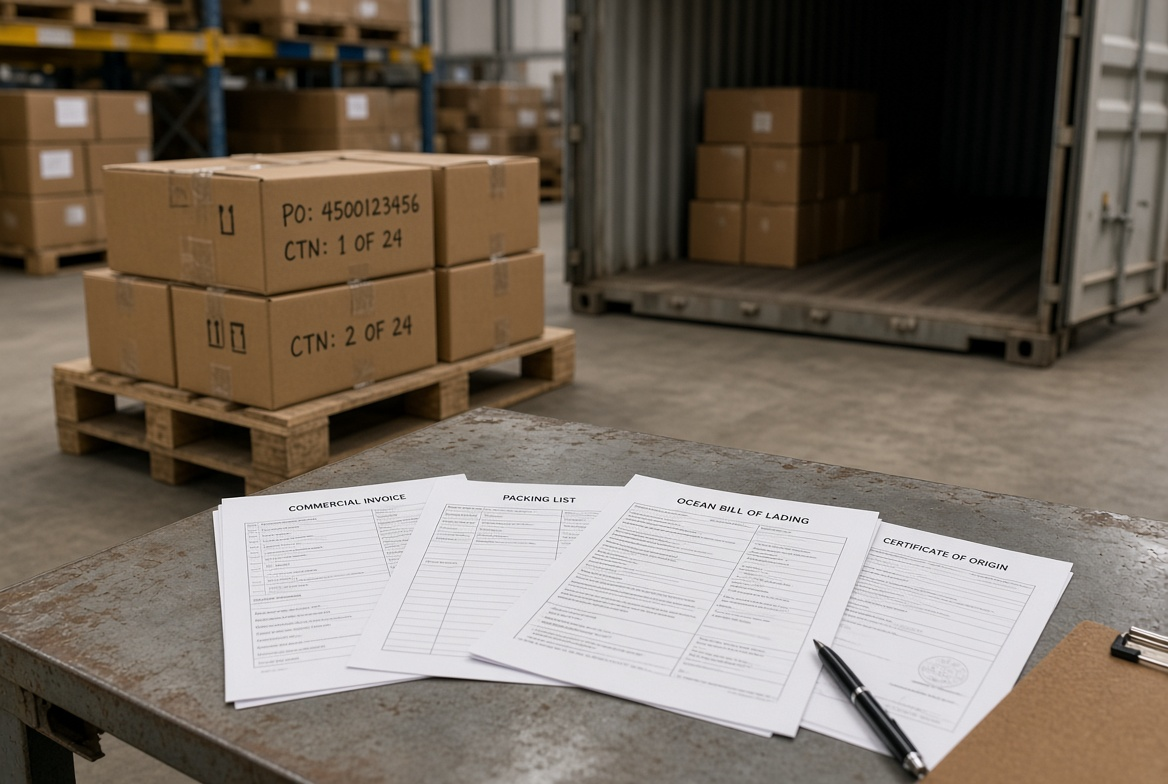
The Core International Shipping Documents for Most Imports from China
Most shipments from China run on a short set of papers, not a unique form for every carton. Those papers fall into three buckets: commercial documents that describe the sale, transport documents that describe the carriage and often control release, and customs or clearance documents that destination authorities use to classify and assess the goods. The set changes when a product needs a license, a test report, or a preference claim. The consistency rule does not change. Names, addresses, commodity wording, quantities, weights, and values should read as one shipment across the file.
If one document says “LED desk lamps, 500 cartons, USD 12,000” and another says “lighting parts, 480 cartons, USD 9,800,” the cargo can still be sitting in the same container. Customs, the bank, or the destination agent will treat that file as two different stories. That is how key documents for importing from China fail in practice: not because a form is missing from a textbook list, but because the forms that exist do not agree.
Commercial invoice and packing list
The commercial invoice is the seller’s bill for the goods. It should identify the seller and buyer, describe the commodity in plain commercial language, show quantity, unit price, total value, currency, and the Incoterm that splits cost and risk. Destination customs uses it to classify the goods and calculate duty and tax. A bank uses it to check that the amount claimed matches the payment terms.
The packing list is the physical map of the same shipment. It shows how many pieces or cartons were packed, net and gross weight, dimensions where required, and the marks printed on the cartons. It does not replace the invoice. It tells the warehouse, the surveyor, and customs how the goods were actually built into packages.
A typical hold looks like this. The invoice lists 1,200 units in 60 cartons. The packing list shows 58 cartons and a different gross weight. Destination customs asks which figure is true. Until the supplier issues a corrected pair that matches the goods on the dock, the file sits. The commercial invoice and packing list for customs have to describe one packing event, not two versions of the order.
Check the draft invoice and packing list before the carrier issues the bill of lading or airway bill. Once the transport document is cut from the wrong commercial data, you are correcting three papers instead of two.
Bill of lading or airway bill
Ocean shipments move under a bill of lading. Air shipments move under an airway bill. Both are contracts of carriage. An original ocean bill of lading is also, in many trades, a document of title: the party that can present it (or obtain a valid release against it) is the party that can take the cargo. An airway bill is usually not a title document in the same way. Cargo is released against the air waybill details and the destination agent’s process, not against a set of negotiable originals.
The practical comparison of bill of lading vs airway bill is less about the printed heading and more about control. On ocean freight, the type of bill and the release method decide whether destination can pick up the container after customs clearance. On air freight, the airway bill number and the consignee details decide who the airline or handling agent will recognize.
The frequent error is inconsistent parties and commodity wording. The invoice names ABC Trading LLC as buyer. The bill of lading names ABC Trade Ltd as consignee. The packing list uses a third spelling. A bank reading an LC file will treat those as discrepancies. A destination agent may refuse to release until the names are aligned. Commodity descriptions do not need to be identical word for word in every trade, but they cannot describe different products.
Ask for a draft bill of lading or airway bill while the cargo is still at origin. Correct shipper, consignee, notify party, marks, piece count, and description before the document is finalized.
Certificates of origin and other basic certificates
A certificate of origin states where the goods were produced or obtained. Buyers request it for their own compliance file. Banks request it when the credit or collection instruction says so. Customs may request it when a preferential duty rate depends on origin, or when the destination simply requires proof of origin for that product.
Not every shipment from China needs a certificate of origin for imports. A general certificate is different from a preferential certificate used to claim a lower duty rate under a trade arrangement. The form, the issuing body, and the wording all have to match the claim you intend to make. A generic “Made in China” line on the invoice is not the same document.
Inspection certificates and simple manufacturer declarations sit in the same “basic certificate” group. A buyer may want a factory declaration of conformity. A destination may want a pre-shipment inspection report. Those papers only help if they describe the same goods, quantities, and values as the invoice and packing list.
Confirm origin and inspection needs before production finishes. A certificate issued after the vessel has sailed can still be sent, but a preference claim or a bank presentation often has a deadline that does not wait for a reprint.
Payment-Related Documents: LC, DP, and Bank Requirements
Payment terms decide how strict the document file must be. Open account still needs a clean invoice and transport document so the buyer can clear and take delivery. Letters of credit and documentary collections add a second reader: the bank. The bank is not checking whether the goods are good. It is checking whether the documents match the instruction it was given.
Share the payment method with the supplier and the forwarder before anyone issues papers. An invoice written for a casual commercial sale is not always acceptable under an LC. Changing wording after the bill of lading is issued costs time and often a courier of originals.
Letters of credit and strict document compliance
Under a letter of credit, the bank pays against documents, not against a factory photo or a tracking update. LC shipping documents requirements are usually listed in the credit: commercial invoice, packing list, full set of original bills of lading or an airway bill, certificate of origin, insurance document if required, and any inspection or quality paper named in the credit.
Banks read those papers tightly. A typo in the beneficiary name, a missing endorsement on a bill of lading, a weight that does not match the packing list, or a description that is close but not the same can be treated as a discrepancy. Discrepancies do not always kill the deal. They give the issuing bank and the applicant a reason to delay or refuse payment until someone accepts the difference.
Treat LC documents as the product the bank is buying. Draft the invoice, packing list, and transport document against the credit text, not against the supplier’s usual template. If the credit asks for “wireless Bluetooth headphones” and the invoice says “audio accessories,” fix the invoice before the carrier prints the bill.
Documentary collections (DP/DA)
Documentary collections release the documents against payment (documents against payment) or against the buyer’s acceptance of a draft (documents against acceptance). The bank is still moving the documents. It is not examining them with the same rigid checklist as an LC, but sloppy papers still stall the handoff.
The risk is assuming DP or DA is “looser,” then allowing a consignee name that the buyer’s bank will not recognize, or a bill of lading that cannot be endorsed. The buyer cannot pay or accept what they cannot use to collect the cargo. A clean, consistent set still matters.
If originals must travel through the bank, plan the courier path. Cargo can arrive while the bill of lading is still in the mail. That is a storage bill, not a documentation theory problem.
Common bank-driven document requests
Banks add wording that is not on a standard factory invoice. They may want the invoice to mention the LC number, a specific origin statement, or a signed declaration. They may want the certificate of origin legalized or issued by a named body. They may want an insurance certificate showing a minimum insured value and named voyage.
None of that is visible to the supplier unless you send it. Forward the bank’s document list, in writing, before the commercial invoice is finalized. Ask the supplier to confirm they can issue each paper in the form requested. If they cannot—because a chamber will not use that wording, or an insurer will not name that voyage—change the instruction or change the document plan before cargo is booked.
Transport and Cargo Control Documents
Commercial papers describe the sale. Transport papers describe who is carrying the cargo and who is allowed to take it. You can have a perfect invoice and still fail at destination if the bill of lading type, the release method, or the delivery order is wrong.
Bill of lading types and release methods
An original negotiable bill of lading is issued in a set, commonly three originals. Cargo at destination is usually released when the required originals are surrendered, correctly endorsed if the bill is made out to order. If the buyer or the bank is waiting on those originals, the container can sit after discharge even when customs is ready.
A telex release (or express release, depending on the carrier’s wording) means the origin agent or carrier instructs destination that originals need not be surrendered. That only works when the issued bill allows it and all parties agree. A sea waybill names the consignee and is not meant to be a negotiable title document. Release follows the waybill consignee and the carrier’s destination process.
Choosing the wrong type delays cargo that has already arrived. An original bill sitting with a bank, or on a desk in China, will not open a container in Los Angeles or Rotterdam. Decide the release method when you book, not when the vessel is three days from port. Confirm who holds originals, who can authorize a telex release, and whether the consignee name on the bill is the party that will actually collect.
Delivery orders and cargo release at destination
Customs clearance and cargo release are not the same event. Clearance is the authority’s decision on the goods. Release is the terminal or carrier allowing the trucker or agent to take the container or freight.
At destination, a delivery order or release instruction is often the paper the trucker needs. It may be issued after the bill of lading is accomplished, charges are settled, and the carrier or destination agent updates the terminal. A shipment can be “cleared” on a tracking page and still be undeliverable because the delivery order was not issued, the pin or release number was not shared, or destination charges were unpaid.
Ask who issues the delivery order on your lane, and what must be complete before they will issue it. If your forwarder or agent is coordinating door delivery, that handoff should be in the service scope, not assumed.
Insurance certificates and risk coverage
Cargo insurance is a separate contract from freight. The certificate or policy copy shows what is insured, for how much, on which voyage, and under which conditions. Banks ask for it when the credit requires insurance. Buyers ask for it when they are responsible for the goods at a point where damage would fall on them.
Under the Incoterm, one party arranges insurance. Confirm who that is before sailing. If the buyer must insure, a supplier’s factory invoice will not create cover. If the seller must insure and present a certificate under an LC, the certificate has to match the credit: insured value, route, cargo description, and named documents.
Read the basic fields. Insured value should relate to the invoice value in the way the parties agreed. The route should match the actual booking. The cargo description should be recognizable as the same goods. A certificate for “general merchandise” against an invoice for a specific machine is a discrepancy waiting for a claim or a bank.

Product-Specific and Compliance Documents
The core set moves general consumer cargo. Batteries, food-contact items, toys, chemicals, machinery, and some electronics pick up extra papers. Those papers are not optional decoration. If the destination will not admit the product without them, the shipment should not leave China.
Inspection certificates and pre-shipment checks
Some buyers write a third-party inspection into the purchase contract. Some destinations require a pre-shipment inspection certificate for named products or value thresholds. The inspection report should identify the same SKUs, quantities, and packing as the commercial invoice and packing list.
A report that inspects “sample units from line A” while the invoice ships a different SKU does not protect you. Schedule inspection against the actual export lot. If the inspector finds a short pack or a wrong label, correct the goods and the documents together. Do not let the cargo sail on the original invoice while the inspection file describes a different count.
Safety, quality, and product compliance documents
Test reports, declarations of conformity, and safety certificates support market access and, in some cases, customs release. Electronics, toys, children’s products, and food-contact goods are the usual examples. The exact certificate depends on the destination and the product. That list changes, so treat this as a planning question, not a fixed global form.
The operational failure is shipping first and asking “what certificate do we need?” after the vessel has cut-off. Testing and certificate issuance take calendar time. If the supplier has an existing report, check that it covers the exact model and the destination’s current requirement. A report for last year’s model, or for a different voltage, is not a spare document you can reuse without reading it.
Licenses, permits, and controlled goods
Some chemicals, dual-use items, restricted technologies, and other controlled goods need an export license from China, an import permit at destination, or both. Those are deal-breakers. No license, no lawful shipment.
Raise the product classification early: what it is, what it contains, what it is used for, and whether it is subject to export control or destination restriction. A freight team can book space. It cannot invent a missing permit after the factory has packed. If a license is required, put the application on the critical path next to production, not next to the sailing date.
A Practical Document Checklist for Importers
Use this importer shipping documents checklist with the supplier and the forwarder. It is a working list, not a promise that every destination uses the same forms. The point is to catch missing or inconsistent papers while the cargo is still in China, and again before destination clearance starts.
Before cargo leaves China
- Commercial invoice: seller, buyer, commodity, quantity, value, currency, Incoterm, and any bank-required wording.
- Packing list: carton or piece count, net and gross weight, dimensions if used, and carton marks that will appear on the transport document.
- Draft bill of lading or airway bill: shipper, consignee, notify party, description, piece count, weight, and release method.
- Certificate of origin, if the buyer, bank, or duty claim needs it, issued by the body the destination or credit expects.
- Insurance certificate or policy copy, if the Incoterm or the bank puts that on the buyer’s or seller’s side.
- Inspection reports, test reports, conformity declarations, licenses, or permits that the product or destination actually requires.
- A line-by-line match across those papers: names, addresses, product wording, quantities, weights, and values.
Do not treat “the supplier already shipped last month on similar papers” as clearance. Last month’s SKU, value, or consignee may not be this booking.
Before clearance at destination
- Confirm the final bill of lading or airway bill against the arrived cargo, not only against the booking draft.
- Recheck that invoice, packing list, and transport document still tell one story after any origin correction.
- Confirm who holds originals and who holds electronic copies. Customs may accept scans. Cargo release may still need an accomplished bill or a telex release.
- Ask whether the destination needs extra local forms, a packing declaration, or a product certificate that was not part of the China export file.
- Confirm destination charges, delivery order, and the party named to collect, so clearance and physical pickup are not waiting on two different desks.
Common document errors in international trade cluster here: a corrected invoice that never reached the destination broker, an original bill still in China, or a certificate of origin that does not support the duty rate the buyer expected.
Frequently Asked Questions
What are the most important international shipping documents for importers?
For a typical commercial shipment from China, start with the commercial invoice, packing list, and the bill of lading or airway bill. Add a certificate of origin when the buyer, the bank, or a duty claim requires it. Add insurance papers when the Incoterm or the payment instruction says so. Add inspection, test, license, or permit documents when the product or the destination requires them. Those are the papers that control payment, clearance, and release.
What is the difference between a commercial invoice and a proforma invoice?
A proforma invoice is a quotation in invoice form. It can support a sample shipment, a bank application, or an import license request. It is not the final commercial invoice for the shipped goods. The commercial invoice should reflect what was actually exported: final quantity, value, and terms. Filing a proforma as if it were the export invoice creates a mismatch with the packing list and the transport document.
Why must the bill of lading match the invoice and packing list exactly?
The bill of lading or airway bill is how the carrier describes the same shipment the seller invoiced and packed. Banks compare those descriptions under an LC. Customs compares quantity and commodity. Destination agents compare piece count and consignee. Small differences in names or weights become questions. Large differences look like two shipments. Align the draft transport document with the commercial papers before it is issued.
When do I need a certificate of origin for imports from China?
You need one when the buyer’s contract, the bank’s instruction, or the destination’s import rule asks for it, and when you intend to claim a preferential duty rate that depends on origin. Confirm the type of certificate and the issuing body early. A general origin statement on the invoice is not always enough for a preference claim or a bank presentation.
What documents do banks check under a letter of credit?
They check the documents named in the credit, usually the commercial invoice, packing list, transport document, and any required certificate of origin, insurance document, or inspection paper. They compare those papers with the credit text and with each other. Payment depends on that comparison, not on whether the cargo has already arrived.
Can I clear customs without original documents?
Often destination customs will work from electronic copies of the invoice, packing list, and transport document. Cargo release is a separate step. An ocean shipment under original bills of lading usually still needs those originals surrendered, or a valid telex or express release, before the terminal will let the container go. Clearing the entry without being able to collect the cargo is how shipments sit after “customs released” appears on a tracking page.