
The decision on how to send electronics from China is made before a booking of a container or flight is made. The most frequent reasons for rejection and damage are the pack, the battery classification, and the mode selected. To assign all devices a generic classification of ‘general cargo’ is the bad practice that can be rejected for an air booking if a lithium cell is placed in or packed with the device.
This article is a selection method. Verify device type, battery type and location, and carton information before. Then pack and label in accordance with the instructions. Comprehend and compare LCL, FCL, Air, Express on Total landed cost and not just on origin freight. Customs and delivery are at the bottom since even if a shipment is booked, it will be halted due to a missing filing or a commercial invoice that is too ambiguous.
Define the Electronics Before You Pack or Book
A usable brief is not a sales pitch. Record the product name (as it would be on an invoice), the type of device, if it has a battery and how that battery is positioned in the carton. Include the watt-hour rating or lithium content if it is a lithium cell or pack. Include carton length, width, height and gross weight. Enter all the cities in China where the goods are picked up along with the Incoterm. One CBM, FOB Shenzhen” is not a brief. It’s a "guess" which ends up as a rejected booking or a damaged screen.
Pickup location is significant as factories in Shenzhen, Dongguan, Yiwu, Ningbo, or inland cities do not provide loading and unloading the same way. A portion of lots are transferred directly to a terminal. Some require a picking operation against the packing list, and a second inspection for battery marks prior to requesting space.
Device type and battery classification
Carriers and airlines do not have a marketing term for “headphones” or “power banks”. They are classified according to battery chemistry and battery location. Not all batteries are alike: lithium-ion batteries, lithium-metal, nickel metal hydride and no battery are not the same goods. Placement is also specific, as it is in the equipment, or packed with the equipment, or shipped as a standalone battery.
That split covers UN38.3, SDS & battery classification, Class 9 treatment (where applicable) and the IATA packing instructions (PI965-PI970) for lithium batteries (commonly referred to as the lithium battery packing instructions). A small cell doesn’t exempt the shipment. The danger here is mistaking a “small battery” for general cargo since no one requested the test summary or the watt-hour number. If the supplier is unable to provide those details, it is not yet clear if air is available.
Carton sizes, weight, and fragility
Typically LCL is rated by volume, but if the cartons are dense, then the weight may be a factor and may still determine the charge. The level of stuffing required in those same cartons in a 20ft or 40ft container is the key to the FCL rate. There are two numbers followed by Fragility. Even if the out carton appears ready for export, a glass screen, camera module, and thin housing requires internal protection.
Avoid using the words “about one cubic meter” or “standard carton”. Take measurement of sample carton, verify the number of pieces that fit in that carton and take a picture of the inside pack. Though several suppliers sent mixed sizes of cartons, they will not cube as a factory drawing had indicated. If an estimate only is given, the initial measurement taken at the first warehouse will replace the freight conversation.
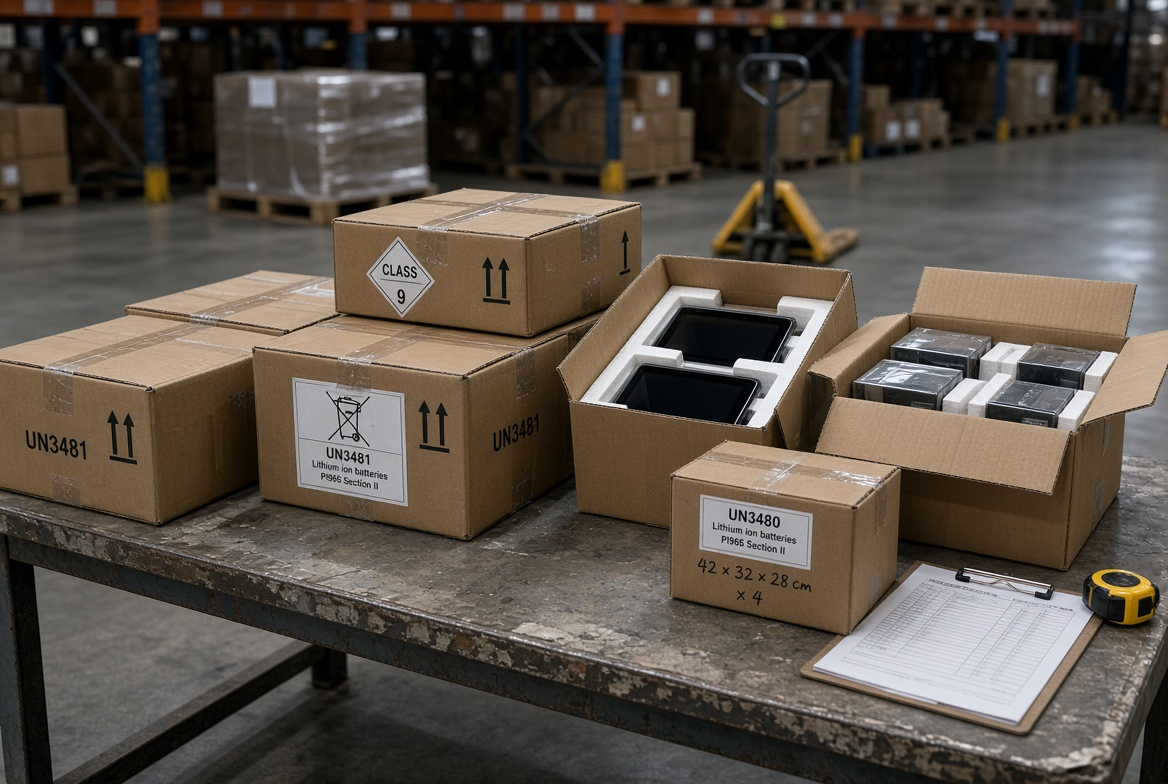
Packaging and Protection for Electronics
Right packing serves two purposes. It protects the screens, corners and connectors from damage during stacking and handling and is the same mark that the carrier will look for on battery cargo. There is no specification for “carton-standard export”. The Board grade, Inner protection, Moisture control, and Battery separation are.
Carton design and internal protection
Do not use a carton if the height of the stack is the same as the factory height for domestic delivery, use the height you intend to stack. Double wall board is used when the cartons are to be placed in an LCL stack or a full container for a prolonged ocean transit. A few pieces of loose fill do not offer as much protection as foam inserts, molded pulp, or fitted dividers to protect screens and corners. Anti-static wrapping should be applied to boards and exposed components susceptible to damage from static. A moisture barrier bag or desiccant helps to prevent moisture if the cartons are to be stored in a humid warehouse or a container that will sweat.
Common problems can easily be identified in a warehouse image. This is a single carton that can be bent by three layers. A screen that is fitted on the outside wall without a corner guard. Accompanying sound of rattling accessories in the same space as a glass panel. Don’t think that the outer print looks professional because the inner pack cannot survive a drop from a pallet height.
Battery packing and marking
Standalone batteries, with devices installed in batteries, or batteries containing devices are packed separately. Isolation, inner protection against short circuit and taping-marks are usually required for standalone lithium batteries. Even those devices that are powered by batteries must have proper handling marks and packing that prevents the power button from being pressed during transit. Batteries of equipment require battery and device controlled in same outer pack to prevent shifting of batteries to other batteries.
Never combine dangerous-goods cartons with non-DG cartons on a pallet without counting, photographing and matching what is in the carton with what is on the floor. A Class 9 mark, which indicates the airline or ocean carrier failed to inform its warehouse about “something which they simply combined for LCL”, is revealed in a general-cargo booking.
Battery Rules and Airline Acceptance
Battery rules are based on Type, Location, Watt Hour, or Lithium Content. This is not a legal opinion but a plan of how things will work. The destination and the carrier will need to be checked against the actual cells in the carton.
UN38.3, SDS, and classification basics
UN38.3 is the most widely expected test to be documented for lithium batteries, both by airlines and by many ocean bookings. Do not accept a verbal ‘it passed’ from the test. Ensure that the report is the same as the cell/pack model listed on the invoice. A frequent cause of a booking stopping is an old report for an earlier version of the cell. The SDS is used for classification and emergency information. Classification then determines if the lot is shipped as installed cells, batteries packed with cells, Class 9 labels and additional handling are required.
The problem is, book first, hunt documents later. Often air is not available on the day of space request when UN38.3 or the SDS is not present, and sea still requires a new description.
Air freight vs sea for battery shipments
The rules and regulations on configuration, state of charge, packing instructions and airline approval will be tighter with air. A number of lithium batteries and some watt-hour ranges are prohibited on passenger aircraft and/or limited on cargo aircraft or are not accepted by a specific airline even if the paper file is complete. For the eligible battery cargo, the Sea has more flexibility for the longer move, but a different set of marks and stowage rules.
Please do NOT ask for a pack-out, as the sales calendar is packed and find out that the airline refuses to accept the pack-out. Verify the correct type and location of the battery before any one pays for pickup. When importing goods that contain electronics and batteries, importers should evaluate classification, packing, and carrier approval before committing to a mode when ordering shipments from China.
Freight Choice: LCL, FCL, Air, and Express When You Ship Electronics from China
LCL, FCL, air and express are not three prices for the same job, but rather different cost structures. Why is it that sometimes the LCL looks lighter at the origin? The amount of work involved with destination work is more intensive: deconsolidation, additional handling, increased locations for a test or storage day. FCL is a full-length container that you can use all by yourself. This is useful when the container is full of cartons and you want to have one seal, one count and less touching. On freight, air and express are more expensive, and apply stricter battery rules. They are suitable for the urgent or high-value small lots, not the low-value bulky cartons.
Evaluate total landed costs. Origin freight = one line. Other lines have destination charges, potential storage, customs processing and delivery dates. Your cheap quote from LCL origin to the exclusion of those lines is not cheap. It is incomplete.
Destination charges and delays for LCL
The cost of LCL is not an after-thought destination fee. The job of breaking the consolidation, making cargo available and moving it out of the CFS. Be prepared for deconsolidation and handling fees, potential customs exam risk, ISF timing on U.S. ocean imports, a bond decision, a delivery appointment and storage should documents and trucks be late. Vague descriptions of electronics cartons also generate more questions that don’t match when the battery mark doesn’t match.
The problem is that people assume the forwarder is responsible for “hidden fees” that did not even show up in the origin quote – as no one thought to ask what happens after the container has been delivered. Before comparing LCL and FCL, ask about what is included at the destination.
When air or express makes sense
Air or express is appropriate for samples, launch units, replacement boards and a small, high dollar lot which cannot be delayed for ocean. It does not make sense for large high value accessories that will occupy a pallet and do not have an urgency to battery. If the air is charged, light but large cartons will be penalized. Rates may appear enticing, but they can still be thwarted by battery rules.
Use air where appropriate for calendar and cargo. Use sea when devices are packed, classified, and are able to wait for a container plan. After measurement and unitization, compare the ocean freight from China (FCL or LCL) prices with the destination work that you need (port-to-port or door).
Customs, ISF, and Delivery for Electronics Imports
It is still necessary to submit a customs entry that corresponds to the goods to import electronics from China. ISF is added to ocean shipments to the United States. The “cleared” step does not necessarily imply delivery. Maintain consistence between the commercial invoice and packing list, battery documents and entry.
ISF, bond, and entry for LCL and FCL
ISF is not filed when the container is already on the water, it is filed prior to loading the vessel. Late filing is a penalty/ delay and not of the pack’s quality. There has to be a continuous bond or a single entry bond. The concept of deconsolidation and clearance is intertwined on LCL: cargo may not be available for exam or clearance on the same clock as an FCL box in a terminal.
Please do not take for granted that the supplier will complete an ISF or have ISF holder/importer-of-record. Prior to the first carton departing the warehouse, name the person who files, the person who is the importer, and which bond is being used.
Air customs and last-mile delivery
Exams DO take place, even though not as fast as air entry. Address on the air waybill must be an address where the goods are to be received. After customs has released cargo, a residential door, a closed warehouse or missing delivery appointment will sit cargo. Document checks can be performed at the airport on top of the airline’s check, even if the booking was made.
Documents and routing can only work together if export & destination customs clearance is planned based on the same invoice, packing list and classification according to origin.
A Practical Checklist Before You Book
Don’t leave it to a one-line order – send a file that a coordinator can use, not a one-line order for “electronics, one container.”
- Specific device listing, Battery chemistry, placement and Watt hours or lithium content.
- Carton sizes and weights, inside carton photos, and packaging for shipments of electronics already used or required.
- Test Summary and SDS Status for each lithium cell/pack model.
- Land cost comparison with LCL, FCL & Air/Express vs. work not freight only to the destination.
- Importer, Incoterm, ISF/air entry plan and delivery address for goods.
In the first email, the photos, the packing list and the Incoterm should be included. Does not mean “cheapest rate”.
Sample scenarios
When classification and marks are complete and the calendar is not a priority, consumer electronics are frequently shipped sea FCL in uniform cartons that occupy the space in a container. Standalone Lithium batteries that are shipped out as a small urgent shipment will also be a different type of packing: they may require airline acceptance only after DG review and packing instructions—or sea may be the only option available. For a few samples and scheduled date, samples and replacement boards are good candidates for express or air shipping. These three lots should not have the same booking template.
Mistakes that send electronics to the wrong mode or packing
- Only comparing origin freight line and disregarding destination charges.
- Not taking into account the state of the batteries and treating them as general cargo.
- Not using report when reporting UN38.3 or reporting a cell that is not the current cell.
- None of the ISF plans for an LCL and/or FCL shipment from the United States.
- Air, for low-value, bulk cartons which sea can move for a lower overall cost.
- Combining cartons, which are marked, photographed and have matching documents, with non-DG cartons.
Frequently Asked Questions
Do I need UN38.3 for electronics with installed batteries?
Normally yes if the cells are lithium and the carrier/airline is asking for the test summary for that specific configuration. Installed batteries can’t be a walk in the park. Request the report corresponding to the exact cell/pack model of the device. If the supplier does not provide a statement and there is not a test summary, consider the file to be incomplete until it is verified against the mode desired.
Can I ship standalone lithium batteries by air from China?
Sometimes in the event of confirmation after classification, packing, documentation and acceptance by the airline. Airline restrictions are generally on standalone batteries. Don’t think that a booking for an aircraft carrying cargo will be granted just because a cargo-aircraft shipment with batteries flew successfully. Please verify packing instructions prior to pick up and the current airline policy for that watt-hour range.
Is LCL or FCL better for electronics from China?
There is no right or wrong answer. If you are willing to sacrifice destination deconsolidation and additional handling, LCL is the option for smaller volumes. FCL fits when your shipment consists of cartons to fill a container and you need to minimize handling of fragile or valuable devices. Do not accept measured CBM, stack strength, battery marks or destination charges – except for a habit of “we always use LCL.”
What documents are needed for electronics imports?
At least: Commercial invoice and packing list with correct name of the devices, battery documents (when batteries are involved – UN38.3 summary and SDS – as applicable), export declaration materials at origin and destination entry file. The United States also requires ISF and a bond decision for Ocean. Exams are formed when there is some sort of ambiguous wording like “accessories” or “parts”.
Do I need ISF for an electronics container by ocean?
What is the importance of ISF on an electronic container shipped over the sea?
ISF applies to the importer’s filing responsibility regardless of whether the box is FCL or the cargo is carried LCL if the destination is the United States, or the move is ocean. File before loading. Please do not wait for arrival.
What details does a forwarder need to quote electronics shipping?
Type of the device, Battery type and placement, Watt-hour or lithium content, sizes and weights of the cartons, photos of the interior packing, presence of UN38.3 or SDS, presence of pickup cities, Incoterm, destination, port or door delivery. It’s that file that makes LCL/FCL/air/express similar.
Share electronics information for a shipping assessment if already available, such as device and battery data, volume, origin and destination.