
The high-dollar errors typically begin on the warehouse floor, not on the ocean rate, when importing and shipping auto parts from China. Just a few of the mixed SKUs from multiple factories, the cartons that crush when they are stacked on the rotors, the undeclared batteries or fluids, and an LCL booking that doesn’t consider destination charges will take the bite out of a “cheap” quote faster than any bunker surcharge. Mode still matters. The mode is determined by carton size, weight, stackability and hazardous nature.
Use as selection method. Consolidation and packing first. LCL, FCL or air second (according to the total landed cost, not origin line). Customs, ISF (if applicable) and delivery third. If the handling, exams and damaged parts are added to the cost, the low origin LCL rate will be more expensive per unit than a well loaded container.
Define the Auto Parts Before You Consolidate
Please do not request to book “auto parts, about one CBM, standard carton”. From that sentence no coordinator can plan stowage, DG acceptance or LCL versus FCL. First, write a physical brief: carton size, gross weight per carton, can be stacked, fragility, hazardous, Incoterm, and all pickup cities in China.
Parts like engines, transmissions, boxes, rotors, wheels, lamps, mirrors and other boxed accessories do not act in the same way in a box. Heavy metal is low, and consumes payload. If the carton on the left side of lights or body trim is overloaded, then they fail. Before talking about CBM, fluids and Li-Batteries change it.
Carton sizes, weight, and stackability
Packaging sizes, weight and stacking capability.
There is a job for each number. LCL is typically charged per volume, and still has a weight limit if the load is heavy. FCL cost is a container rate and whether or not it is a cheap or expensive "per unit landed" is determined by the utilization. The height the warehouse can reach to stack their pallets and the amount of crushing force on the bottom pallet during the ocean leg is determined by stackability.
Measure the length, width and height of the export carton (not the inner retail box). Note down gross weight, NOT “about 20 kilos.” Indicate if carton is rated to accept a second layer. A stack of rotors on a single-wall carton of filters is a claim that needs photos. Standard carton is NOT a measure. If two different suppliers are sending the same SKU in different carton sizes, consider them two separate cargo types until they can be repacked.
Hazardous items and special handling
Batteries, brake fluid, aerosol cans, airbags and certain adhesives are not standard items that are normally ordered when you book a car. They require proper classification, acceptable inner and outer packaging, marks and labels and carrier acceptance. That status is not revealed until the load has been booked into the warehouse, which is why it is rejected, delayed or rolled.
Include statement stating SKU must be shipped in case it has a lithium cell, a pressurized can, or liquid ingredients which may leak in shared container on first packing list. It is easier to accept air and express than ocean. There is still a place for Oceans to be declared. Never put an undeclared DG carton into a general load of auto parts in LCL and expect the CFS to not notice. The rejection is made at the origin and the remainder of the shipment remains with it.
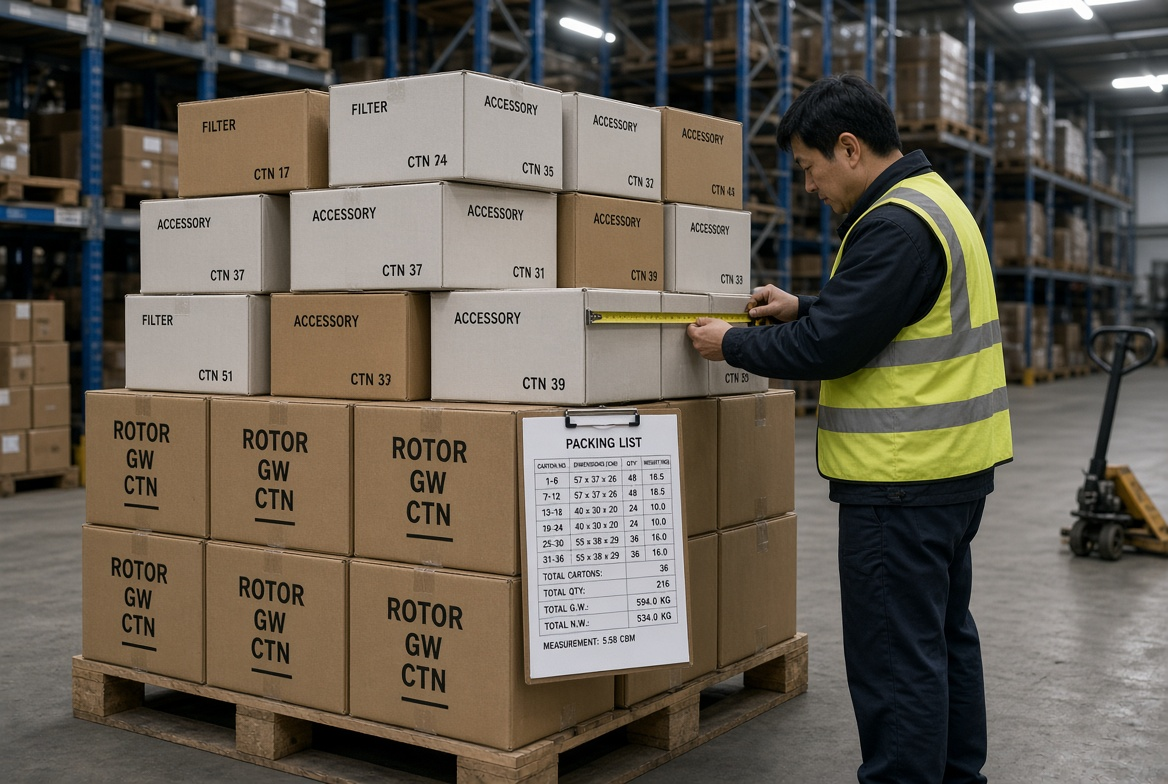
Consolidation Strategy for Multi-Supplier Auto Parts
China does not do “put everything on one truck” auto parts consolidation. It is being loaded from more than one supplier with one origin warehouse, checking count and damage, repacking where cartons cannot be loaded as received and loading in a planned sequence. That process is suitable for mixed SKUs, and it is suitable for factories located in different cities and volumes that are not able to fill up a container entirely.
If one party has already packed a container for one consignee, this party is not required to have the same warehouse step. A purchaser from Guangzhou picks up lamps, Wenzhou for filters and Qingdao for rotors does. If there is no receiving point, you take all the fault of the carton quality and loading habit of every factory.
Origin warehouse process
Normal flow: factory pick-up, delivery to the origin warehouse, picking against the packing list, storage for a short while, consolidation and labelling, customs clearance in the origin country, international leg, short-term storage to be deconsolidated in the destination country for LCL, customs clearance in the destination country, and delivery. But that’s not necessarily a door-to-door sequence. Many quotes only end at the origin CFS or end at the terminal. Read the scope before thinking that the last mile will be covered.
Mixed SKU problems occur when you receive. This should prevent short cartons, no export strength cartons and parts packed in retail boxes at source. If the warehouse is merely a transit floor without check, you are consolidating the other person’s errors.
Cost factors for consolidated auto parts
Enhanced price of shipping components for cars from China is not just a single ocean line, but a stack. Origin charges are for pickup, warehouse receiving, storage, export documents and loading. Ocean freight is based on the CBM, LCL or per container, FCL. The destination charge includes deconsolidation, terminal handling, customs, if applicable, exams, and delivery. If buyers only compare the origin freight line, they will find the rest upon arrival of the vessel.
To receive and check the goods and to load them in a planned sequence for export, importers who import auto parts from two or more factories often require warehousing and consolidation in China. The Warehouse fee is clearly displayed. The not-claimed claim is not.
Packing and Protection for Auto Parts Shipments
Packing for auto parts shipping has two tasks: ensuring the part is not damaged and ensuring the carton is not damaged. The word "standard" on a quote does not mean "specification. Indicate carton grade, inner protection and loading method.
Carton design and internal protection
Large and fragile items like rotors and hubs still require a carton that will resist stacking. Double-wall board is frequently used when the carton is going to be placed under other cargo. Inner protection at edges and corners on fragile parts – Lamps, Mirrors, Sensors, Trims – requires foam, molded pulp or wrap to prevent the part from walking away from the edge of the box. If the glass is in contact with the wall, then even if there is no pad inside the carton, it fails.
Never use the same single wall carton for shipping a lamp to the domestic market. Never leave liquid in a carton that has no absorbent and no seal on the carton. Avoid placing sharp metal against a neighbor’s carton wall. If the carton is not strong enough for the desired height, either substitute the carton or substitute the stack. Unfortunately, there is no third alternative that will last with a CFS forklift.
Palletization and loading plan
Heavy parts go low. High fragile cartons. To sequence the load by SKU and, if delivery is split, drop point. Mixed SKUs loaded in random order presents 2 issues: 1) crush damage on the way in; 2) the destination floor can’t locate the first SKU without the stack being split.
Pallets are useful for consistency in carton size and when pallets can be delivered. If all cartons are not the same size and the load will be restacked at a CFS, then they waste cube. Put the loading plan in place before the arrival of the truck. A photo of a ‘full’ container with rotors on top of lamp cartons does not constitute a loading plan. This is the beginning of a damage file.
Freight Choice: LCL, FCL, and Air for Auto Parts
Ship Auto Parts from China LCL FCL or air based on volume, damage risk, urgency and destination complexity, not who is looking smallest on the origin line. LCL tends to have a higher origin freight outlay, more destination handling and a longer cash cycle. FCL provides exclusive use of box and cleaner loading control where volume allows. It is impractical to use air freight to transport large valued items, nor is it a default method for large, low value items.
Discuss total landed cost. All of the origin freight, origin handling, ocean or air charge, destination charge, storage, and damage charges should be on the same worksheet.
Destination charges and delays for LCL
LCL shipping auto parts to USA and other destinations picks up fees that never appear on a port-to-port origin sheet: deconsolidation, handling, customs entry, possible exam, bond where required, delivery appointment, and storage if the cargo sits. For U.S. ocean cargo, ISF is a separate filing with its own timing. None of those items is a “hidden fee” if the origin quote never claimed to include them. They are destination work.
LCL also shares a container with other shippers. Your loading plan ends at the origin CFS. After that, other cargo, other delays, and other exam risks sit in the same box. That is acceptable for a trial order. It is a weak choice when volume is already close to a container and the parts are easy to damage.
When FCL is cheaper than it looks
The charges and delays for LCL cargo in transit.LCL cargo charges and delays on transit.
LCL shipping auto parts to USA and others collect charges which are not indicated on the origin sheet from the port and that’s deconsolidation, handling, customs entry, possible exam, bond (if applicable), appointment delivery and storage if the goods remain. ISF is a filing issued separately from the ocean cargo filing and has a different timeframe for U.S. ocean cargo. If the origin quote never claimed to include any of those items, none is a “hidden fee.” They are a work that is meant for a particular destination.
Other shippers are co-located with LCL in a single container. The origin CFS is the end of your loading plan. Other cargo, other delays, and other exam risks then reside in the same box. It’s okay for a trial order. It is a poor option when there is already some volume near a container, and there are parts that are relatively fragile to break.
Customs, ISF, and Delivery for Auto Parts Imports
Auto parts still need a correct customs entry, and ocean shipments to the United States need ISF on top of that. Delivery is a separate appointment, not an automatic last step. Treat these as cost and delay factors, not as a full customs course.
ISF, bond, and entry for LCL and FCL
For U.S. ocean imports, ISF is filed before the vessel sails, with enough lead time for the required data. A late filing is a penalty problem, not a paperwork inconvenience. Bond—continuous or single-entry—has to exist before cargo can clear. LCL adds a wrinkle: the cargo may sit in a deconsolidation warehouse while entry is still open. If documents, classification, or ISF data are late, storage starts while the parts wait.
Do not assume the supplier files ISF or posts the bond. On FOB and similar terms, those tasks sit with the importer or the importer’s broker. On a tighter delivered scope, confirm who files what before cargo leaves China. Guessing after departure is how LCL cargo ages on a destination floor.
Air customs and last-mile delivery
Air entry is faster to start and still subject to exam. The air waybill address has to match the party who can receive the freight. A missing delivery appointment, a warehouse that will not take a tail-lift delivery, or a consignee closed on the arrival day turns a short air transit into a storage bill.
Last-mile for heavy cartons is not a courier default. Rotors, engines, and boxed transmissions need the right vehicle and a site that can unload them. Write the delivery constraint next to the airport, not after the flight lands.
After customs and delivery are scoped for both modes, automotive parts shipping from China is the cargo-specific page for packing, consolidation, and delivery planning on this product family.
A Practical Way to Choose When You Import and Ship Auto Parts from China
Copy this sequence before anyone books space:
- Exact carton dimensions, gross weight, stackability, fragility, and hazardous status for every SKU.
- Total volume, number of suppliers, and pickup cities.
- LCL versus FCL on total landed cost, including destination charges—not origin freight alone.
- Customs capability, ISF plan for U.S. ocean cargo, bond, and a real delivery address.
- Risk tolerance for shared handling, damage, and delay.
Send photos, a packing list, and the Incoterm. “Auto parts, one container, best rate” is not a brief. It is an invitation to quote the wrong service.
Sample scenarios
A trial order of mixed filters, lamps, and accessories from three factories is a consolidation-plus-LCL problem. Volume is low, SKUs differ, and you need one warehouse to check cartons before they share a container.
A full or near-full load of brake rotors from one region is an FCL problem. The parts are dense, stackable if packed correctly, and they benefit from exclusive loading control.
A line-down engine or a small set of high-value electronic modules can justify air if chargeable weight and destination acceptance work. The same air product is a poor fit for bulky, low-value body parts that fill a pallet and wait for a shop that is not actually stopped.
These are planning contrasts, not rate cards. The live quote still depends on the packing list in front of you.
Mistakes that send auto parts to the wrong mode or packing
- Comparing only the origin freight line and ignoring destination charges and damage.
- Booking without carton sizes, weights, or stackability.
- Hiding batteries, fluids, or aerosols until the cargo is in the warehouse.
- No ISF or bond plan on a U.S. ocean LCL or FCL shipment.
- Using air for bulky, low-value cargo because the last urgent shipment went by air.
- Loading mixed SKUs in random order with heavy cartons on fragile ones.
Frequently Asked Questions
Is LCL or FCL better for auto parts from China?
There is no right answer or wrong answer. LCL is designed for smaller mixed size loads that do not require a container and can be handled and deconsolidated at the destination. FCL is ideal for full or near full loads, items requiring a controlled load and customers who desire fewer points of contact during a shipment’s destination. Compare the total landed cost of the list of actual cartons.
How should auto parts be packed to reduce damage?
Make sure to use a carton grade that will pass the specified stack. Cover edges and corners of sensitive components. Do not mix or re-use fluids. Place heavy cartons on the bottom and fragile cartons on top. Use SKU to load (not the first available pallet). If the factory carton is not able to travel this way, repack at the origin before exporting.
What destination charges should I expect for LCL auto parts?
If documents or appointments are late, expect deconsolidation, handling, customs entry, possible exam, delivery and storage. In addition, the U.S. ocean cargo must be bonded and have an ISF. Those are the things that are not included in many origin only quotes. Before deciding upon the sum as a full cost, ask what the quote encompasses.
Do I need ISF for an auto-parts container by ocean?
Yes for imported goods into the U.S. from the oceans. ISF is applicable to FCL and also to LCL. Be sure to submit all details before departing. Late filing is a penalty risk and may be a release complication. Confirm who files. Not every factory that sells the parts is the filer.
Can I ship auto parts with batteries or fluids by air?
In some cases, where the product is classified, packed, marked and accepted by the airline. There are many batteries and liquids which are limited or prohibited on passenger aircraft and limited on cargo aircraft. When acceptance is close, often the best way to go is by the sea. Provide the item at quotation. Avoid finding the restriction at the origin warehouse.
What details does a forwarder need to quote auto-parts shipping?
Cargo dimensions and gross weight, number of cartons, CBM, images of the packed cargo, SKU list, hazardous, pickup cities, destination, Incoterm, and door or port delivery. If they didn’t exist, the quote would be an educated guess.
If you already have details of carton data, volume, suppliers, origin and destination, share about auto parts for a shipping assessment.