
Shipments are rejected by calling an e-bike or e-scooter “general cargo.” Carriers classify electric bikes and scooters into different categories for shipping, according to battery chemistry of the pack and whether it is installed or removable, as well as watt-hour rating. If the SDS is missing, is an older SDS that may be incompatible, or there is an incorrect packing instruction, an air booking may be cancelled before the crate even leaves the warehouse. Weak crating then affects frames, displays and handlebars, which were originally very good.
This is a selection and not a rate sheet. Confirm battery compliance and documents first; then packing and mode (LCL, FCL, air, or express); then destination customs and delivery. It’s not a small battery problem, the right plan depends on the device, the battery and the destination.
Define the E-Bike or E-Scooter Before You Pack or Book
A usable freight brief is a tangible document. Record the type of device, type of battery, battery location, watt-hour, unit size & weight, incoterms and pickup cities in China. The term “standard e-bike, one container” cannot tell a warehouse how to crate the e-bike, or tell a carrier whether this is a battery equipped e-bike, an equipment containing battery or a standalone battery.
Device type and battery classification
“Micromobility” is not a booking category that airlines or ocean carriers can use. They rent a thing of value that is not safely classified.They rent an unsecured item of value. The lithium-ion batteries typically found in e-bikes and e-scooters are generally classified as lithium batteries, and are often considered Class 9 dangerous goods if so configured. Placing modifies the file:
- Battery installed in the frame or deck
- A removable battery that is packed with the device.
- Separate extra batteries (not attached to the vehicle)
These three cases are NOT interchangeable. Type and placement is followed by UN38.3, SDS, marking and the applicable packing instruction (air: IATA PI965 to PI970 family). The typical problem is when a “small” pack appears as regular cargo, since the supplier had not provided a test summary.
Unit dimensions, weight, and fragility
LCL is normally given on volume (CBM) and there is still a weight limit if the frame, motor and battery include weight. FCL relies on the number of units that will fit in a 20ft or 40ft without crushing the first row. Painted frames, displays, throttle housings and handlebars are fragile even if the battery is compliant.
Weigh gross weight per unit or per crate. Take pictures of assembled product and the packed product. “About one unit” results in a crate that’s too short on the stem or too light to stack.
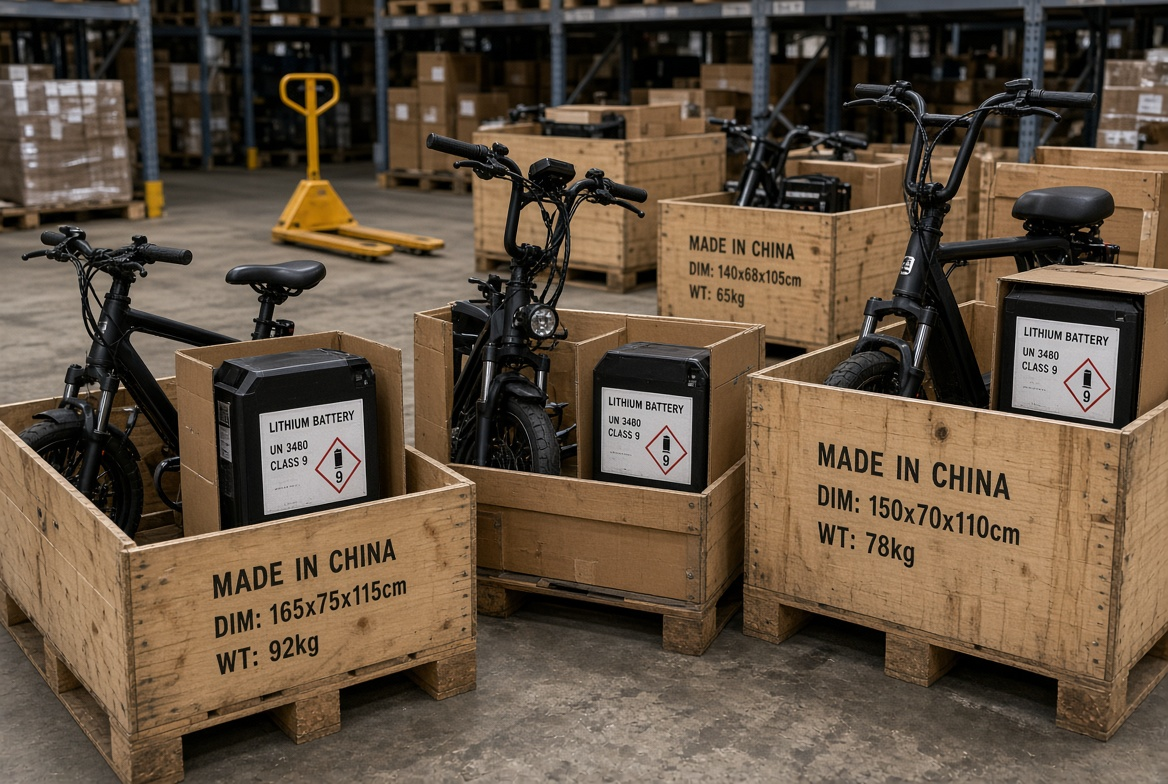
Packaging and Protection for E-Bikes and E-Scooters
Packing serves two purposes: to protect the device, and to comply with carrier battery regulations. The term “export-standard crate” does not constitute a spec. The crate must be equal to the weight of the unit, the stack height and if the battery is situated inside the vehicle or a separate carton.
Crate and pallet design
When frames have the potential to move, wooden crates with blocking and bracing are often used. Metal frames or reinforced pallets are helpful when units are heavy and when it is desirable to double stack in the warehouse. Protect corners, handlebars, displays and folding joints. Ensure adequate internal clearance, not allowing stem and or fender to be first point of contact.
It isn’t a carrier failure if a crate appears neat in the factory but collapses in a consolidation warehouse. When multiple suppliers are shipping to a single warehouse, discuss crate outer dimensions prior to first pickup to ensure pallets can be built without damage to cartons.
Battery packing and marking
Different inner packing material is used for installed batteries, removable batteries and standalone spares; different marks are used. Never put spare packs in the same unmarked box as kickstands and manuals. Do not mix up inner packages containing DG and non-DG products and maintain the paperwork related to each package with its corresponding package.
Marking and labelling is based on classification – not a stock and flow sticker that was printed at the last minute. If the warehouse needs to open a crate to determine which carton the spare pack is in, the file is not ready to book.
Battery Rules and Carrier Acceptance
The rules governing e-mobility cargo batteries vary based on chemistry, placement and watt-hour rating. This is not legal guidance when booking this section. The determination of acceptance will be made by the carrier and the applicable regulation for that mode, on that route, for that configuration.
UN38.3, SDS, and classification basics
Request the latest UN38.3 test summary for the model of battery being shipped, and an SDS for the same model. A common reason for air cargo to be refused at origin is an old report for an old cell or an SDS that mentions a different pack.
Typically the first question in classification is: is the lithium battery contained in equipment, packaged in equipment or shipped separately? Class 9 may apply. Packing instruction, the number of items packed and acceptance of the booking by the airline are determined by the watt-hour rating. Note state of charge, inner packaging, package marks, etc., are part of that same file, not extras that are added after space is reserved.
Sea vs air for e-bike and e-scooter shipments
Paper is quicker than air, and practice is even quicker. Some spare-battery/high watt-hour combinations are denied or restricted. Sea is more feasible for assembled units with installed packs, but is not a free pass — classification, packing, and documents must all fit the cargo.
Avoid booking on air just because of a launch date and finding out that the airline won’t take the spare batteries with the same shipment! Verify carrier acceptance with the battery file prior to paying for a crate made for a different mode.
Importers who need to classify, pack, and get approval from carriers for their e-bikes/e-scooters containing lithium batteries and who require all of these tasks to be completed as one shipment should research the shipping of electronics/batteries from China before considering them a regular consumer shipment.
Freight Options to Ship Electric Bikes and Scooters from China: LCL, FCL, Air, and Express
Mode is a "landed cost" determination. Look at the origin freight, destination costs, battery acceptance, damage risk and delivery—all ocean and air.
When you have a few crates, but not a full container, LCL can appear cheaper at origin. You’re sharing space, followed by deconsolidation, handling and a more complex destination process. FCL gives you exclusive use of the box. That typically translates to: cleaner loading, less fragile frames being stacked on top of one another and easier handoff when the volume is filling up the container. Air and express are more expensive per unit, and have to comply with stricter battery regulations, but still require a plan of delivery upon arrival.
Destination charges and delays for LCL
Origin only quotes will fall apart when it comes to LCL destination cost. Be ready for deconsolidation, potential customs exam, storage if documents are delayed, delivery appointments, and for ocean shipments from the U.S. ISF and bond which remain in the importer’s hands, not the Chinese factory. These are not “hidden fees” added after the sailing is started, but rather charges that must be associated with the structure and processes of the sailing itself.
If the quote is only for pickup and export, but not destination handling or ocean freight, then don’t assume that there will be a surprise at the end. Before you select LCL because the first number was smaller than FCL, inquire what is included.
When air or express makes sense
Air or Express is used for samples, urgent launches, replacement parts or a small high value lot where calendar risk outweighs freight. It’s a lousy default for large, low dollar fleets that can wait for a ship.
The problem is that when a mixed shipment of assembled scooters and spare packs is involved, the usage of air transport without the confirmation of both is not an acceptable practice. If the devices can travel by ship and only the samples have to travel by air, divide the booking rather than having to use two different battery files.
After units are measured, crated and clearly identified for ocean (not air) transport, move from China by FCL and LCL ocean transport as port-to-port or as a one-line “container rate”, but with some understanding of scope of delivery.
Customs, ISF, and Delivery for E-Mobility Imports
Even though the battery file is complete, e-bikes and e-scooters will require a real customs entry. The vehicle classification, a description of the battery and commercial paperwork must convey the same message. This is not the complete customs manual, it’s just the section that slows down your delivery if no one owns the file.
ISF, bond, and entry for LCL and FCL
On U.S. ocean imports ISF is an importer responsibility that is filed before, not after, loading the vessel. Late ISF will impose penalties and can slow down release. Determine the continuous bond versus a single entry bond before cargo is on the water.
With LCL, the goods are transported to the airport, but not directly to the airport.LCL includes an extra deconsolidation phase between arrival and delivery. When entry data, ISF and arrival notice are not in sync, crates sit, while storage accrues. Under no circumstances assume the supplier “handles everything” under FOB or EXW. The terms are not a contract delegating to the factory the U.S. ISF.
Air customs and last-mile delivery
Air entry may be much quicker and yet be interrupted, such as in exam, loss of paper documents or mismatch of waybill address with delivery site. Last-mile from the airport requires an address, an open window, and a strategy for crates that won’t fit down the standard elevator shaft.
Use export customs clearance and destination customs clearance as the working scope and don’t embed them as an afterthought once the goods are in a ship or an aircraft.
Use this practical checklist before you book to steer clear of getting your head in the sand.
A Practical Checklist Before You Book
Send a file a coordinator can price and accept, not a slogan.
- Details of devices and batteries: model, chemistry, location, watt-hour rating, number of batteries installed and spares.
- Marking: inner battery marking, crate/pallet design, marks matching classification.
- UN38.3 and SDS classification for the battery that is being shipped.
- LCL vs FCL vs air vs express when compared for total landed cost (including destination charges).
- Customs and delivery capability: ISF/bond on ocean to USA, entry documents, delivery address and appointment.
Please add photos, packing list and the Incoterm. This isn’t a briefing, its "E-bikes, one container, cheapest rate".
Sample scenarios
Usually, when volume supports the box, assembled e-bikes with installed batteries, sufficient for the shipment to be loaded clean, and no spare-pack issue will be loaded on sea FCL. Different cargo: Lithium batteries for e-scooters are a load that may require packing as DG, and is often refused or subjected to a strict limit on air. If the battery configuration is agreed, urgent samples of one or two units may be acceptable and the production lot can be sent on ocean instead of copying the sample mode onto a full fleet.
Mistakes that send e-mobility to the wrong mode or packing
- Comparing origin freight only and not destination LCL freight.
- Regardless of whether the battery is installed or in the device or it is a spare battery
- Booking without an up-to-date UN38.3 test summary.
- There is no ISF or bond plan in place for an ocean LCL or FCL in the U.S.
- Filling units with air versus a pallet which are more bulky and less valuable in a container to fly.
- Unmarked general-cargo cartons containing spare packs.
Frequently Asked Questions
Do I need UN38.3 for e-bikes with installed batteries?
Generally, yes when the lithium pack is in an e-mobility application. Carriers and regulators consider the battery model, not the final bike. Request the latest test summary which corresponds to the pack in the frame. If an old report is made for another cell, it is considered as missing paperwork.
Can I ship spare lithium batteries for e-scooters by air from China?
At times, under more stringent rules than an installed pack. The classification and packing of spare batteries is frequently different from batteries in equipment. Before making up an air crate around loose packing, verify watt-hour rating, packing instructions, quantity and airline acceptance.
Is LCL or FCL better for e-bikes from China?
Both are not necessarily better. LCL can accommodate small unit counts, FCL is typically cleaner when units fill a container and less stacking of frames and displays are desired. Not only origin ocean line, compare the charges and damage risk of the destination.
What documents are needed for e-bike and e-scooter imports?
Minimum: commercial invoice, packing list, transport document and the battery file (UN38.3, SDS, and classification and/or declaration if required by the mode). As well, importer numbers, bond and product information may be required to enter the destination. Maintain models in line with battery papers.
Do I need ISF for an e-bike container by ocean?
ISF is usually mandatory and importer’s filing for the U.S. ocean imports before loading. It covers FCL, and to LCL moved as ocean cargo. If goods are purchased EXW or FOB, do not assume the responsibility to the factory.
What details does a forwarder need to quote e-bike shipping?
The type and number of devices, battery type and location, the amount of watt hours, packed dimensions and weight, photos, UN38.3 and SDS status, origin cities, destination, Incoterm, and port or door delivery. If the facts are ready, and you need a live assessment, provide details of the e-bike for a shipping assessment.