Most shipments from China are rejected before they leave the warehouse when you ship chemicals from China. The product was declared on the book as general cargo, the SDS did not correspond to the invoice, the drum is not rated for the product or the carrier never approved the class. Classification, documents, packaging, and mode must agree prior to a booking being made.
Think of this as a work sequence. Always check product data and SDS prior to use. Lock Hazard Class, UN Number (if available) and Packing Group. Provide packaging and marks. Then compare Sea vs Air and make Customs and Delivery plans. To call all solvents, all adhesives, all cleaners and all powders – “ordinary cargo” – is the quickest route to refused booking.
Define the Chemical Before You Pack or Book
Avoid beginning with "one drum, cheapest ocean rate. Begin with a physical brief that can be used in the warehouse and in the booking office. As a minimum, record the commercial product name, physical state of the product (liquid, solid, powder, paste), hazard clues that the supplier is already familiar with, flash point of flammable liquids, notes on corrosivity / toxicity, the type of package that you actually have (steel drum, plastic drum, IBC, bottle, carton), the Incoterm and the cities where you are picking up the product in China.
If goods are to be sent from more than one plant then the origin of each plant should be stated. The two receiving events are not a “chemical shipment,” but a coating in Dongguan and a hardener in Qingdao.
Product data and hazard clues
Cargo from a marketing name is not classified by carriers and terminals. They examine the hazard class, UN number (if assigned), packing group and proper shipping name on the shipping papers. Flash point, pH and vapor risk alter packing and the type of holds or aircraft that the liquid may go into.
The common issue is a supplier e-mail stating that it is “non-hazardous” without an SDS or test data to back it up. The above sentence does not classify. If there is no SDS and/or supporting test report, consider the cargo as unclassified, and do not book it as general cargo.
Physical state and packaging
Liquid products must be leakproofly inner-packaged, bunged and have sufficient headspace to prevent product from being expelled by heat and pressure. For powders, moisture and dust control is necessary to prevent the powder from caking, leaking or contaminating the next pallet. For cartons that will be placed under other freight, solids must also be crush resistant.
The term “standard drum” does not refer to a specification. Write notes on the material, capacity, closure type and if required, package rating for dangerous goods classification. Small leaks are converted to a rejected load at the terminal in the following manner: overfilled IBCs and loose capped bottles.Small leaks turn to a rejected load at the terminal in the following ways: Overfilled IBCs and loosely capped bottles.
SDS, Classification, and Documentation
Every subsequent decision is subject to the correct SDS and classification. This is an operational guide and does not provide legal advice. Where the SDS description of the goods, description on the invoice and the declaration of dangerous goods differ, the shipment already carries a risk.
SDS basics and classification workflow
Safety data sections that are most important for shipping are: hazard identification, composition, handling and storage, and transport information. Those pages are where a coordinator maps the product to a hazard class, and a UN number (if applicable) and a packing group.
Request the most up-to-date version (available in your destination broker’s language) and verify that the transport information corresponds to the type of transport you are looking to book. A common reason for chemicals SDS classification shipping errors is if the SDS is written just for the workplace or an older SDS that was created before an update to a formula. The destination rules may also differ from the version that is maintained on file with the factory. Align document prior to printing labels.
Documents beyond SDS
You may also need a dangerous goods declaration, test or performance report for the package, a certificate of analysis and any local import forms the broker names, depending on class, destination. Product names should be identical in SDS, commercial invoice, packing list and on the DG declaration. If the name on the invoice is “Industrial cleaner” and the SDS lists a different name, then it will be sufficient for an examination or a hold.
Never fill in "Forced" fields to make the booking appear full. If you do not know the UN number or packing group, halt, obtain support for the classification of the cargo prior to marking the cargo.
Packaging, Marking, and Labeling for Chemicals
Packaging serves two purposes, it retains the product in the package, and it indicates to the carrier and the terminal what they are carrying in the package. It’s not a generic “export drum” photo that determines dangerous goods packaging from China, but the classification you already confirmed.
Packaging types and performance standards
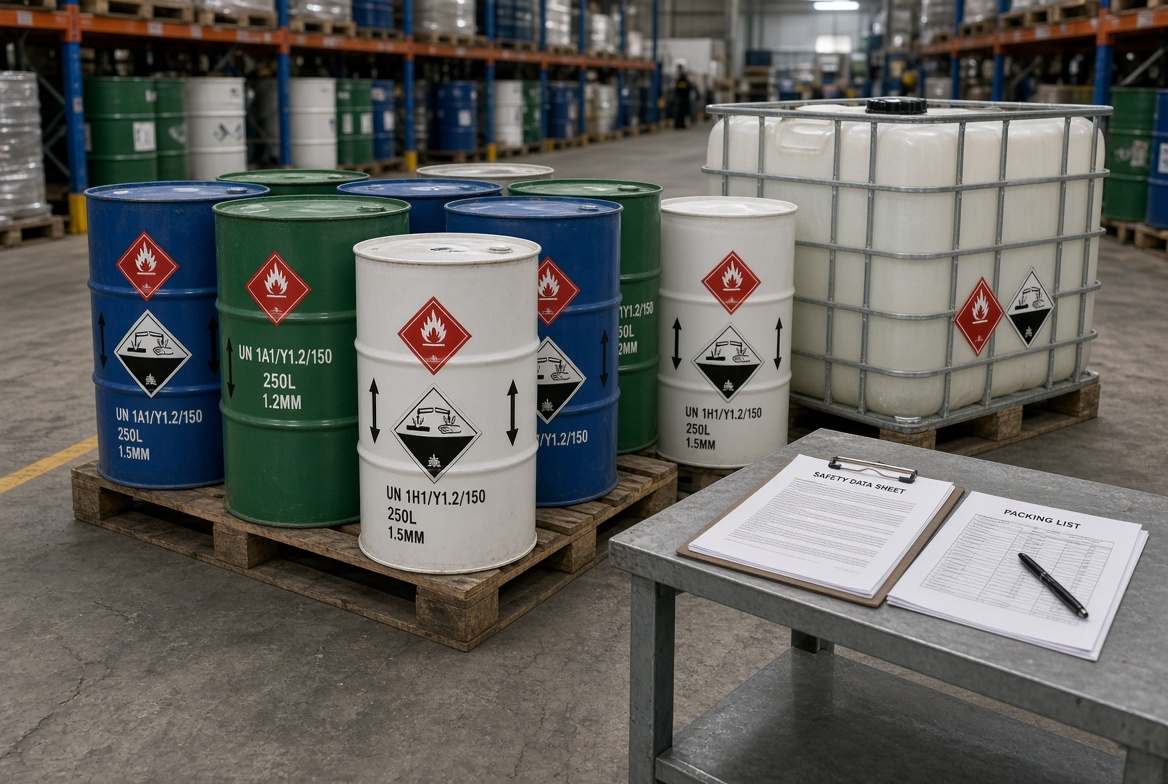
These include drums, IBCs, bottles and cartons all used, provided they are of the right type and rating for the hazard and the quantity. A performance mark may be included on the DG packages. Leaks and refused loads begin with an unmarked carton for a classified liquid or by filling the drum over a safe fill limit.
Outer drum is not the only drum that is important, inner packaging, cushioning and overpacks are equally important. When multiple small bottles are stored in a carton, they require orientation, separation and a drop-proof closure. Match the package with the packing instruction for that class and packing group. Even if the drums are in the factory, and moved by sea last year, don’t assume the drum is good for air!
Marking and labeling
Marks and labels must include appropriate shipping names, UN numbers, hazard labels, and orientation arrows (if applicable) for liquids. There are some places which add additional marks. The condition of missing, faded or incorrect labels can be a frequent cause of cargo being left in the terminal or not passing a spot check.
Use labels that are approved, not from a previous shipment that “looked similar.” If the product requires DG classification, rated packaging, and approval from the carrier, then it is a chemicals/dangourous goods shipment from China, not a general cargo shipment with additional tape packing.
Carrier Approval and Mode Choice
Classification and packaging does not result in a booking. The carriageage still needs to be accepted, the amount, the package and the route. Packaged DG can be more accommodating to sea. Classes, net quantities, and types of packages are all more rigid in air. DG approval should be verified prior to the last carton being taped in the factory.
Sea vs air for chemical shipments
As long as package, markings and documentation of classified chemicals are done correctly, sea freight can transport a more comprehensive list of such items. For smaller quantities that are time sensitive, where the airline can accommodate, air freight might be warranted, but certain classes and some quantities may be limited or denied. A common failure is to book airline space first, then request acceptance later: space is reserved and then the airline says no to the SDS.
Compare sea vs air freight costs – chemicals – more than origin freight. Consider origin handling, any DG surcharge, if applicable, destination charges and cost of a rejected booking. Once accepted, packaged chemicals that are already containerized typically ship FCL and LCL in China via ocean transportation.
Tank vs packaged DG
Tank containers can be used for bulk liquids if volume requirements, product compatibility and cleaning requirements allow. Smaller lots are transported as packaged DG in either drums, IBCs, or cartons. It does not make sense to force a tank on a few drums, as it will be an added expense and cause additional problems of cleaning and residual product. Some products may be safer to pack into a large bulk lot as loose drums, but this is not necessarily the most efficient method if the appropriate piece of equipment – a tank – is available.
Match equipment to volume and physical state. Avoid selecting the tank due to the ‘industrial sound’.
Customs, Documents, and Delivery for Chemical Imports
Chemicals still require a clean customs entry, and still need a delivery plan the site can accept. There is more to how to import chemicals from China than just a freight question. Even if the ocean or air transport is uneventful, the imports of chemicals are delayed due to inconsistent descriptions and missing SDS pages.
Key documents for chemical shipments
Carry a working set of documents: Commercial invoice, packing list, bill of lading/air waybill, up to date SDS, dangerous goods declaration, if required, and any certificates as required for the destination. Descriptions must match with net and gross weights, and package counts. When the invoice reads “resin,” the SDS will name a classified mixture, and when the packing list reads “drums,” the broker will be operating from three different cargoes.
Destination clearance and final delivery
Once arrived, the entry can be a routine or a question for examination. Duties and taxes are based on the tariff classification of the product and not the mode of transportation. If the terminal to plant/warehouse delivery mode is to be used, the address must be usable, there should be a receiving window, and the equipment must have the ability to accommodate drums or IBCs.
If the wrong plant gate is used, or an appointment is made to pick up a shipment that arrives at a location that is only pick up on certain days, the bill of lading becomes a bill of storage. For readers who wish to have documents, declarations and routing coordinated around the freight move, export and destination customs clearance can be utilized as the coordination layer.
A Practical Checklist Before You Ship Chemicals from China
Run this sequence prior to requesting a quote:
- Product name, physical state, if applicable, flash point, pickup cities, Incoterm and destination.
- Current SDS and a confirmed classification (hazard class, UN number (if assigned), packing group).
- The type, rating, level of filling, marks and labels that are of that type.
- Carrier Approval Status for the proposed mode and route.
- Total landed cost – sea versus air.
- Customs document and delivery plan to which receiving site can respond.
Please provide SDS, packing list and Incoterm. No, a coordinator can’t book “Chemicals, one drum, cheapest rate.”
Sample scenarios
Once the seals and carton strength have been confirmed by the warehouse, a non-hazardous process liquid with existing SDS which is suitable for general cargo can be transported as packaged sea freight.
A classified SDS is a different booking for a flammable solvent. Only under strict quantity and packaging restrictions is it possible to have air, and it can only be done once the airline agrees to the file. Sea packaged DG is the more popular option when the quantity is greater than a few inner packs.
Any bulk liquid that is placed into tank equipment needs to be on a tank plan, not in a pile of unmarked drums booked as LCL. These are planning contrasts, not rate quotes. Know the real class and the acceptance of your product by the carrier.
Mistakes that send chemicals to the wrong mode or packaging
- Comparing only the origin freight line and ignoring DG handling, destination charges, and rejection risk.
- Booking without a current SDS.
- Accepting “non-hazardous” as classification.
- Printing labels from an old shipment instead of the current SDS.
- Requesting air before the airline has accepted the class and package.
- Using air for bulky, low-urgency cargo that sea can move once packaging is correct.
- Forcing tank equipment onto a small packaged lot, or packaged drums onto a true bulk liquid.
Frequently Asked Questions
Do I need an SDS to ship chemicals from China?
Yes in practice. Even when the product may move as non-DG, the SDS is how the warehouse, carrier, and broker confirm that claim. Without it, most carriers will not accept a chemical booking as general cargo.
How are chemicals classified for sea and air freight?
Classification uses the SDS and, where needed, test data to assign hazard class, UN number when applicable, packing group, and proper shipping name. Sea and air then apply their own packing and quantity rules to that same classification. The class does not change because you prefer air.
Can all chemicals be shipped by air from China?
No. Some classes, quantities and packagings are not allowed or accepted by airlines. Certain items shipped regularly by sea will not be allowed on passenger or even even cargo planes. Always verify with the airlines before offering a date for an air date.
What packaging is required for dangerous goods?
Packing instruction for that class/packing group must match with the package. This may be rated drums or IBCs, a maximum number of inner drums, closures and marks that survive handling. The typical carton used in a factory does not necessarily make it a DG carton.
What documents are needed for chemical imports?
When the cargo is classified, plan on an invoice, packing list, transport document, SDS, and a DG declaration. Local forms or certificates may be added by the destination broker. Maintain uniformity of names, weight and package numbers.
What details does a forwarder need to quote chemical shipping?
Product name, SDS, Physical State, Package, Quantity, Pick up location in China, Destination, Incoterm, Door or port delivery. If you have a classification, and a preferred mode, add those as well. Once these files have been completed, provide chemical information for shipping purposes to verify classification, packaging and acceptance by the carrier.
Do not send a one-line “chemical drums” request if you already have product data, SDS, volume and origin/destination.