
China export customs declaration is a legal form of electronic submission to Chinese Customs providing the information of the goods out of China including their classification, quantity, value and trade terms, etc. so that the goods can be released for loading. It is most commonly filed by the Chinese exporter or by an appointed broker. The overseas importer still enters the names of the product and materials, intended use, quantities, values, and Incoterms into that file. A factory may declare a marketing name, a copied HS code or gift value and may file. That file might not contain the information to cut off vessels and may go with the cargo to the destination paperwork.
This guide will explain the China export customs declaration process, what documents must match the physical shipment, the elements of a customs declaration, the customs inspection and release process on the floor and common mistakes that cause cargo to be held at origin.
What China Export Customs Declaration Is (and What It Is Not)
Export customs clearance in China is an origin duty, not a destination duty. The declaration allows goods to be exported from China based upon the facts you submitted. It is not subject to the U.S. or EU duty. Does not substitute destination ISF, AMS or ENS filings. It does not in itself constitute preferential origin for a buyer who requires a certificate of origin later on.
Usually, a file specifies three parties. The party which is the exporter of record is the one party who is entitled to declare the goods. The overseas consignee is the party named on the commercial documents who is buying the goods or who has been nominated as the receiver of the goods. The declaring agent (declaring broker or forwarder) shall be the broker or forwarder designated to submit the electronic form. Without those 3 names being the same as the invoice, packing list and booking, the file already has a weak link, let alone HS codes!
Imagine that the export declaration is a story and the Chinese Customs is going to compare it with the story in the cartons. The same cargo will later be the subject of another story written by destination customs. If both stories contradict each other, the importer’s is the winning story.
Who files, and what the importer still owns
Filing is done by a party who is entitled to do so under Chinese rules, that is, the exporter or a broker on a written authority. The importer retains the right to control the facts about the product, such as its Incoterm, destination and restricted-cargo facts already known, including batteries, chemicals, wood crates and dual-use items, etc. Children’s toys should never be shipped as “general goods” since there is no risk of inspection removed by stating “use a simple name.” It shifts the risk to the mismatch between the contents of the carton and the description filed.
The job of the factory is to produce, and sometimes the first draft of an invoice. The importer’s role is to reject an unauthorized draft for which the count in the warehouse or the entry at the destination is not acceptable. Classification questions, document alignment, export and destination customs clearance should not be a two separate email thread.
The Export Declaration Process, from Cargo Ready to Customs Release
A typical ocean FCL or LCL process does not begin at the Single Window screen. It begins when the cargo is real and one can describe it.
Verify the exporter of record, the Incoterm, load port and destination, and the cargo type: general goods, licensed goods or dangerous goods. Gather a matching invoice, packing list, contract/purchase order, and the declaration elements that the code needs. Check the supervision conditions attached to the HS code and the China commodity code for filing, if the product is classified under an international HS code and a China commodity code, and supervise it based on the conditions. On the warehouse or CY verify piece count with shipping papers, net and gross weight with shipping papers! Submit via the China International Trade Single Window or for this shipment, the existing channel from GACC. The file is then directed to Customs for either auto-release of the documents, document review by Customs with questions, or inspection. Once the sample is released, loading can be continued. Retain release record with the booking record.
The same applies to air, rail and trucks. The cut-off clock and the transport document are changed. There is no need for a file that matches the load.
A China Single Window export declaration is dependent on the data that is entered into it. If it doesn’t have all the elements, the consignee is not the same as the invoice, or the weight is different from what will be entered by the warehouse scale, it will not be accepted before anyone questions the sailing date.
Time the file to cutoff, not to a made-up calendar
Declaration shall be accepted prior to the earliest of documentation cutoff, VGM cutoff and port cutoff for that booking. It’s often possible to miss all three by stuffing during the time when SKUs are being rewritten. The old packing list is used for carton marks. This invoice is still pending. The broker files what they have as the vessel won’t wait. Next, the factory is asked a question by the customs that it is not able to answer in time.
If the container is used, the verified gross mass of the container is VGM. It should not conflict the declared cargo gross weight on the export file. This article is not a SOLAS methods guide. The point is easier to understand: if the warehouse scale, packing list, and VGM (which stands for "value gross mass") cannot coexist, then the file is not ready.
When cargo is consolidated from more than one supplier
Two workshops, one warehouse, one LCL booking: carton marks and packing lists must be shrolled back to the exporter/exporters mentioned on the form. A problem, not an inconvenience, if the exporter of record has two separate factories and no authorization. Marks containing the word Factory A, but with the declaration named Factory B will not last a carton-open examination.
The receiving must occur before and not after the file. Count the cartons as they come in. Photograph marks. Create a single packing list that can be added without having to create another product name. This is why the receiving and checking of the export file, and consolidation of the cargo, comes before warehousing and cargo in China: to ensure that what the declaration says is what is actually on the floor!
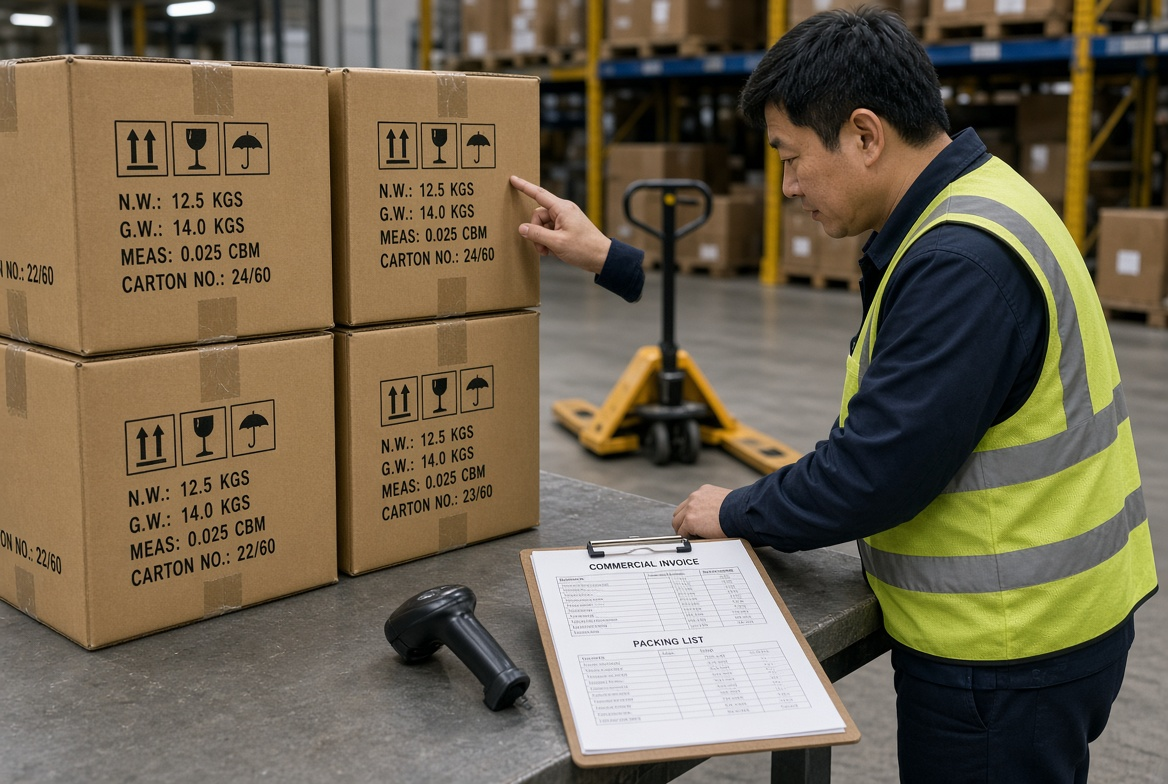
Required Documents for a China Export Declaration
There are two sets of documents that are essential for the clearance of export customs documents to China: the core documents that are used by almost every commercial shipment to China, and the conditional documents that only exist when the HS code, type of goods, or buyer demands them.
The commercial invoice, packing list, sales contract or equivalent purchase order, broker authorization (if broker is involved) and transport or booking details (identifying the vessel, flight or truck) are examples of core papers in a typical general-goods file. Conditional papers include export licenses, inspection/quarantine fields, MSDS and dangerous goods packing certificates, and origin certificates. Not all China export papers include a certificate of origin. Preparation is done when destination customs or the buyer requires it for import treatment.
Mostly, the customs declaration documents in China are not completed due to the incompleteness of the documents and not because the form has no stamp. Do not use the table as a filing chore.
| Document | What must match the physical shipment |
|---|---|
| Commercial invoice | Description, quantity, unit price, currency, Incoterm, consignee |
| Packing list | Carton count, net/gross weight, dimensions, marks |
| Contract / PO | Parties and product scope, not a different SKU set |
| Declaration elements | Material, use, brand/model if the code requires them |
| Authorization | Same exporter who owns the shipment |
| Special certificates | Only if that HS code or cargo type requires them |
Don’t file 420 if the warehouse records 418—do it right now, this time. Edit the papers prior to filing them.
Declaration elements are not optional product copy
China needs code specific components: material, function, intended use, and in some codes, brand or model. One of the most frequently used holds is on “Parts” or “Machine accessory.” Those words give Customs very little information about the contents of the carton. Importers must include composition, intended use, and model (from the factory, not catalog names) on the product page.
The appearance of a charger that has been declared as an “electronic accessory” will differ from a charger that has been declared with housing material, output, and use. The 2nd version is also available for review. The first one asks a question which the factory can’t answer off the invoice.
HS Codes and Why a Supplier Code Is Not Enough
HS code for export to China begins with the headings of the international six-digit Harmonized System. China then applies a longer domestic code for commodities in the tariff schedule and Single Window filing. GACC practice currently assumes that the customs commodity code utilized for tariff and declaration is a 10-digit tariff-schedule code. There are also other inspection or CIQ digits in other systems for some products. A supplier’s old listing, an Alibaba category number or a destination HTS code is not a replacement for the code which will be used for filing in China.
Bad codes cause document review, bad license check or a destination duty dispute later. If a change in supervision-condition is made by copying last year’s code, and it “shipped fine,” it becomes a hold. Check the code with the latest tariff schedule and declaration elements which require code. When two factories provide you two codes for the same SKU, BREAK and label the physical product, NOT the more attractive looking invoice.
The destination import code may vary from the China export code following the 6-digit heading. It is possible to use the supplier’s China code as a basis for discussion. It cannot be assumed that destination customs will accept it.
Mixed cartons and kits
Depending on the manner in which the goods are sold and presented, more than one classification or rule may be appropriate for a charger, cable and case in one carton. It’s a fairly common method to tap the whole carton as “electronics accessories” to keep the file simple. It is also a frequent cause when an inspector opens the carton to see three products under the one general line.
If the kit is sold as a retail set, state this and then classify the set according to the appropriate rule. If the carton is only being used to hold three separate SKUs, then those three lines should be in the file. This is exacerbated by mixed cartons from two different suppliers: marks, invoices and codes must convey the same message.
Inspection, Release, and What Happens If Customs Stops the Shipment
Risk routing is not some mystic catchphrase. A lot of files are released on documents. Some ask questions: pictures, specs, more detailed material description, weight explanation. Some are picked for scan or physical checkup. The cartons can be opened to be compared with the declaration. It’s impossible to publish an inspection rate that will be accurate for your next booking. Don’t take the selection as an insult, it’s a possibility.
Once the shipment is intercepted by Customs, the options are few and restrictive in time. Make amendment if amendment is not completed yet. Provide specifications and pictures that correspond to the cartons. Wait for Exam when ordered. When the document review becomes the problem, it follows the exporter to the dock because the buyer changes the PO, they’re swapping the cargo.
Loading is permitted after release. Only the origin gate is the China side’s release. The global supply chain, destination clearance and last mile delivery remain unchanged and is still within the scope of door-to-door shipping from China as agreed. The export file won’t do those things for you.
Common Export Declaration Errors That Delay or Expose the Shipment
Matching errors are often the most common errors in customs declarations, not any obscure legal theories.
There is a discrepancy between the mark, description, count or weight on the invoice, packing list and the carton. The elements of the HS code and declaration do not match the actual product. Sample or gift is written down in the case of a commercial sale of the goods. The exporter listed on the form is not the party who is the owner of the shipment, or the broker authorisation specifies an exporter who is not the party owning the shipment. Some materials such as batteries, chemicals, and some wood packaging material are reported as restricted cargo, which are general goods. Only the DG packing rules are followed when stufing. Declared weight is inconsistent with what is reported by the warehouse scale and more importantly, VGM. The file is updated after the cut-off date or after loading, when the facts on the dock have already been modified.
Keep penalties QUALITATIVE. If a declaration is false or incomplete, it is governed by the rules of GACC. The importer’s commercial cost is more prominent here: a missed loading, storage while the file is being rewritten, and a destination entry with a bad description.
A pre-declaration check the importer can actually run
You should pass this list on to the factory and the forwarder before anyone has filed:
- Images of carton marks on packing cartons, carton numbers
- Final carton count, NOT an early count from an early production plan.
- Net and gross weights for a warehouse scale, by carton, and total gross weight
- If your product is not a catalog headline, it is not material, intended use or model/specification.
- Yes/no for battery, chemical or wood; if yes, specify the packing method
- Incoterm as written on the commercial invoice
- Consignee Legal Name: Name of the destination port company as it is written on the entry.
- Exporter of record and (if a broker files) a matching authorization
- The confirmation of the same SKU on the invoice, packing list and contract
If there is any line which is still a draft, then the file is considered to be still a draft.

Frequently Asked Questions
Who files the China export customs declaration—the factory or the importer?
It is the responsibility of the Chinese exporter of record or one of their agents to file the declaration. Often, the overseas importer does not click submit in the Single Window. The importer retains ownership of the product facts, Incoterm, consignee name and any restricted-cargo information required to be included in that file.
What documents are required for export customs clearance in China?
Once a broker files, there are typical commercial files that require an invoice, packing list, contract/PO, booking, and a broker authorization. Licenses, inspection fields, DG papers and origin certificates are merely added if required by the code, cargo type or destination. Matching the shipment is more important than getting additional stamps.
How long does China export customs declaration take?
It relies on completeness, risk routing and Customs questions/examination. A clean, matching file can be released on documents. A partially completed file awaits for responses. There are no single SLA’s that apply to all products and ports that can be considered to be honest.
Can I use the supplier’s HS code at destination?
Not in a copy and paste manner. The first 6 digits are the international HS. Those digits are continued by China and the destination country under their own timetables. Classify for a separate destination entry, starting from the supplier’s China code.
What happens if the invoice and packing list do not match?
It will probably attract questions and/or an exam. The Piece count, weight, Mark and description must match with the cartons. At the time of filing, repair papers. A missed loading is caused by a paperwork error that is corrected after cutoff.
Does export declaration include destination duties and taxes?
No. China export customs declaration is the origin filing which allows goods to be exported from China. The payment of destination duties, taxes and import formalities is a separate process under destination law.
When origin, destination, cargo, weights and volumes, Incoterm and timing are known, provide all information to a forwarder to verify completeness of the export package before booking is cut off.