
The most common error that importers make is not distinguishing between detention and demurrage until they receive a container invoice with a large and difficult-to-explain line. The charges imposed on the cargo or container remaining in the terminal for an excess of time is called demurrage. You are charged for detention if you leave the carriers equipment outside the terminal after free time has ended. Those clocks typically run after the goods have arrived at destination and are quicker for a sea freight shipment from China than some procurement teams realise.
These are not just random “port taxes” but rather the carriers’ concern too. Free time can be lost in a few days due to late customs forms or missing a trucker slot or having a box sitting in the warehouse for extra storage. This guide explains what fees are, how they are earned and what you can do to minimise or eliminate these fees.
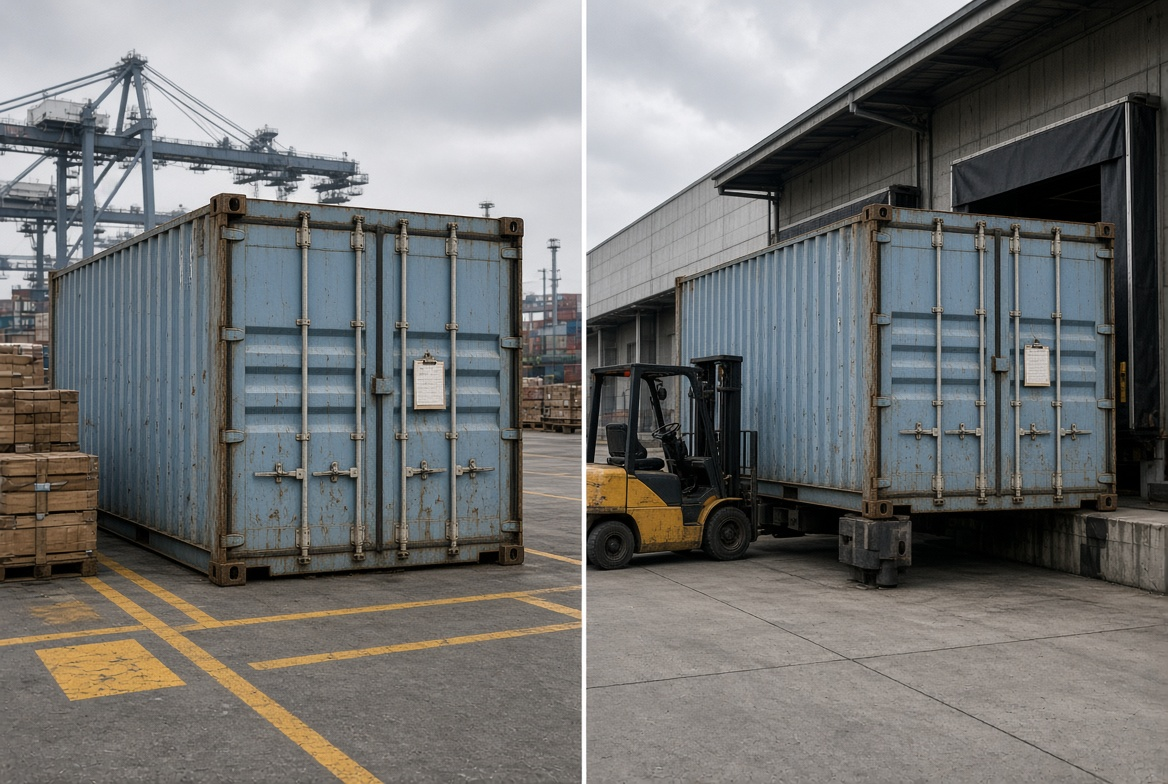
Detention vs Demurrage Defined: Who Controls What, and Where
It’s easy to mistake the two charges for being synonymous, as they are frequently combined into “D&D” for invoices. In their essentials they are distinct clocks, run by distinct operators and located at distinct sites.
Demurrage: Time Your Cargo or Container Spends at the Terminal
Demurrage applies when import cargo or its container stays in the destination terminal beyond the period of free time, as agreed with the operator, for pick-up and/or clearance. The terminal is being auctioned off both in terms of space on the grounds or its ability to move traffic. If the agreed period is over, then a day is charged for every day that passes.
Common causes of cargo from China are the delay in getting the goods out through customs clearance, inappropriate or missing commercial documents, delayed post terminal/CFS appointment, and failure to make the appointment of the trucker within the company. There is still room for the vessel to arrive on time and demurrage still runs if the importer’s file is not ready for clearance, or the importer has booked the pickup slot after free time has started.
Detention: Time You Keep Carrier Equipment Outside the Terminal
Detention is applied after the container has left the terminal. The carrier desires that box to be in circulation again. Detention applies to the shipper or consignee if it is stored at the shipper’s or consignee’s warehouse, trucker yard, or any other off-terminal location when the free time for unloading and empty return has passed.
Common causes include slow unload in the warehouse, late return of the empty container to the designated depot, trucker capacity constraints and multi day utilization of the container as temporary holding. Detention is a charge for equipment, NOT a terminal-space charge. If the empty remains on your dock, the clock doesn’t stop when the cargo is taken off the yard.
How Detention and Demurrage Charges Are Calculated
After knowing what clock it is when the clock is running, the next question is what is the invoice constructed? Demurrage and detention charges explained at this level are typically comprised of free time, daily charges and dates ranges, rather than a one-size-fits-all “port fee.”
Free Time, Grace Periods, and Tiered Rate Structures
Typically, both detention and demurrage will begin with a free-time window. The length is based on the port, the carrier, the contract and sometimes on the commodity. A few days to up to a week is a normal timeframe but it is not a definite timeframe. Check the actual free time, per the booking or service contract, prior to departure of the vessel.
Once free time has concluded, daily charges start to apply. A lot of carriers and terminals employ a tiered pricing paradigm, where the initial few chargeable days have a lower price, the following tier has a higher price and if it extends beyond that, a higher rate. Two days off is costly. Later days cost more than earlier ones and a two-week miss is too costly.
Origin vs Destination: Where Importers Feel the Pain Most
Charges can take place at the origin and destination. They are felt most at destination by importers from China.
- Demurrage at destination: goods are not removed or placed in the terminal on time.
- Detention at destination: If empty not returned to designated depot during free time after unload.
Detention/Demerrage on origin side can still reach the importer. When goods are not loaded at the factory or origin warehouse or an empty is returned late after being exported – the exporter’s additional expense may appear in a higher freight quotation or in a surcharge along the chain. The two line items that the buyers of containers will still see on the final invoice are free time and D&D at the port of destination.
Typical Line Items on an Invoice: What to Look For
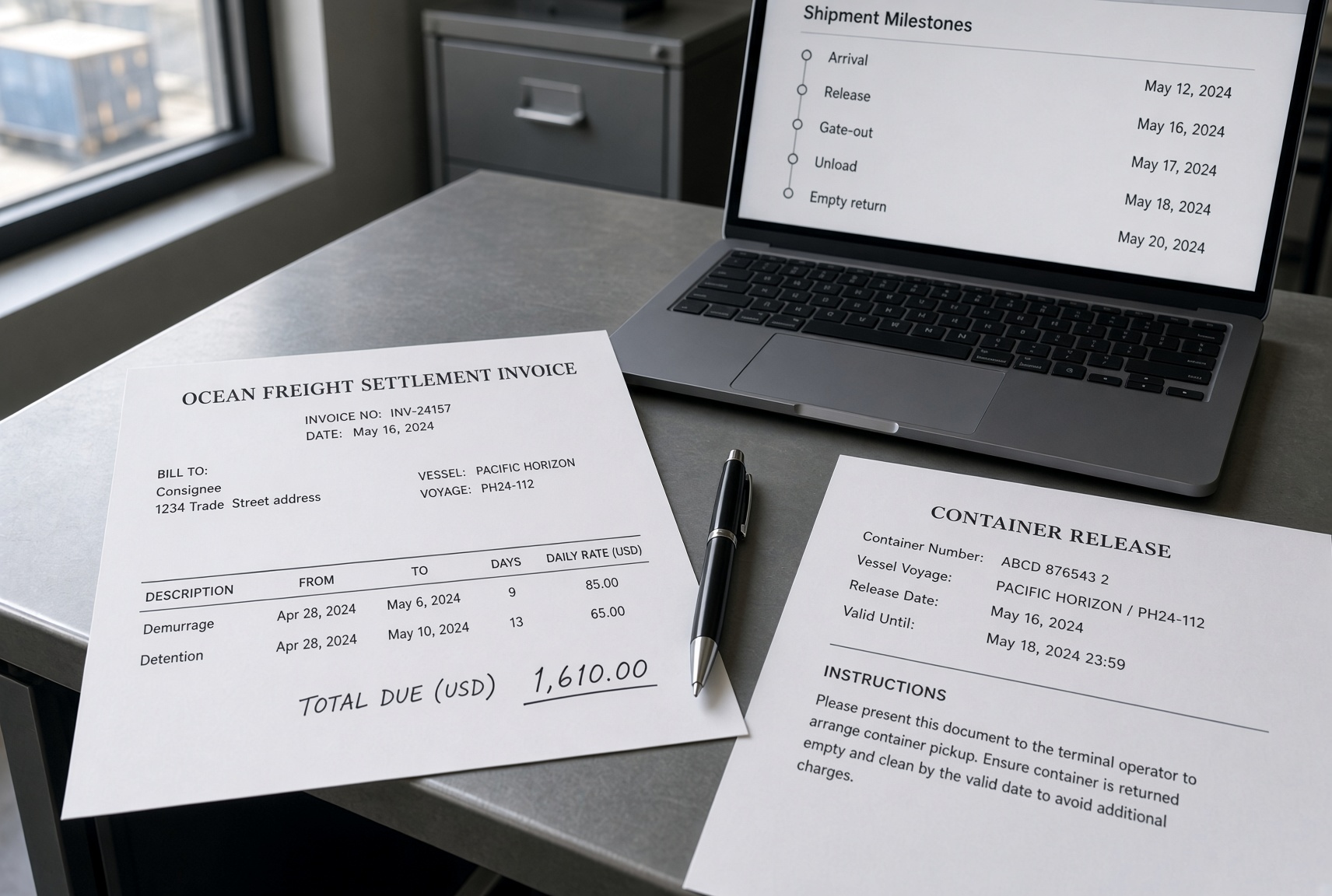
Detention and demurrage are typically presented as separate lines: “Demurrage” or “Detention” or “D&D” and a “Days” column and/or “Rate per Day” column and the date range. They are sometimes added to storage charges or hold charges on some invoices making the first pass more difficult.
Compare those dates with your own file: customs release date, terminal appointment, gate-out time, date of unloading at the warehouse, and empty-return receipt. If the billed start date is earlier than your release/gate-out record, please elevate with the forwarder prior to any payment. How the small errors of process become accepted cost is through date mismatches.
Common Scenarios That Trigger Detention and Demurrage
Definitions help. The charges usually start in a few repeatable situations.
Customs Clearance Delays and Documentation Issues
Cargo will not leave the yard if the import papers are not completed or missing. An entry can be delayed if the commercial invoice does not agree with the packing list, the HS code is not the same as the one the destination customs officer will use or the certificate is missing or the value does not match the entry. Delays in clearance and demurrage risk increases even more if such documents are sent to the forwarder or broker after the ship has embarked on the pilot station.
The same error is more costly when arrived in tight windows. When demurrage is not a theoretical risk anymore, it’s because there is little free time and the file is still being corrected on day two. It is the following line on the invoice.
Trucker Scheduling, Appointment Slots, and Terminal Congestion
Delayed pick-up and empty return due to limited trucker capacity, missed appointment windows and terminal congestion. A container which is not able to obtain a gate slot remains on the terminal and incurs demurrage. Detentions are earned by a container that leaves late, waits for a return appointment or an unload crew. Often, trucker scheduling and detention fees are positioned on the same week’s time line.
Both issues are exacerbated when it’s “peak” season or port disruptions occur. The mores of the job is to book the trucker the next day after arriving; this is a bad practice when appointment calendars are full days in advance. The freight plan includes buffer time around vessel arrival, customs release and warehouse unload capacity, rather than it’s an after-thought.
Using Containers as Temporary Storage or Multi-Stop Unloading
Some importers leave the loaded box on the warehouse floor since it is close to the floor, or unload the same container two or three times over a period of days. This makes it easy. If a detention tariff (ET) exists it will be costly.
The carrier didn’t lease you a storage unit. They rented a box for you with a fixed window for you to unload into and then return it to them. If additional dwell is required, make it a storage/depot decision, not an unpaid use of carrier equipment.
Detention vs Demurrage in Context: How They Interact with Other Charges
DnD is bundled with other terminal/handling charges. Either mixing them on one spreadsheet obscures the distinction between the normal costs and the delay costs.
D&D vs THC, CFS, and Storage Charges
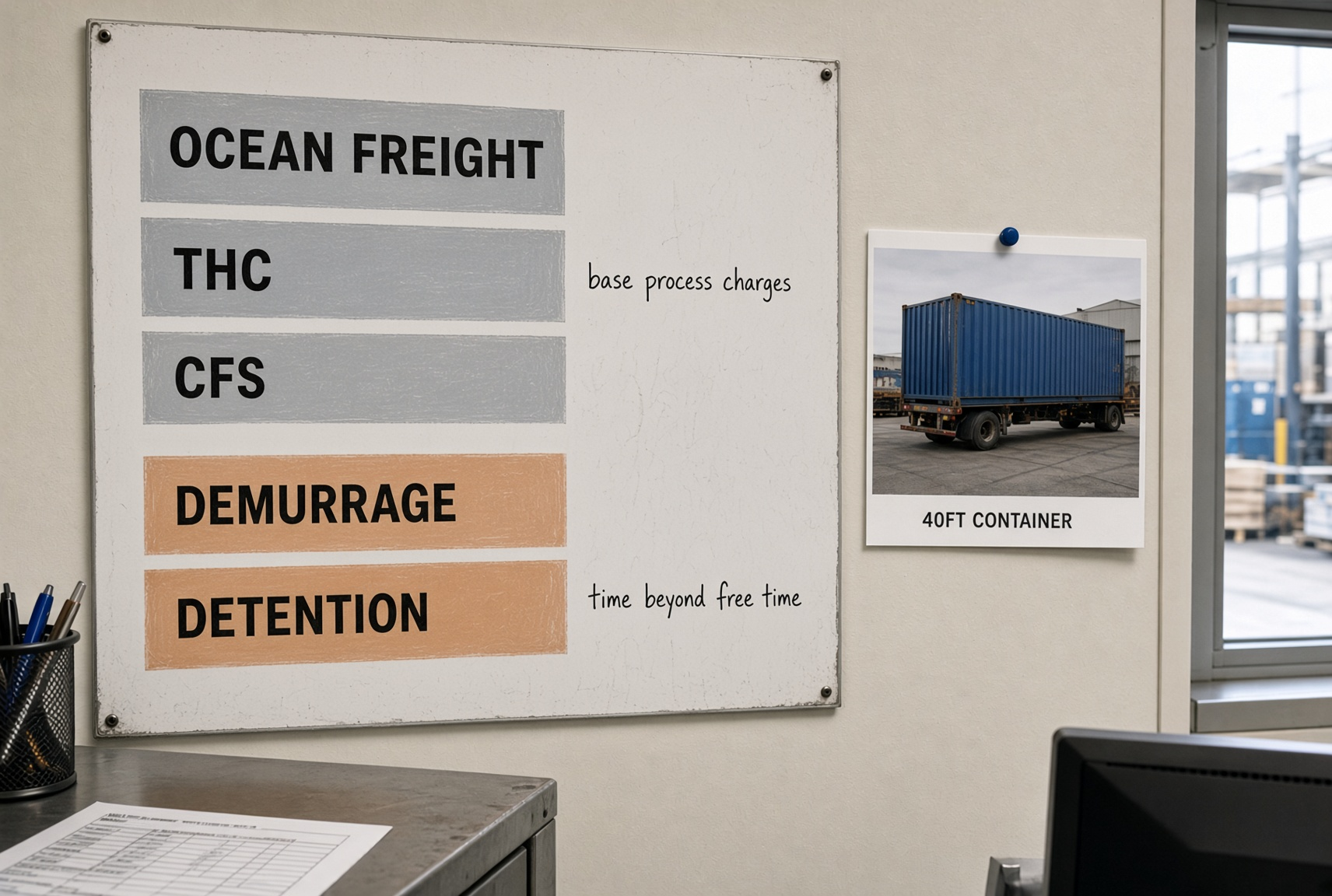
Separation of time based penalties from routine handling helps Detention vs demurrage vs storage and THC:
- THC – the terminal handling charges are the common charges for handling the container inside the terminal area. They apply not just on a delayed shipment, but on a normal shipment as well.
- The most common CFS charges are for consolidation or deconsolidation of LCL cargo.
- A terminal or depot may charge storage fees for the time a cargo or empty remains outside a published time. They may be concurrent with demurrage or detention but a different tariff and party.
D&D penalties are based on days off free time. The charges for process which the terminal or warehouse actually does are called THC and CFS. Extra free time is not purchased with payment of THC.
D&D in Total Landed Cost and Quote Comparisons
It’s okay to use occasional D&D as an exception. Repeated D&D should be in the landed-cost model. A lower rate on the sea can be more expensive than a slightly higher rate on the sea with usable free time and a team that warns of the imminent expiration.
When comparing carriers or forwarders, see if they offer free-time on the lane, what the D&D terms are, who gets the empty return and what tracking you will receive between arrival, release, pickup and empty-in. Those answers should not be in a footnote at the end of the first surprise bill, but rather with the base freight.
Practical Steps to Avoid or Reduce Detention and Demurrage
Avoiding demurrage and detention for importers is largely a process. The fees correspond to dates which can be observed if a person is observing them.
Documentation Readiness and Early Customs Filing
Create an import file in advance, before the vessel approaches. Review HS codes, values, descriptions, consignee information, and certificate information with the packing list and/or commercial invoice. Submit the set of shipping documents to the forwarder or customs broker upon receipt, not upon notice of arrival.
If pre filing or early clearance is available for the destination, take advantage of it. When cargo arrives at the yard in a releasable status, it takes fewer chargeable days to wait for a clerk to open an email.
Booking Truckers and Terminal Appointments with Buffer Time
Make appointments with the trucker and the terminal as soon as you can determine a reliable arrival time, particularly during high season or at a congested port. Provide buffer time around vessel arrivals, customs release and warehouse unloading activities to prevent the entire free-time window from being used up in one day.
If the warehouse is unable to unload the box on the day it arrives on site, advise this prior to pick-up. Detention begins on a clean shipment with the saying, “just until tomorrow.”
Clear Internal Handoffs and Accountability for Container Moves
Assign owners. The one person monitors the arrival of the vessels. One person is the "owner" of the customs file. One person arranges the trucker. One person monitors the free-time timer. One person grants any additional dwell. If those jobs are in a shared inbox, but without a name on them, each team will presume that the other team moved the box.
A short chain of shared trackers beats an email chain of length. The point is not a new software project, it is a date that is visible beside each milestone.
Negotiating Free Time and Using Milestone Tracking with Your Forwarder
In regular lanes and volume, a discussion about free time of greater duration can take place. Make the request in the contract and not just in the first invoice. When the freight forwarder is end-user, and also the importer, the most useful way to track and prevent from China is to have the same stages, such as arrival, customs release, gate-out, unload, empty-in, with alerts before the free-time date, not after.
A China-based forwarder, who is already doing the factory pickup, warehouse receiving, booking with the carriers, and destination agents, is in a suitable position to observe the origin delays before they become destination D&D. This will only work if you provide them full documents and a decision-maker for when to pick up.
Treating Detention and Demurrage as Manageable Risks
Detention and demurrage is not a black art port tax. They are costs associated with terminal space and carrier equipment, and they are based on certain gaps: late file; late truck; overrun unload; storage box.
Definitive definitions indicate what clock is operating. These early documents, buffer appointments, owners for every handoff and milestone tracking with your forwarder reduced the number of charges and their size. Do not think D&D is some cost that you discover after receiving the invoice, it’s an operations risk that you plan for on the next China shipment.