
Customs clearance is the formal inspection to allow goods to be imported from China into the country to which they are going. The process of customs clearance is identical on most routes: Prepare documents, submit export declaration and import entry, classify the products, calculate customs and taxes, finish inspection and goods release for delivery. It’s a regulatory process, it’s not tracking status, and it involves paperwork, currency and possibly physical checks.
The most common error made is to assume that this clearance is granted as soon as the vessel sets sail or the airway bill is issued. If papers are missing or incomplete, description is not clear or the certificate is missing or charges are not paid, then the shipment will be halted at either end. This guide will take you through the export/import clearance process from China, the documents that facilitate the process, a realistic understanding of timing and the delay patterns you can anticipate before goods leave the factory.
How Does Customs Clearance Work on Both Sides: Export and Import
There is no single customs clearance for a shipment from China. It is double cleared, departing from China, then arriving to the country of destination. If there are problems on either side, the entire move is delayed. Export work is the process of declaring what is to be exported, and getting the goods released from the Chinese port or airport. Import work involves making entries, establishing the value of the goods, paying the import duties, and releasing the goods for delivery.
Consider the two sides to be attached files, not different jobs. The Chinese export declaration is accompanied by three documents: the invoice, packing list, and bill of lading, which are the same documents a destination broker will use. Errors are inherited at the destination side if those papers disagree.
Export clearance in China
On the Chinese side, the goods are declared on an export declaration by the shipper or their agent.On the Chinese side, an export declaration is submitted by the shipper or shipper’s agent. The filing requires a valid commodity description, quantity, value, destination, and trading parties. The declaration is examined by customs and if the file is accepted the goods can be loaded.
A common hold doesn’t begin with a dramatic act of inspection. It begins with an incongruity. Cargo has already been at the warehouse or terminal, booking has been done and the commercial invoice still has a different number of cartons or value than the packing list. It will not be possible to file the declaration without going back to the factory or the bookkeeper and getting one pair of numbers. As long as the goods have not crossed a single inch, it remains “export clearance”.
The filer is determined by the commercial arrangement. In some cases, the supplier will do the China declaration. Others, the buyer’s forwarder does. In either case, the data must be the same as it will be on the destination entry. A description that is written only for the purposes of being paid for is insufficient.
Import clearance at destination
Entry at destination is made by the importer of record or their customs broker. That filing introduces the cargo to the destination authority—what it is, from where it has come, who will be importing it, its value, and its classification. From that filing duties and taxes in customs clearance are computed and then payment is made in accordance to local customs practice. Release occurs once the authority has taken the entry and all the selected check has been completed.
One common mistake is relying on the supplier’s export packing for entry to the destination customs. A normal product name, a value that only shows the factory deposit, or the consignee information in the invoice does not match the importer in the arrival notice, etc., may be insufficient for entry in Shenzhen. The destination file is used by the destination officers. They don’t have to recreate the meaning of the factory.

Key Documents That Drive a Clean Clearance
Nothing is as strong as the papers behind the customs clearance process for imports. Officers have to compare documents with each other first, then with the cargo. The shipment waits when three files tell three stories.
Maintain the explanations operational. There is no need to click on the policy citation to check if the invoice, packing list and transport document refer to the same goods.
Commercial invoice and packing list
Commercial invoice is the value and identity document. It should identify the seller and the buyer; include words a classifier can use to describe the goods; include the quantity, unit price, total value, currency, and Incoterm; be consistent with the goods that actually left the factory. The packing list is the actual paper listing. It should be consistent in terms of the number of pieces, net and gross weight, and size, and should correspond carton by carton to what was loaded.
The biggest one-time risk first-time importers face is the leftover proforma. Useful when preparing a payment and for an early booking estimate: a proforma invoice. If the quantities, SKUs, or values have changed since the deposit, it is not the document for clearance. One of the most common reasons a destination broker returns to ask questions on day one is for them to have been sent a payment draft as the commercial invoice.
Read the invoice as an officer will. On the other hand, “assorted household items” is not a classification. Can 500 sets of “Wireless earbuds, plastic housing, lithium battery, model AB-12”. Do not file if the packing list has 48 cartons and the invoice has 50, and hope its just a minor quantity. Tear the paper up before putting in the entry.
Bill of lading or airway bill
The bill of lading or airway bill is a document that binds the cargo to the contract of carriage. On that document, the shipper, consignee, notify party, piece count, weight and commodity description must follow next to the invoice and packing list and that is that. An inconsistent name is sufficient to slow a release: the trading name of a factory on the B/L, the brand name on the invoice, and the personal name as consignee on the arrival notice.
Commodity wording should be specific enough to identify but not from a generic wording template provided by a carrier. The phrase “STC general cargo” in the ocean bill column next to an ocean invoice calls for a document check. Align the description prior to issuance of Original B/L. Once the ship has departed, it is more time consuming and costly to change than to get them correct in the beginning.
Certificates, licenses, and product-specific documents
There are products that require additional to the basic three documents. A test report, origin certificate, license, or mark may be necessary for certain foods, electronics, branded items, machinery, batteries, and some chemicals due to requirements by the destination country. Requirements vary from product to product, and country to country. The common practice is to ask the question early in the process, is there a need for anything other than invoice, packing list and B/L?
This question goes hand in hand with the factory ready date. A missing safety mark, or an unsigned certificate found after arrival is NOT a paperwork inconvenience. It’s cargo that can’t be offloaded until the missing item is present. Double check the list with the destination broker/forwarder before the goods are shipped, while still in China where a factory label or a report can be printed.
The Clearance Timeline: What Is Realistic?
There is no one defined customs clearance time. Time will vary with quality of documents, risk profile of the product, importer’s record and the level of product activity at the local office and terminal during the week. When it comes to transporting goods, or anything else, the exact same speed is classified as “customs speed”.
Well-documented and well-structured documents cut down on work. It is extended as a result of inspections, classification questions, and unpaid charges. Rather than a slogan that says how quickly a particular port ‘usually’ clears, plan around those factors.
Document review and entry processing
The common process at destination is: entry filed, review of documents, classification and value checks, calculation of duties and taxes, confirmation of payment. This stage can roll over without incident if the file is clean. If the file is disorganized, too much time is spent on e-mailing, changes to invoices and fixing entries.
The same reasoning goes for the China export market. A statement of filing of matching papers is a simple administrative procedure. If a declaration is made, but the packing list is still incorrect, it is a warehouse day, but a cutoff risk. The review stage gives a benefit to the importer who conducts a three-way match before anyone files.
Inspections and targeted checks
Not all shipments are inspected. Some are sent off on the documents.Some are sent off on the documents. Others are chosen for more in-depth assessment by means of a physical exam or a detailed review of their documents. Selection may be made by product type, declared value of the product, trading partners, random targeting or by a previous problem on a similar shipment.
The problem is that you assume that all boxes from the same supplier will take the same amount of time. It is not the same kind of case as a low risk general commodity with a clean file, and a well known importer. If cargo is chosen, include time for examination and possible sampling and paperwork. Never assume that nothing will ever be inspected when building a retail launch date.
Release and delivery handoff
“Released” is when the customs authority accepts the entry. Does not mean that a truck is already at your door. There is still a need to provide the terminal / warehouse release, pay any local handling charges and give instructions that a trucker can perform.
A common situation: The broker sends a message saying the entry has been released, the importer sits back and waits, and the container waits. There was no delivery order delivered with an address and receiving window or terminal fees were never paid. There are two steps: paper clearance and physical handoff. Tackle them as such in the plan.
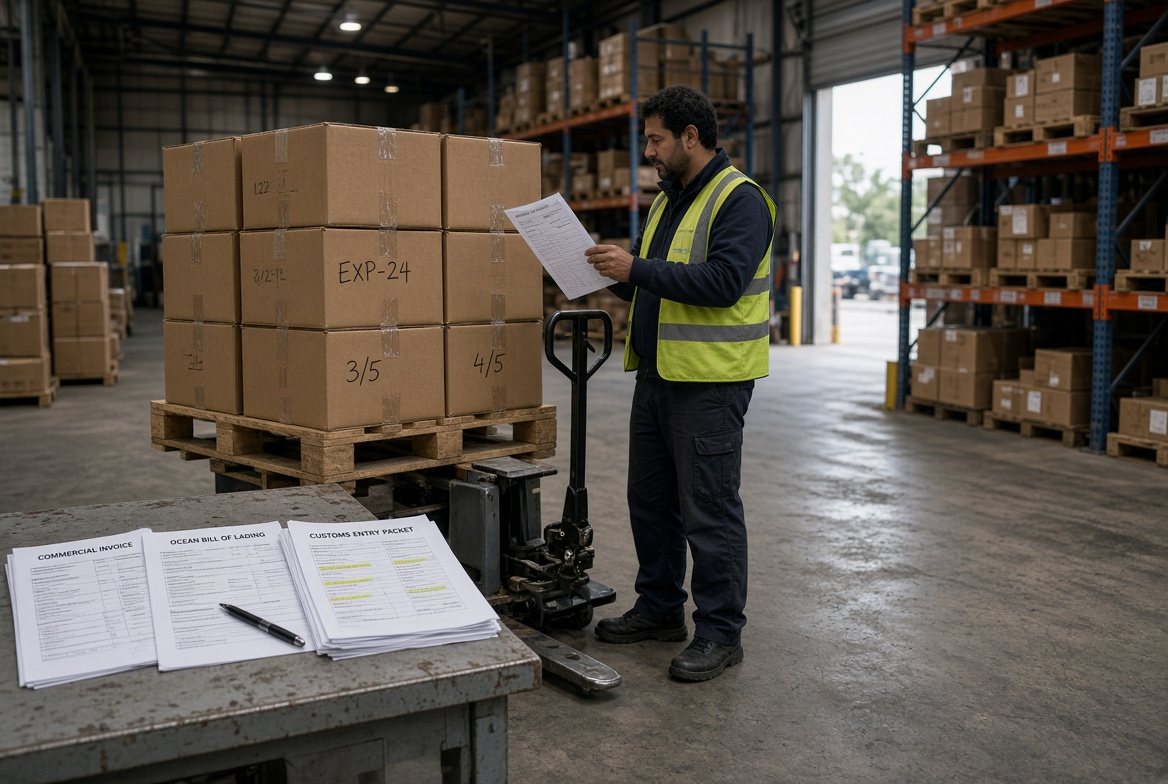
Common Causes of Customs Delays and How to Avoid Them
The reason for a shipment getting stuck in customs is typically a lack of classification, a missing certificate, an unpaid charge, or the file, not a mysterious “customs delay” for no given reason. There are checkable patterns for each of which is listed below, before cargo leaves China.
Inconsistent or incomplete documents
A common reason for holds are mismatching weights, values, carton counts or description on the invoice, packing list and B/L/AWB. There is no such thing as a favorite document. They stop the file until the three agree.
Prior to filing, run a 3-way match. Same sender/receiver names. Same piece count. Same weights. Same commodity terminology at an appropriate level of detail. Use the same invoice term (Incoterms) and currency.Identify the same invoice term (Incoterms) and currency on the invoice. If a number has been updated since it was loaded, update the document. Refrain from filing the old version and telling them afterward.
Classification and valuation questions
The treatment and calculation of the duties is determined by HS code and customs classification. The one-line description provided by a supplier is not a classification.A supplier generally doesn’t provide a classification, only one-line description, such as “plastic parts” or “electronic accessories” or “home goods.” The entry invites a question by copying it into the entry.
Value questions are the same as well. The declared value of goods that only covers a deposit, or goods that are very low in comparison to others is likely to result in a review. The preventive work is specific: write a description an officer can classify, to maintain the commercial value similar to the sale, and provide the broker with the facts behind the price if the product is new, customized or the price is too cheap. Taking a guess at a code to achieve a lower rate is what makes a short delay longer.
Missing certificates, licenses, or marks
When clearance is denied, it is because of product-specific documents or required marks. The country of origin markings, safety labels, test reports, and licenses are things to keep in mind when the factory is accustomed to domestic packing.
Check the destination list prior to packing cargo. If it is necessary for a mark to be placed on the carton or on the product, it is a factory task, not a broker task after the product is received. If a certificate is signed or accompanied by a lab report, the certificate should be taken during the goods are in China. The replacement of the missing paper from abroad is longer than printing one from origin.
Unpaid duties, taxes, or terminal charges
When the money is not in place, there is no movement of cargo on correct documents. Each duty, taxes, broker or terminal charge may prevent release. The Incoterms indicate who was supposed to pay what. It does not pay the bill.
Clear out the terms of payment before sailing, including who will be responsible for whom as the importer of record, who will be paying for duties, who will be paying for terminal charges and what will happen if there is an inspection day added to sailing. If the conversation is never recorded with the duty payer’s name, it is not a DDP plan. Write down the names at a time when the booking can be easily changed.
A Practical Pre-Clearance Checklist for Importers
The following is a checklist of import customs documents, which you can use with the forwarder or broker, prior to filing for entry. This is a work list and not a theory page.
Document checks before entry filing
- All of the above (invoice, packing list and B/L/AWB) refer to the same goods, piece count, and weights.
- Seller, buyer, consignee names are uniform and match with your desired importer.
- Commodity description is specific enough to classify, not a catalog slogan.
- On the invoice, the incoterms and the currency are indicated and are consistent with the commercial agreement.
- Don’t change quantity or value afterwards – they’ve been recorded in the papers already.
If one line is wrong, stop and correct the paper. If a mismatch is known, filing it will simply begin the delay process sooner.
Compliance and duty/tax readiness
- Make sure you test the classification with the destination broker prior to creation of entry, particularly for entry of a first shipment or a new SKU.
- Query if the product category requires certificates/licenses/marks, and obtain them prior to cargo leaving China.
- Identify those to pay duties and taxes for and how payment is to be made, according to the agreed Incoterm.
- Confirm post-release terminal and/or warehouse charges for settlement prior to delivery.
- Prior to the cargo release on paper, provide the broker with a receiving address, contact, and delivery window.
The last item is not a decoration, but rather operational. A shipment to be delivered has been released but no delivery instructions have been provided.
Frequently Asked Questions
How long does customs clearance usually take?
No single number reliable for all countries, products and files. A clean document and a simple transfer of a commodity moves faster than a first time shipment that has a missing piece of the documentation or a product is being inspected. The planning should be based on the readiness of the documents (and what you think you may need to check) rather than a promised “standard” clearance day count.
What documents do I need for customs clearance on an import from China?
The usual paperwork includes a commercial invoice, packing list, and bill of lading (B/L) or airway bill. There are also many products that require certificates, licenses or test reports. Before the goods are packed out from China, the destination broker should confirm the list with the factory for your commodity and country and the factory can correct packing or provide a missing paper.
Why would customs hold my shipment?
Holds are typically from inconsistent documentation, unclear classification or value, missing product specific documents or marks, selected inspection, or unpaid duties and charges. Ask which of these it is. Stuck in customs’ is a condition, not a disease.
Who is responsible for paying duties and taxes?
No responsibility is assumed for the commercial terms as well as the importer of record, but not for the tracking page. The “who pays” question should be included in the Incoterm. If not, the destination side will expect to see someone who pays the assessment before releasing. Call out the name of the payer before the cargo sails away.
Can I clear customs without a broker?
In some jurisdictions, an importer may be allowed to file an entry directly. There is still a significant number of importers who are still using a licensed broker due to the ease with which classification, valuation and local procedure can be missed on the initial shipment. The documents are filed by the importer of record and so are the legal obligations whether through a broker or on their own.
What is the difference between “cleared” and “delivered”?
Cleared – customs clearance accepted. Delivered indicates that the cargo has been delivered to the agreed destination after it has been released from the terminal and transported by truck. Shipments may be cleared and still remain at the port due to unpaid charges and/or no delivery order issued. Consider the two words as being two separate events.