
Lithium ions don’t need to be defective to be treated as a dangerous good, it’s because they can overheat and enter thermal runaway. The logistics of sending lithium-ion batteries from China is a compliance process: the cargo is to be classified correctly; it is to be packed and marked according to the rules in force; the test certificates and dangerous goods documentation are to be put together; and a space booking is to be made only at the booker’s assurance that the ship will be packed in that way.
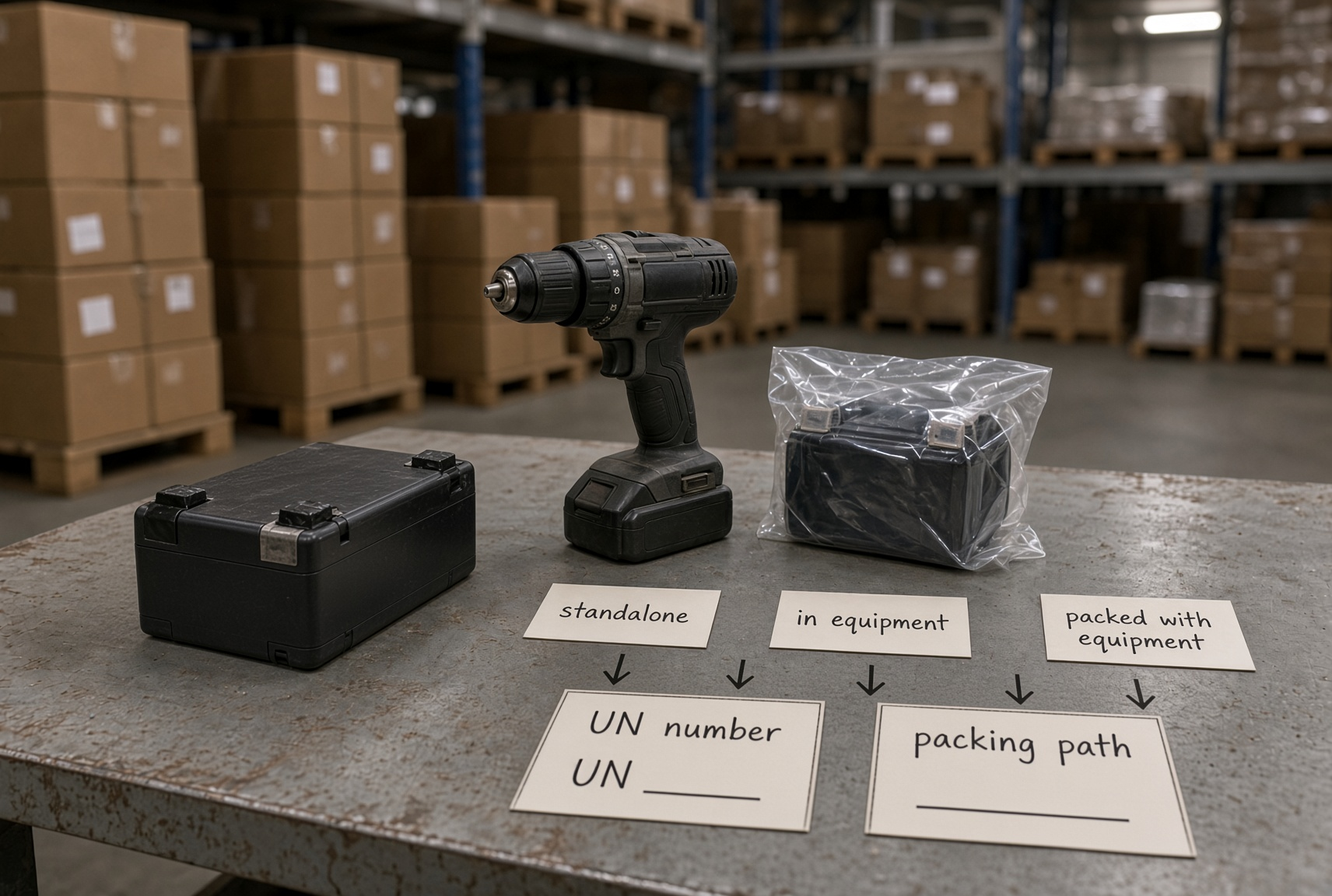
One trick for batteries in tools, bikes, or devices is to consider them as regular cargo. This is often incorrect. Equipment with lithium cells may still require Class 9 handling, lithium battery marking, quantity limits and a declaration that is consistent with the physical pack. The setup on the floor – standalone cells, batteries loaded with equipment or batteries within equipment – determines the UN entry, packaging and whether it will transport by air or sea.
Step 1 – Classification: UN Numbers and Shipping Configurations
All shipments of lithium batteries begin with the classification. The UN number, proper shipping name and packing path are based on what is being shipped from the warehouse, not a commercial invoice nickname for a product. If you miss this step, the carton marks, declaration and the booking all get lost of the cargo. The carriers test for that mismatch.
Classification determines the cargo which will be accepted. A watt-hour standalone pack is not the same booking problem as the same chemistry, same battery under a seal inside a consumer device. Treat them as one SKU and you will have to explain the reasons for the file bounce during the week with the airline or ocean line.
UN 3480, UN 3481, and related entries
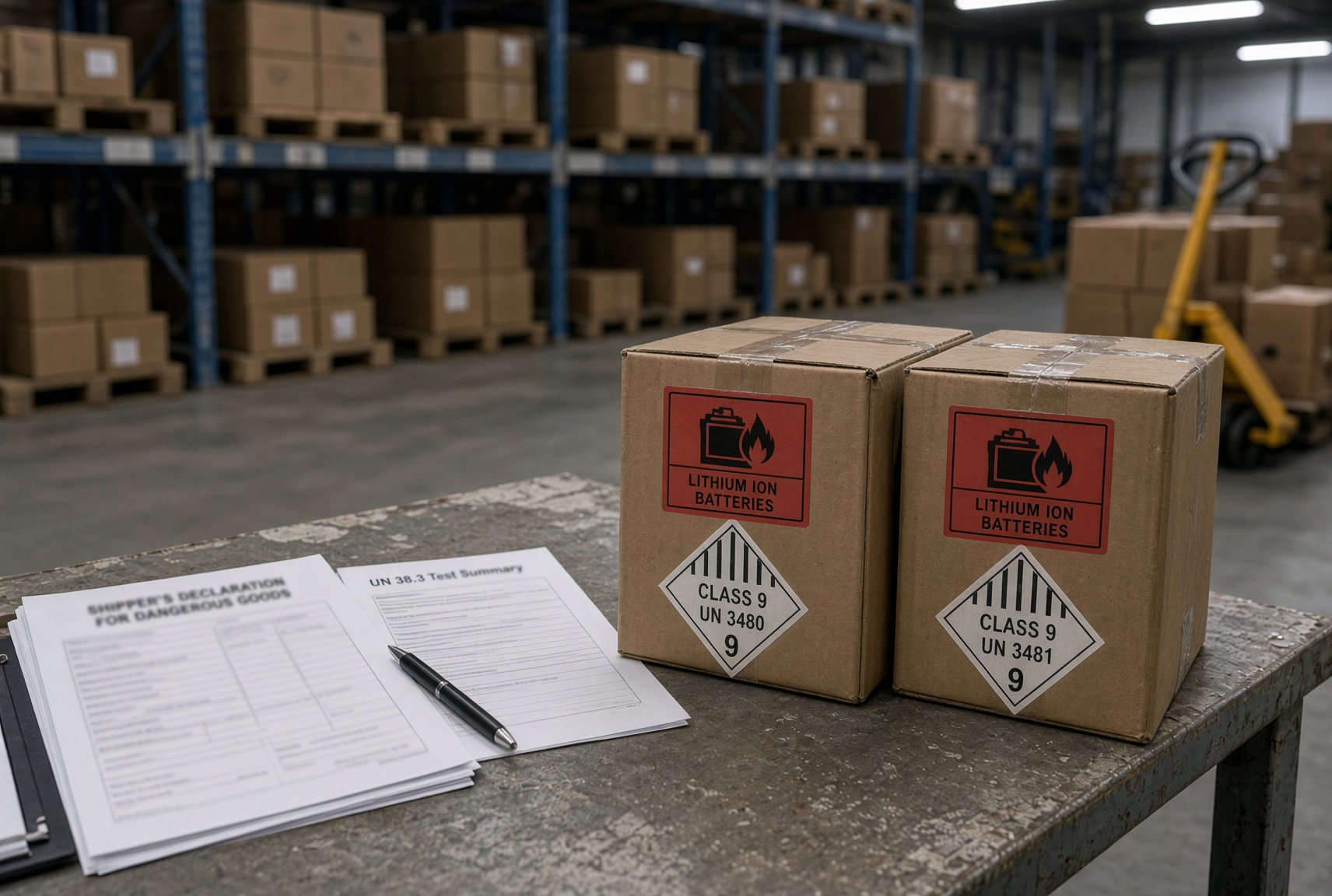
For use in current practice, lithium-ion cells and batteries are typically limited to a few UN entries. Standalone Lithium ion Cells and batteries are mostly declared as UN 3480. Equipment that has lithium ion batteries installed in it or contains lithium ion batteries is normally classified as UN 3481. For lithium metal cells and batteries, the pair of entries used is different. Those assignments are the language of bookings today and not a replacement for your actual classification for the mode you’ll be using.
The scene resembles the one that’s used in operations. A shipper sends an e-mail that reads, “200 cartons lithium battery, air to Los Angeles.”A shipper sends an e-mail stating: “lithium battery, 200 cartons, air to Los Angeles.” The first question is not the rate. Whether the battery is loose in the carton or a charger or tool, or whether the battery is already in the product. The UN number and the shipping name will be changed with that answer. Calling them all “lithium battery” is how UN 3480 is swapped on the paperwork for UN 3481 lithium batteries.
When the cargo is a mixture, related entries are important. A pallet of power tools with batteries will not be the same as a pallet of spare power tool packs in the same container. If both configurations are moving in unison, then they must be classified separately. Please do not combine them in the same UN number because the same invoice description was used by the factory.
Standalone batteries vs batteries in equipment
A cell may be presented in multiple ways, each having a different classification. These are the three most common export cargo configurations seen in China.
- Batteries or cells shipped without other components except for spare packs, energy-storage modules, replacement batteries.
- Batteries filled with equipment, e.g., the tool and spare tool pack in the same outer case.
- Batteries in products (e.g. an e-bike, laptop, handheld tool or power station with battery already installed).
Batteries or cells shipped without other components except for spare packs, energy-storage modules, replacement batteries.
Batteries filled with equipment, e.g., the tool and spare tool pack in the same outer case.
Batteries in products (e.g. an e-bike, laptop, handheld tool or power station with battery already installed).
The problem is to have one classification per order of the same model. At the factory, they completed devices in week one. Week two it ships spare packs as the buyer ran short. No change in the product name on the invoice. The UN entry did. If the warehouse does another marks, the next carrier screening will be able to detect it.
Watt-hour rating and its role
Watt-hour (Wh) rating is not an option. It is listed on the classification worksheet because it will impact packing instructions, package limits, and some marking requirements. The 20 Wh cell, 100 Wh pack and several hundred Wh energy module do not move in the same conditions for many air and some ocean rules.
Request the rating from the factory for the actual model in shipment, NOT for a “similar” pack of the same family. For a battery pack made up of several cells, check the rating published by the manufacturer for that particular battery pack. If the commercial invoice provides 36V 10Ah, and no one has yet converted to Wh, STOP and DO THE CONVERSION before anyone prints a label.
Use Wh as a control field in the same manner as net weight. It should be included on the test summary sheet, the spec sheet, the declaration sheet, and the inner and outer mark, where appropriate, for the instruction.
Step 2 – Compliant Packaging, Marking, and Labeling for Batteries
If the physical pack does not match the classification, then classification is not useful. Lithium battery packaging and documents fail together when the carton looks “neat” but the cells can move, and the marks refer to a different UN entry than the declaration. This section is all about what the warehouse needs to do at the time the truck departs.
Don’t use packaging as a marketing ploy. The outer box must withstand stacking, droppings and the sortation that battery cargo experiences. A thin mailer which appears neat on a photo, will not do the same on the path.
Inner and outer packaging and cushioning
Batteries must be packed so they are not shorted, shifted or crushed against other cells. In practice that means:
- Batteries must be packed so they are not shorted, shifted or crushed against other cells. In practice that means:
- Single terminal protection (caps, tape or recessed terminals not in contact with metal).
- A package which prevents motion of each battery or device within the carton, which acts as the outer packaging.
- Cushioning to fill-in gaps without concealing damage.
- A durable outer casing that is suitable for the weight and stack height to be used.
This is a common reject in which loose spare packs are falling into a thin export carton. The box could look fine at the factory and not pass the drop and/or stacking test at an airline or ocean terminal. Open plastic trays of power-tool batteries—this time with a photo!
If devices are packed with spare batteries, keep the spare packs from contacting the metal parts of the tool. Separate packs if they are contained in the same outer box to avoid having a crushed corner create a circuit across two terminals. The warehouse should pack according to the instruction that is in line with the classified configuration, rather than according to the lowest cost carton on the shelf.
Lithium battery marks and hazard labels
Lithium battery mark, UN number and — if applicable — a Class 9 hazard mark and additional transport marks are often required in packages. This combination varies according to mode, amount and batteries being in equipment or stand-alone. It is not a method to copy the label set template from last year.
The errors appear repeatedly. The first is a good-looking class 9 label on the carton, but still with the wrong UN number. The second one is a Lithium Battery spec mark with no watt-hours or a watt-hour number that does not correspond to the spec sheet. They both appear “full” when viewed from 2 m distance. A desk review is done for both and they fail it.
Marks must correspond with the declaration line for that package. The pallets are not allowed to contain both UN 3480 spare packs and UN 3481 devices unless they are in separate cartons. Any labels that were placed previously should be removed and not covered with another label that will peel off in humidity.
State of charge and special packing conditions
Some modes and carriers have a state of charge (SoC) limit for standalone lithium ion batteries, and they may limit the number of cells or packs per package. This tends to be more demanding on air freight than sea freight. A pack that has been charged to 80% or 100% upon leaving the factory can actually be legally unsellable for the air booking that you thought you were going to sell.
Before the factory seals the cartons, please verify the SoC rules and packing conditions. Once goods arrive at the gateway, it is typical to inquire about the goods, which typically involves the opening of boxes, discharging of packs, or the movement of goods to ocean. None of these restore the original cut-off.
Other packing conditions may consist of orientation arrows, bans on stacking, temperature markings or plugged equipment and protection from accidental activation. Document those conditions in the packing SOP for this SKU. Please do not hand them on verbally to the last person on the packing line.
Step 3 – Test Reports and Dangerous Goods Documents for Batteries
Packaging is not a replacement for documents. They must explain the exact same goods that the warehouse has packed. A lithium battery test report for shipping of a model or different Wh rating or a different design of a pack is not “close enough.” Carriers and destination authorities equate the paper to the physical goods.
The file should be created as follows: classification, test evidence for the actual cells or packs, dangerous goods declaration, commercial papers. If the four items are not all the same, STOP and correct the file. If the booking is over a known mismatch, it will simply be pushed to the ramp.
UN 38.3-type test summaries and manufacturer letters
The majority of shipments of lithium batteries require certification as having passed the transport testing protocol known as the UN 38.3-type tests. Typically what carriers will want is a summary test and if necessary, a manufacturer letter that correlates the summary test with the models on the shipment.
Summary must be in line with the goods. A 48V 20Ah pack from the same brand is not included in a report for a 36V 5Ah pack. If the design or protection circuit, or configuration, of a battery pack has changed, there is no automatic coverage on the finished battery assembly in a cell level report. Ask what document covers the completed product being exported from the factory if they were assembled in China from cells that were tested elsewhere.
Don’t use a scanned copy of the latest version from 2 generations of the product. If the buyer changes suppliers in the middle of the program, replace the test file. The usual culprit for a screened booking killing it after cargo has been loaded is because it’s the same chemistry.
Shipper’s Declaration for Dangerous Goods
A dangerous goods declaration for lithium batteries must accurately describe the cargo that is classified: UN Number, Proper Shipping Name, Class, Packing Group (if applicable), quantity, packaging type, and an emergency contact that can be reached. The declaration is the main hazard for the booking. All other should match it.
The classic mismatch is when the tools are in the cartons with batteries in place, and the declaration is written for standalone batteries. Another is a quantity unit which is not consistent with the way the goods were packed at the warehouse – pieces on the declaration, kilograms on the packing list, and ‘cartons’ on the invoice.
The shipper on the declaration is responsible for being able to back up the classification. Someone must verify the UN number and shipping name match the cargo on the floor, if the UN number and shipping name on the form match the cargo bookings on the form it could be the forwarder, if not it must be the factory. A statement that will look neat and say the wrong configuration is worse than a draft that is half-done, because it will get farther until it is picked up.
SDS, commercial invoice, and consistency checks
All the following documents should match the declaration and test report: product name, model, Wh rating, quantity, standalone or in equipment. The commercial invoice is read by destination customs.Destination customs reads the commercial invoice. The carrier reads the declaration. If these 2 documents show conflicting information, it is a stalling shipment.
Follow the hazard information of the DG declaration as the master document. Then take a stroll around the commercial papers against it. If your model number is nearly identical, with an additional letter, a variation in size or a “Pro” model, it is assumed to be a different article until confirmed by the manufacturer.
If the SDS is a generic batch SDS pulled from a supplier’s website for a particular product, and the cargo is a finished battery pack, be sure the SDS is the one belonging to the battery pack, not the generic one. Consistency checks are not done for a held container.
Step 4 – Carrier Approval, Mode Choice, and Operational Constraints
The classification, packing, and document is not a guarantee for a booking. The Gate for lithium battery shipment is a separate one approved by the carrier. Airlines, ocean lines and some truckers check battery cargo against their own list of accepted cargo, aircraft or vessel limitations and route restrictions. Those lists are not static and, in fact, are sometimes more stringent than the basic transport regulation.
A rate confirmation is not an acceptance. Request the carrier’s proof of what is required, send it and wait for written authorization of that configuration on that mode.
Pre-approval and battery screening by carriers
Pre-approval of lithium batteries is usually required by many carriers, particularly for air freight, high Wh packs, standalone batteries, or energy storage cargo. Typically, screening requests include the UN number, shipping name, Wh rating, SoC, package type, quantity per package, test summary and occasionally photos of the packed cartons and marks.
That screening is the only way for cargo to enter the gateway and halt. The airline station or ocean terminal will NOT “work it out on the ramp.” They will book you out and then you will get stuck with a storage bill and a weekend issue.
Send same file that the warehouse used. If a different model is packed by the factory once the photos have been taken for approval, the approval is not valid for the new cartons. Re-screen when the configuration changes.
Air vs sea: different risk tolerance and rules
The decision between air and sea freight for lithium batteries isn’t a straightforward one based on costs or speed. With the exception of SoC limits, which may be more stringent, and the amount allowed per package (which may be stricter), and which configurations are accepted on passenger versus freighter aircraft, all of these are usually more rigid for air freight. There are some stand alone battery systems that do move by sea, but they are limited or not allowed in the air.
The danger is that a battery, which shipped by sea last quarter can fly this week under the same marks and charge level. It may not. If the buyer’s time necessitates an air conversation, classify and pack for air from the beginning. The process of converting a sea-packed shipment at the airport is slow, costly and in some cases may be impossible without bringing the shipment back to a DG packing bench.
Sea freight is not ‘unrestricted’.” Vessels are still subject to DG lists, stowage and documentation checks. This is typically the easier option for heavier standalone packs or energy storage loads carrying documents and marks, as long as they are accurate. Select the mode based on the battery setup, not on a general preference for transportation.
DG surcharges, handling, and cut-off times
Lithium battery shipments frequently are subject to DG surcharges, require special consideration and have earlier cut-off times than general cargo. Financialize for those expenses, as well as additional calendar time. Bookings that seem cheap up until that point in time when the DG fee comes on screen are not cheap bookings.
Handling may involve a different segregated staging area, additional checks and a limited window of opportunity for receiving at the airline and/or ocean terminal. In the case of the general cargo clock, the battery cargo has been late if the factory is late. Construct the timeline for the pickup and warehouse backwards from that previous gate, not the ETD for the vessel or flight on a non-DG schedule.
Common Mistakes That Get Battery Shipments Rejected
Rejection of shipments of lithium batteries is usually not a mysterious occurrence. They are gleaned from a short list of avoidable errors. The following section is for pre-alerting, not for post mortem.
Misclassification or missing classification
Typical failures:
- No spares protected by terminals.
- Thin carton with empty space containing loose batteries.
- Lithium battery mark is missing.
- Wrong or missing UN number on outside package.
- Marks left by the previous user on re-used cartons.
Labels that are placed above the instruction, but not required by it, or not placed, are considered Class 9.
Wrong or missing packaging, marks, and labels
Typical failures:
- Mistakes on the DG declaration in UN number, shipping name or quantity.
- Test summaries for various model, capacity, and pack designs.
- Manufacturer letters that reference a factory not mentioned in the commercial invoice.
- SDS or invoice descriptions referring to “parts” with the declaration referring to standalone batteries.
- Completeness of pages is checked and rejected if they do not agree. Completeness does not equal consistency.
- A Lithium Battery Shipping Checklist for Shippers
This is a working list to share with the factory, forwarder and carrier. It will NOT override an existing classification. It will prevent most of the files from being left unfinished in the building.
Declaration and test report mismatches
Typical failures:
- Typos in UN number, shipping name, or quantity on the DG declaration.
- Test summaries that cover a different model, capacity, or pack design.
- Manufacturer letters that name a factory the commercial invoice does not mention.
- SDS or invoice descriptions that call the cargo “parts” while the declaration calls it standalone batteries.
Carriers reject complete-looking files when the pages disagree. Completeness is not consistency.
A Practical Lithium Battery Shipping Checklist for Shippers
Use this as a working list with the factory, the forwarder, and the carrier. It will not replace a current classification. It will stop most files from leaving the building unfinished.
Before classification is finalized
- Obtain the current SDS and the battery or device spec sheet for the exact model.
- Confirm watt-hour rating and whether the figure is cell-level or pack-level.
- State the shipping configuration: standalone, packed with equipment, or contained in equipment.
- Confirm whether the equipment can be powered on in transit and how it will be secured against activation.
- If the product is a pack assembled from purchased cells, identify which test document covers the finished article.
- Engage a qualified DG classifier when the configuration is mixed, the Wh rating is high, or the factory’s last shipment used a different UN entry.
Do not lock a freight mode before these items are written down. Mode choice depends on them.
Before booking and handover to carrier
- Confirm classification: UN number, proper shipping name, class, and the packing path for the chosen mode.
- Pack to that path: terminal protection, cushioning, rigid outer package, and the marks and labels that belong to that entry.
- Confirm SoC and quantity limits for the mode and the carrier you intend to use.
- Prepare the dangerous goods declaration so it matches the packed cargo.
- Gather the UN 38.3-type test summary and any manufacturer letter that ties the summary to the shipped models.
- Align the SDS, commercial invoice, and packing list with the declaration.
- Obtain carrier approval in writing for that configuration, quantity, and mode.
- Photograph marks, labels, and inner packing on the actual tender cartons.
- Build pickup and gateway timing against the DG cut-off, not the general-cargo cut-off.
If any line is still “to follow,” the cargo is not ready to tender.
Frequently Asked Questions
What is the first step in shipping lithium-ion batteries from China?
Classification. Identify whether the batteries are standalone, packed with equipment, or contained in equipment, then assign the UN number, shipping name, and packing path that match that configuration and watt-hour rating. Packaging, marks, documents, and carrier screening all follow from that decision. Booking first and classifying later is how cargo gets rejected at the gateway.
Who is responsible for classifying lithium batteries: supplier or forwarder?
The shipper is responsible for presenting a correct classification of the goods being offered for transport. In practice the factory holds the spec sheet and the test file, and a forwarder or DG specialist can help apply the current transport rules to that data. Neither party can classify a battery they have not described. If the supplier cannot state configuration and Wh rating, the forwarder cannot invent them.
What test reports are typically required for lithium battery shipments?
Carriers and authorities commonly ask for a UN 38.3-type test summary for the cells or batteries actually being shipped, plus a manufacturer letter when the summary needs to be tied to a specific model or factory. The document has to cover the shipped configuration. A cell report does not automatically cover a redesigned pack, and a pack report does not cover a higher-capacity sibling model.
Can lithium batteries always ship by air if they can ship by sea?
No. Air freight generally applies tighter SoC limits, quantity limits, and configuration rules than ocean freight. A standalone pack that is acceptable on a vessel may be restricted or refused on an aircraft. Classify and pack for the mode you will use. Do not assume sea acceptance transfers to air.
Why do carriers reject battery shipments even when documents look complete?
Because the pages do not match each other or the physical cargo. Common causes are the wrong UN number for the configuration, a test summary for a different model, marks that do not match the declaration, SoC outside the carrier’s limit, or a booking that was never pre-approved. Completeness without consistency fails screening.
Do small lithium batteries in devices still need dangerous goods documentation?
Often yes, depending on watt-hour rating, quantity, mode, and how the device is packed. “It is only a small battery inside the product” is not a classification. Some device configurations travel with reduced documentation and marking; others still need a full DG declaration and Class 9 treatment. Confirm the current rule for that device, that quantity, and that mode before you treat the carton as general cargo.