
International shipping terms and abbreviations are found on every quote, contract, bill of lading and tracking screen an importer encounters as the goods are shipped out of China. They’re working language, they’re not filler. Incoterms determine who pays and where is the risk transferred. Space is booked according to container codes. What is outside the ocean line will be determined by charge codes. Date codes are the deciding factor in inventory planning. If you miss any of those, you compare incomplete prices or take on a liability that you didn’t mean to.
It’s hard to imagine that a one-line search result is the same term as used on a China factory pickup, LCL warehouse receipt, or door to door quote. This shipping dictionary for importer categorizes the words you actually come across: trade terms, equipment, charges, schedules, documents, and air/express billing and tells you what each of these words does to the cost, risk, and planning of your shipment.
Incoterms and Trade Terms: Who Pays What and Where Risk Transfers
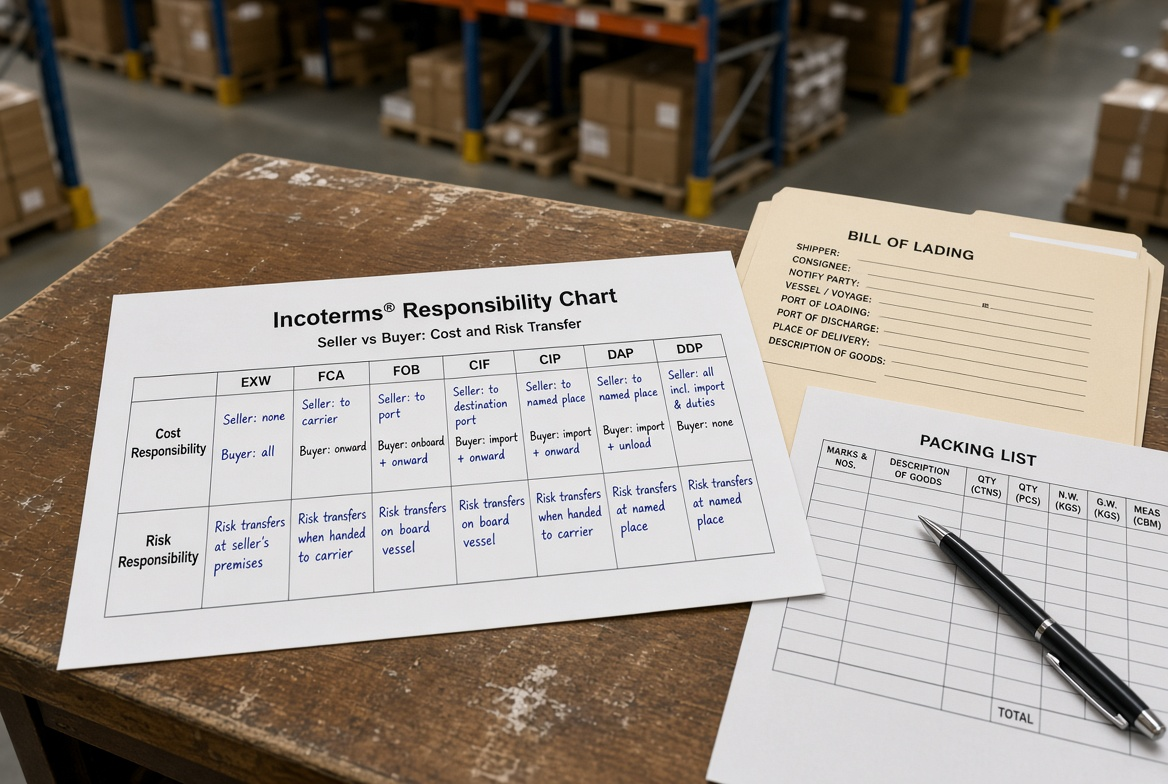
The trade term on the purchase order dictates all subsequent quotes, and the terms and shipping charges glossary entries begin here. The names of the place in the term are just as important as the three letters. The FOB Shenzhen and FOB factory, Dongguan are not the same job.
EXW (Ex Works)
EXW is the seller provides the goods at their premises or at another named place. Usually the buyer makes all arrangements for origin picking up, export formalities, main carriage, insurance, destination charges and duties. Risk typically passes when the goods are handed over to the buyer at that named place.
This is a normal occurrence in China imports if the buyer desires the freighter to pick up from a factory in Guangdong or Zhejiang and maintain freight control. The hidden work in EXW is the packing and loading of goods for export and export declaration, none of which the EXW seller is responsible for running.
FOB (Free On Board)
FOB is a term in which seller delivers the goods on board the buyer’s nominated ship at the named port of shipment and is responsible for export clearance. Main ocean freight, insurance, destination charges and duties are usually the responsibility of the buyer. The risk of goods is transferred once they’re on board at origin. FOB is one of the sea or inland waterway terms.
The FOB on factory contract is still commonly found in China imports even if goods are delivered at a container yard instead of over a ship’s rail. Verify port name & booking for the named vessel. If the seller says “FOB” and you have to arrange for the trucking to the terminal, that’s more like EXW in reality.
CIF (Cost, Insurance and Freight)
Cost, insurance, and freight from seller to the specified port. Risk is still transferred if the goods are on board at origin, not at arrival. Unless stated otherwise in the contract, destination unloading, terminal charges upon arrival, import clearance and duties typically rest with the buyer. CIF is not a comprehensive insurance policy and is a minimum cover only.
While a CIF quote from China may seem “all-in” until the destination THC, demurrage or inland delivery is itemized on an invoice, the devil is in the details. Only compare CIF with other port-arrival scopes.
DAP (Delivered At Place)
In DAP, the seller delivers the goods when they are ready to be loaded onto the vessel at the named place of destination and the seller pays the carriage to the named place of destination. Import clearance, import duties and taxes are generally done by Buyer of goods. Risk of loss passes at the named place at the time the goods are ready for unloading.
DAP is useful in China door programs where the seller and/or forwarder is required to deliver the goods to the buyer’s warehouse or a named terminal, but the buyer wishes to have his own broker on entry. Specify the precise name of the location: a port gate, a CFS and a warehouse dock are 3 different deliveries.
DDP (Delivered Duty Paid)
DDP is when the seller provides the goods for importation at the designated location, and the duties and taxes are paid. This is the highest of the common terms that sellers can be bound by. Typically, the buyer’s tasks will be restricted to unloading the contents, unless the contract specifies otherwise.
DDP isn’t synonymous with “no paperwork” from China. There should still be classification, bonding and destination restrictions that can be used. The term on the PO will not save the shipment if a seller is not able to actually clear and pay duty in the market.
FCA (Free Carrier)
FCA: The seller arranges the delivery of the goods to the carrier or to another party nominated by the buyer at the named place and shall take care of export clearance. The risk passes through that transfer. FCA is applicable to all modes of transport such as container yard delivery, airport delivery etc.
FCA at a named CY or forwarder warehouse can more readily suit the needs of the containerized China exports. Auditing a documented handoff with the seller is the end of their job, not when you see the vessel.
CIP (Carriage and Insurance Paid To)
CIP – Carriage and Insurance to the named destination is the responsibility of the seller. Risk "transfers" when the goods are passed to the first carrier – this can be well before the main voyage. The insurance cover that is required under CIP is higher than the minimum CIF cover.
If moving by more than one mode, consider using CIP and use the named place, policy limit and destination charges contingencies after the sale.
Container and Freight Types: FCL, LCL, and Equipment Terms
These FCL LCL THC D&D terms for importers govern the actual movement of the cargo and you the importer’s handling.
FCL (Full Container Load)
FCL refers to using a full container load with the arrangement agreed upon. The use of typical volume, weight or cargo control is sufficient to warrant the box. The reason for this is that the cost is dependent on container utilisation, not carton quantity. Before the container is full, it may reach weight limits when loaded heavily.
LCL (Less than Container Load)
LCL is when cargo is sharing a container with other cargo. This is good for lots that won’t require a full-sized box, but at the cost of receiving, consolidating, and deconsolidating. There are no cutoffs or additional handoffs as an optional add-on, but rather a component of the product.
20ft / 40ft / 40HC (High Cube)
Common dry container dimensions. A 20ft box is generally used for large and heavy loads. A 40ft box is a box with a length that is 40ft. A 40ft high cube provides extra space for light, large cartons. When it is not the proper size, you are wasting money on unused "cube" or you will have to buy a second container.
TEU (Twenty-Foot Equivalent Unit)
A TEU is a unit of capacity measuring 1x20ft container. A 40ft container is equivalent to 2 TEUs. TEU is used by the carrier, port and planning teams to discuss space and volume, not carton numbers.
SOC (Shipper’s Owned Container)
If the container is not owned or leased by the ocean carrier, it is classified as SOC. It can be useful for when you need to use equipment control, special equipment or a one-way move. You also assume the duty of positioning, repair and planning to return or dispose.
COC (Carrier’s Owned Container)
COC (Carrier Provided) indicates that the carrier will furnish the box. It is the normal course of business for most commercial China export. That carrier’s equipment is subject to free time, detention, and per diem rules. The box is not your own but is borrowed on a clock.
Dry Container, Reefer, Open-Top, Flat-Rack
The basic closed steel box for ordinary cargo is dry container. A reefer is refrigerated. Open top and flat racks are used for cargo that will not fit through standard doors or for over height or over width planning. Cost of a special equipment is higher than dry box and is booked earlier.
Charges and Fees: Understanding the Cost Components
One line is an ocean or air line haul. The rest of the stack is explained using these abbreviations.
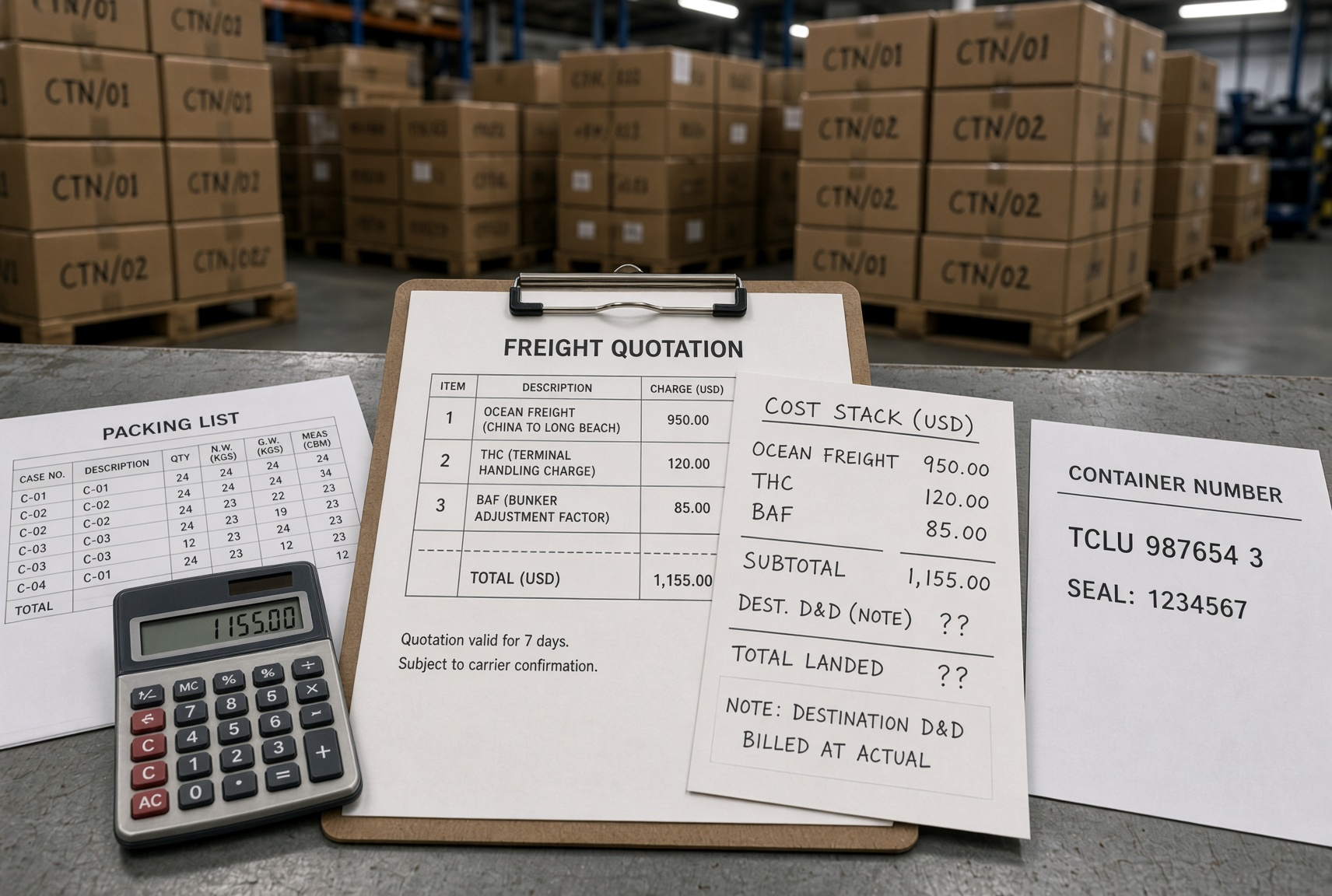
THC (Terminal Handling Charge)
The charge the terminal imposes for movement of the container/cargo at the terminal or port is called THC. Can be seen at origin or at destination or both. This is a standard handling charge and is not a penalty. You mostly affect it if you know if it already exists inside the quote.
D&D (Demurrage and Detention)
D&D is the short-hand for two related penalty clocks: demurrage and detention. Those quotes of “D&D excluded” are telling you those clocks are your problem as free time ends.
Demurrage
Demurrage is paid if the container remains in the terminal/CY after the free time. It’s not a freight rate, it’s a destination or origin storage penalty. A fast clear up and an appointment for pick up decreases it.
Detention
The fees for detention are imposed when the container is away from the terminal (typically in your warehouse or on the road) outside free time. It is a penalty for equipment that is late. It’s kept down by same day unload and empty return.
Per Diem
After free time there is also a charge for equipment usage every day, commonly referred to as per diem, which is discussed at the same time as detention. Review the tariff: some contracts will recognize per diem and detention as one clock, but under different names.
CFS (Container Freight Station) Charges
CFS charges are for receiving, stuffing, stripping or holding LCL cargo at the container freight station. These are origin and/or destination handling fees not a fine. They can be supplemented with late cargo or additional sorting.
BAF / FAF (Bunker / Fuel Adjustment Factor)
Fuel Surcharge – BAF or FAF – is an additional charge on the ocean or intermodal move. It is not a punishment, but an average penalty. You don’t ‘avoid’ it but just find out if it’s all-in or base-rate plus BAF.
CAF (Currency Adjustment Factor)
When currency is moved between the tariff currency and the billing currency, CAF will adjust the freight rate to reflect the change. It comes as a regular surcharge when used.
PSS (Peak Season Surcharge)
PSS is a small fee that is charged for high demand sailing and flight times. It depends on the time of the year and the filing of the carrier. The pragmatic answer is to book in advance, and remain flexible about sailings.
Door-to-Door, Port-to-Port, CY/CY
These are the terms of the service scope that have to do with cost. Typically, port-to-port or CY/CY will end at the container yard. Door to door includes pickup from and/or delivery to the door. There can be no comparison between two quotes without matching scope words.
Dates, Tracking, and Schedule Terms
ETD, ETA, ATD, ATA shipping labels should not only be in the tracking email, but also in the planning.
ETD (Estimated Time of Departure)
ETD: Expected Time of Departure of the Vessel, Flight or train. Line-up factory readiness and cut-off with it. It is an estimate. Without a cargo cut-off, the ETD is of no significance.
ETA (Estimated Time of Arrival)
ETA is the expected time of arrival at the specified port, airport or ramp. It can be the difference between having a receiving and inventory plan in place for the warehouse or not. It can be moved after booking due to either port congestion or weather or itinerary changes.
ATD (Actual Time of Departure)
ATD is the time the conveyance actually left. After ATD posts, you’re no longer planning against an expected sailing and you’re measuring your transit from an actual event.
ATA (Actual Time of Arrival)
ATA is always the moment the conveyance did arrive. Customs or terminal free time or delivery appointments should be measured from the reality and not from the original ETA.
Cut-Off Time
The last date on which cargo and/or documents are due before a scheduled departure. The port and terminal cut-off can vary from the document cut-off and VGM cut-off. The absence of any of them will cause the shipment to roll.
Transit Time
Transit time: the anticipated time of the primary international transportation, which can be expressed port-to-port or door-to-door. Stick to the scope that the number is referring to. The origin handling and destination dwell does not factor into port-to-port time, but it does count towards door-to-door time.
Rollover
Rollover: The cargo has been dropped off the intended vessel or flight and transferred to another later one. Can be caused by space, weight, documentation, or terminal congestion. Include buffer in launch and replenishment dates.
Blank Sailing
Blank sailing is the “cancellation of a scheduled port call or voyage.” The booked cargo is wound up for the future voyages. It is not a defect of the cargo; it is a schedule event. The planning responses are alternative sailings or a mode change.
Documents, Compliance, and Cargo Handling Terms
Delayed arrival of cargo due to wrong paper work. Use these as working tools.
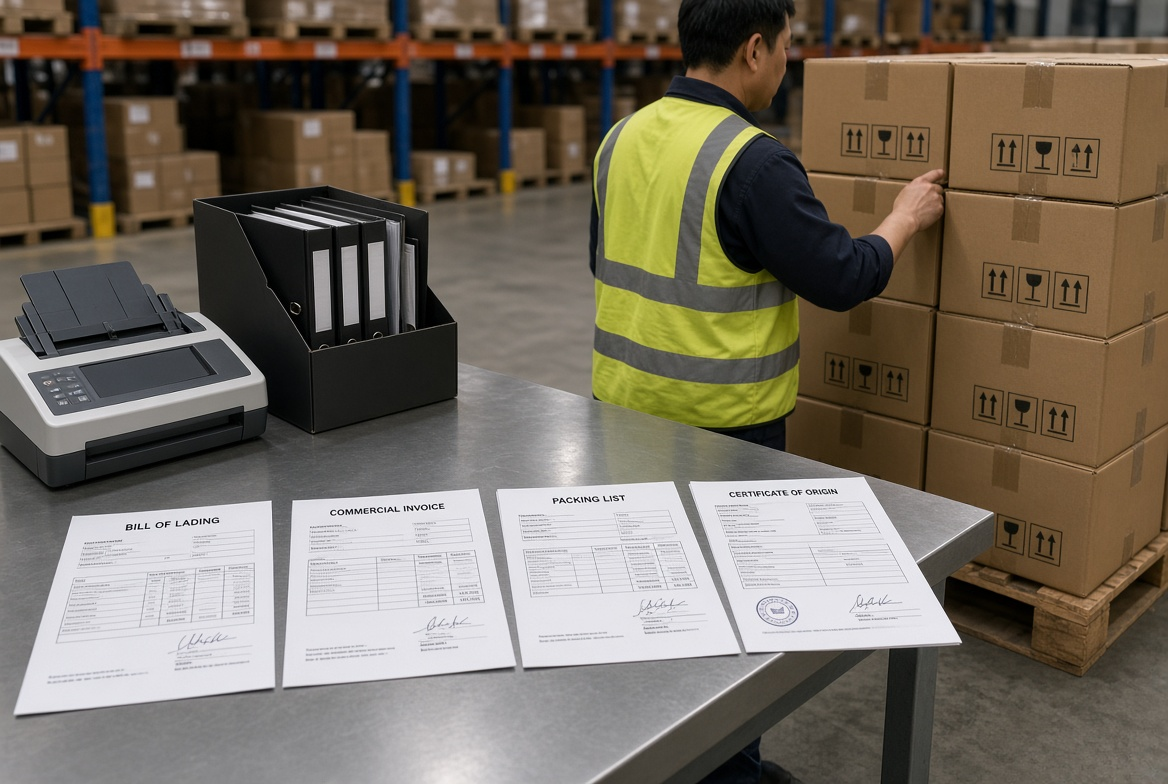
B/L (Bill of Lading)
The ocean transport document which can serve as receipt, contract evidence, and (in the case of a negotiable original) document of title is a bill of lading. It is issued by the carrier or NVOCC. Release at destination may often depend on surrender rules which are consistent with the issuance of the B/L.
Sea Waybill
A sea waybill is a document of sea carriage that is non-negotiable. Sometimes, cargo may be shipped to the consignee, who has been named rather than the original. It facilitates the transfer of title on simple commercial shipments when the transfer of title is not necessary.
Commercial Invoice
The commercial invoice details the goods sold, the quantity sold, to whom, the value of the goods and the terms of the sale. It is typically ready to use by the supplier. It is used for classification and duty by customs. A vague description or a value not listed on the packing list is a common hold up.
Packing List
The packing list details carton count, weights, dimensions and SKU packing. It is prepared by the supplier/ consolidator. It is responsible for receiving, LCL measurement and inspection. Discrepancies between cartons and invoice have a delay before anybody discusses duty.
HS Code (Harmonized System Code)
An HS code is a tariff classification number that is used to determine the duty and regulatory controls. When the supplier suggests a code, the importer of record must make sure that the code is correct. A mismatch code will result in a mis-match duty or an examination by customs.
Certificate of Origin
A certificate of origin is a document that indicates the place of origin of the goods. It is issued by the supplier or from a chamber or another body authorized for issuing it according to its shape. It is required in some cases for duty preference or entry to some destinations. Don’t expect a standard letterhead letter to suffice.
SDS (Safety Data Sheet)
Chemical hazard and handling information is provided in an SDS. It is supplied by the manufacturer or supplier. It is used by airlines, ocean carriers and destination authorities to determine if the cargo can move and how it should be packed.
Dangerous Goods (DG) Classification
DG classification is the official classification of hazard class, packing group and shipping name. The shipper is responsible for proper classification prior to booking space. If the commercial invoice appears ordinary, the batteries, aerosols or chemicals are not classified as “general cargo”.
Customs Clearance
Clearance of goods is the procedure by which goods are presented for entry and duty is paid or secured and goods are released. It is typically filed by a broker or the importer’s designated agent. Documents that do not have all the information required, valuation questions, exam holds, are not placed on the vessel, but rather, on this step.
Bonded Warehouse
A bonded warehouse is a customs clearance facility that provides goods with customs clearance before they are duty paid, based on local rules. It can assist if you receive cargo before you have finished getting on to it. It is not a free storage plan, its availability and time limits are different for each market.
Air and Express Shipping Terms
Air freight/express shipping terms glossary items have different pricing for space and speed than ocean.
Chargeable Weight
The chargeable weight is used to charge for air freight or express freight and it is defined as the greater of the actual scale weight or volumetric weight. A light bulky carton can cost a lot more than the kilos that are listed on the packing list.
Volumetric (Dimensional) Weight
Volumetric weight is the weight of a carton cube converted into a billing weight. It is used by carriers so that the low-density cargo pays for the space it takes up. The final carton size is more important than an estimate of the weight of the product.
Dimensional Factor
The divisor of length × width × height is the dimensional factor, typically 5,000 or 6,000 (in centimetre-kilo units) depending on the product. The smaller the divisor the greater the volumetric weight. Double check the factor on the quote before comparing two air offers.
Air Waybill (AWB)
Air waybill becomes the air-transport contract and receipt. It is not an ocean-B/L type document of title. It has live tracking, routing and consignee information.
Master Air Waybill (MAWB) vs House Air Waybill (HAWB)
The airline will provide the MAWB to the consolidator/forwarder. The forwarder makes out a HAWB to the shipper or consignee. Your tracking number may be a house document and the airport the master. Be familiar with the number of the destination agent.
Airport-to-Airport vs Door-to-Door (Express)
Airport-to-airport does not end until at the destination airport. Door to Door Express is a product of the Courier/Forwarder product which includes Pickup and Delivery. PVG or CAN is not your warehouses.
Courier vs Traditional Air Freight
Courier companies like DHL, FedEx and UPS transport door-to-door parcels and small-sized freight with built-in clearance services. Traditional air freight transports larger quantities of goods on airlines’ transport space, requiring a separate pick-up, customs clearance and delivery process if these are not included. Do not make your selection based just on brand recognition.
How to Use This Glossary in Daily Import Operations
Your list of international shipping terms and abbreviations is only as useful as it is if it leads you to read the next quote differently. Practical shipping vocabulary for overseas importers is not a test of vocabulary but a way to check.
Quick Checks When Reviewing Quotes and Contracts
Read the Incoterm and named place first. Then identify those charges that are included or not included; origin pick up, THC, BAF or PSS, destination THC, D&D, clearance, delivery. Finally, match the scope words for the service to the price: door to door, port to port, CY/CY, airport to airport. Note: If two offers have different terms or different scope, then it’s not a comparison.
Aligning Internal Teams and Suppliers on Common Terms
Three letters are used for different jobs by procurement, finance, warehouse, and the sales teams. To some, FOB is "seller handles export", and to others it is “price includes ocean”? When you issue a PO or approve a freight quote, or brief a new supplier, share the relevant portion of this glossary. There are fewer messages beginning with “I thought that was included.”
Building a Company-Specific “Top 20 Terms” Cheat Sheet
Not all the terms are equally important to frequent importers. Create a one page sheet of the 20 words used in your lanes, including one-line definitions in your own workflow language, such as FOB or FCA, FCL or LCL, THC, D&D, ETD/ETA, B/L, HS code, and chargeable weight. New staff members can read quotes quicker and suppliers will not be perpetrating their own definitions of common codes.
Summary Guidance – Turning Jargon Into a Practical Advantage
Shipping language is created because the labor is divided between the factories, terminals, carriers, brokers and warehouses. The benefit is not to learn all the abbreviations. It’s understanding which term will increase your cost, which will change your risk, and which will just define a schedule estimate. With that filter read the next China quote and it’s not a riddle anymore, it’s a plan.