If you’ve been familiar with the Chinese factory quote "FOB Yantian" and wondered what the "FOB" stands for in shipping, here it is. FOB (Free on Board) means that the seller delivers the goods when the goods are placed on board the vessel at a named port of loading under Incoterms® 2020 and risk transfers at that time. The seller will typically arrange for goods to be loaded onto a ship from the factory to that port on a China export.On a China export, the seller will normally arrange for the goods to be loaded onto a ship from the factory to that port, and will arrange for the completion of export formalities. You book and pay ocean freight and destination clearance, duty, delivery handled.
It deals with the actual costs and the various risks that go along with an FOB price, what each party is expected to do and also when FOB makes sense for a sea shipment from China.
FOB (Free on Board) Defined in Plain Language
FOB is an ocean & inland-waterways term. The seller’s performance is considered to be completed with the delivery of the goods on board the vessel at the named port of shipment. From there the buyer assumes ownership of the main carriage and assumes risk of loss or damage in transit, aside from any origin charges paid by the seller.
FOB is not an air or express term, and is not a door to door promise. A courier parcel, with “FOB Shenzhen” written on it, is playing with the letters. FCA is the more appropriate Incoterm for air freight. Don’t use FOB as a general term for “the factory will ship it.”; use it for ocean cargo as a port-loading term.
The content of this article is paraphrased commercial practice according to Incoterms® 2020. It does not constitute legal advice. Rules are published by the International Chamber of Commerce and your sales contract and named port will determine how the term is interpreted.
Where Delivery and Risk Transfer Under FOB
Delivery and risk transfer occur simultaneously: delivery occurs at the same time as the goods are aboard the vessel at the named port of loading. The term “FOB Yantian” or “FOB Ningbo” or “FOB Shanghai” refers to that event at that port.
Once the cargo has been loaded, any damage in transit, delay after sailing and any loss to the terminal at the destination port or place of destination is normally the responsibility of the buyer unless there is cargo insurance to protect them against such damage and delay. One thing that often gets confused is that risk remains on the seller until the container is closed, the bill of lading is issued, or the box arrives at the seller’s warehouse. Sealing and documents are important. These do not take the place of the on-board transfer point in the FOB rule.
FOB Requires a Named Port, Not “FOB China”
“FOB China” doesn’t specify any particular terminal, sailing or inland transport that the seller is required to make. China has numerous loading ports. Different jobs like factory to Yantian and factory to shanghai, different trucking, cut-offs, origin charges.
Do not accept a proforma invoice with a blank line for the “FOB”. Specify the port of loading in the contract, such as “FOB Yantian” or “FOB Ningbo.” When the factory decides to change ports later, consider it a change of term and not a footnote on the paperwork. All port changes impact trucking, cut off dates and even often who can book the vessel.
The Real Cost Stack Behind an FOB Quote From China
An FOB unit price will be clean as it stops at the ship’s rail. Landed cost doesn’t. The seller’s number is to cover the route from the factory to on board at the named port. Ocean freight, destination terminal charges, customs, duty, inland trucking and last mile delivery are still on your side of the ledger.
Don’t compare quotes until you have mapped that whole path. Two factories may have the same FOB price and whilst you may be charged the same freight and destination price you may end up with a very different total cost.
Origin Costs Covered by the Seller Under FOB
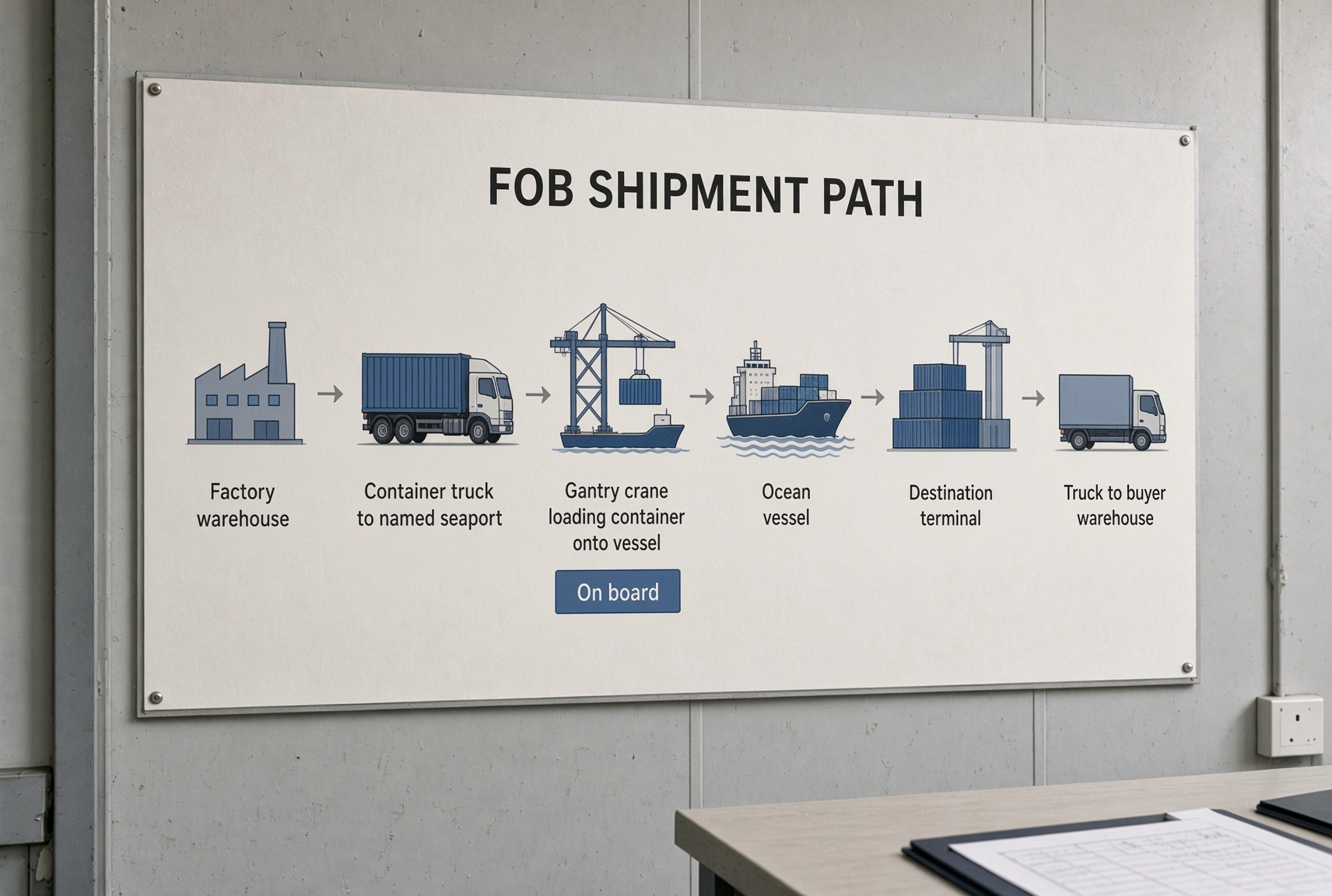
Under the properly used FOB term, the seller pays and arranges:
- The factory packing to export standard will be used.
- Road transport from manufacturing to the mentioned port.
- Documents required for export declaration and usual export documents.
- Port handling up to loading on board
- Loading of goods on the ship at that port
Practice still varies. Some FOB price sellers incorporate origin terminal handling charges (THC) and documentation charges. Others display them as extras once they have been nominated as a forwarder. Who appoints the origin agent also varies. Confirm in writing the seller’s or the buyer’s nomination of the forwarder, and whether the seller’s or buyer’s origin line items are included in the FOB price or billed later.
Main Carriage and Destination Costs Paid by the Buyer
After the goods have been shipped, it’s your bill of fare. Budget for:
- Ocean freight and bunker/fuel surcharges
- Security and advance-filing fees required in the lane (such as security on an AMS or ENS type filing)
- The choice of destination THC and terminal storage when time is missed
- Customs clearance and agency charges
- Import taxes and charges
- Inland trucking from the discharge port or CFS
- To-the-door service to your warehouse/customer.
- If purchased (FOB does not include this) cargo insurance.
The difference between the two FOB unit prices may be small when compared to those destination and duty lines. Once you have that origin-to-warehouse map, review mode, routing and clearance practice for the country you actually ship to, using the country-level shipping from China instructions.
A Simple FOB Cost Checklist for Importers
Please make sure to make a copy of this list before comparing an FOB quote with EXW or DDP:
- The price quoted by the seller is the factory to on board at the named port (FOB).
- Fuel surcharges & Ocean freight.
- Origin and destination security and documentation fees (as applicable)
- Cargo insurance (optional, but recommended)
- Clearance fees and Destination THC.
- Import and export taxes and fees
- Inland trucking and last-mile delivery.
An FOB price is a one-line price. The list is landed cost. If supplier or forwarder can’t assist you in filling in the blank lines, you don’t have a similar quotation yet.
Risks and Responsibilities for the Buyer Under FOB
FOB allows the buyer to have a say in the booking of the ocean leg and a say in the onward leg. It also places the ride risk to the buyer at the point "on board". The convenience of the term comes at a cost: the trade-off—and the likelihood of using it incorrectly.
Risk Transfer On Board at the Named Port
Risk passes when the goods are on board at the named port of loading. A damaged container in heavy weather, a short-landed container or a container that arrives wet on the deck of the vessel is usually a commercial loss for the buyer, unless the insurance company pays.
Don’t think in that way later when you arrive. Take photos of packing, keep the packing list up to date with the invoice and mark container and seal numbers. The Incoterm transfer point will not be moved by those records. They will defend a claim if it goes awry after loading.
Export Declaration and Forwarder Nomination
FOB usually means that the seller also arranges export formalities. This is why many importers choose FOB over EXW for a simple sea shipment – the factory is in closer proximity to the documents China Customs wants to see.
The catch is a nomination. If the origin forwarder is appointed by the seller, he works to the seller’s instructions. You are the one who arranges the letter of endorsement and have visibility of space and charges on the forwarder but the seller must make it at the specified port on time. Record the name of the person who books, the origin fee paid by, and who receives the draft bill of lading. Never take it for granted that the seller’s agent will reserve your freight rate or your free time on your destination without specific instructions.
Insurance Is Not Included in FOB
With FOB, there is no obligation to provide an insurance for the goods under Incoterms® 2020. The seller is not insured during the term of the sale. The buyer is responsible to cover from the on-board point forward and many buyers initiate cover earlier than their desired point of coverage if they wish to enjoy warehouse-to-warehouse protection.
However, on high dollar, high-value, or ocean-cargo that is fragile, skipping insurance – in the name of “saving cost” – is a bad deal. The price for the FOB price had already been settled at the ship. The ocean leg is the leg that is now yours.
Because FOB is a sea term and you control that ocean leg, compare sea freight from China as FCL or LCL before you treat the supplier’s FOB unit price as the whole plan. Container load and LCL consolidation change origin cut-offs, destination handling, and how charges appear—not only the ocean rate.
When FOB Makes Sense for Importers Buying From China
China as FCL or LCL before you consider the unit price FOB from the supplier as the entire plan. Not just the ocean rate is impacted by Container load and LCL consolidation, it is altered by the origin cut-off, the destination handling, and the way charges are presented.
You Want the Seller to Handle More Origin Work
FOB is a very common term in exports to China sea, as it divides the work at a place both parties are able to see – the named port. It isn’t always the lowest of the terms and isn’t the best term for every cargo.
You Are Shipping FCL or Standard LCL by Sea
FOB is applied when you wish the factory to take care of inland trucking to port, export declaration and loading onboard. This decreases the amount of origin vendors to pursue on a single supplier sea shipment. It still needs to be determined by you to watch the Cargo Ready Date and the Vessel Cut-off.
When FOB Is Usually the Wrong Choice
If the container is full from one supplier, the physical flow is often equal to FOB: the supplier delivers to the terminal, the container is then booked and the vessel is run destination work by the supplier. If the cargo is one lot, the port is agreed and both parties agree who will deliver the cargo into the consolidation warehouse and by what cut-off time, then Standard LCL can be used.
FOB vs EXW and FOB vs CIF — Short Decision Guidance
First time importers should never use FOB unless the seller can specify the port, origin charges and provide a loading date. When the factory says “we will deal with shipping at a later stage”, it is not a workable term at this stage.
FOB vs EXW: Who Handles Origin and Export
EXW involves the seller making the goods available at the factory and the buyer having to arrange for the goods to be collected, the export procedures and all subsequent matters. FOB: Seller delivers on board at specified port; buyer assumes ocean freight & onward transportation. Typically, FOB omits origin coordination for a plain van shipment from one Chinese factory. EXW may still be appropriate for the buyer who has already arranged to have a pickup from China and is seeking complete control from the workshop dock. If the quote is going back and forth between EXW and FOB, then make sure to use a specific EXW vs FOB comparison.
FOB vs CIF: Who Books Freight and Bears Risk
FOB is a contract in which you make the booking and pay the ocean freight. Under the CIF contract the buyer arranges for freight and assumes a minimum amount of insurance but risk still remains on board at origin. The seller may include freight on the proforma as a part of its price so CIF can appear simpler. There is less control over the carrier, the routing and insurance coverage. Always make a separate FOB vs CIF comparison when the factory is actively promoting CIF as a “door ready” option. It is not one.
Common Mistakes Importers Make With FOB From China
- Using ‘FOB China’ rather than ‘FOB Yantian’ or ‘FOB Ningbo’. If there is no terminal to attach to then there is no responsibility and no cost.
- If FOB is quoted, it is assumed that destination THC, duty or door delivery is included. The terms remain with the buyer if you don’t change it.
- Mixing up Incoterms® FOB and U.S domestic “FOB shipping point” or “FOB destination.” Unlike the domestic phrases, there is no strict “on-board/nammed-port” rule.
- Avoiding cargo insurance, on the grounds that the seller is responsible for origin. Origin work was complete on the vessel.
- After cargo has arrived at the port, switching from FOB to another term. This is where documents fail to book, who books and who pays the storage fee is broken.
- Failure to state clearly who is nominated as a forwarder.Vagueness in nomination of forwarder. When no one is paying for the bookings, cut-off dates are missed, and origin extras are added at the end.
Frequently Asked Questions
What Does FOB Mean in Shipping From China?
FOB – the seller delivers when the goods are on board a vessel at a named port of loading, and the risk of the goods passes to the buyer at that time. Usually the seller arranges transport from the factory to the port and export formalities. Ocean freight is paid for by the buyer and they clear and handle duties at the destination.
Is FOB the Cheapest Option for Importers?
Not automatically. FOB lowers origin coordination cost on sea shipment, but overall landed cost still includes ocean freight, destination charges, duty and delivery. Look at the entire checklist, not just the unit price of FOB.
Who Handles Export Customs Under FOB?
The seller is normally responsible for export formalities, which are usually carried out on delivery of the goods aboard at the named port. Ensure that the contract is binding and ensure that the commercial documents are in accordance with the cargo.
Does FOB Include Ocean Freight and Insurance?
No. Buyer arranges and pays ocean freight–FOB. The term does not include insurance. You can cover from the on-board point, or ahead of that point if you desire to have a broader policy.
Can I Use FOB for Air Freight or Express Parcels?
Number FOB is for shipments by sea or by inland waterway. The Incoterm which is more suitable for air freight is FCA. Express parcels should be delivered as per the courier service terms
Should First-Time Importers Use FOB?
FOB is usually a good place to begin a straightforward sea shipment from one dependable supplier, as long as the port is identified, origin costs are provided and insurance is covered. Should the factory not be able to identify a port or the goods be transported by air, it is a poor first choice.
It is common for sea transactions from China to use FOB, but it can only be used when the sea leg is insured and responsibilities are specified and documented in the contract. Outline the cost listing and verification of origin arrangements in writing prior to booking the vessel.