
Amazon FBA packing requirements must be adhered to before the shipment is sent from China and not when it arrives at its destination dock. Packaging, labelling and at times palletizing is done in a Chinese packing house or warehouse. Amazon can refuse the inbound, slow check-in inbound or take the freight for rework because of a barcode that cannot be scanned, a box that deforms during transit or a pallet that arrives with an overhang. It will be costly to those problems after they have crossed an ocean.
One of the misconceptions is that Amazon will resolve the small labeling or pallet problem when it is delivered. In the real world, one of the most common causes of FBA inbound stalls is non-compliant cartons and pallets. The lowest cost control point is origin – match labels in shipment plan, verify carton strength after stacking, and inspect pallet height, wrap, and side marks prior to sealing of the container.
Amazon FBA Packaging Requirements That Matter at Origin
Packaging rules determine the construction, sealing and safeguard of the cartons in China. Please always check Amazon’s latest guidelines in Seller Central as restrictions and product-specific guidelines may vary. The origin team still has to develop a working baseline: carton size and weight in the range published by Amazon; boxes strong enough to withstand international freight; internal packing that will not cause bulge; additional care for fragile, liquid, sharp or shifting cargo.
Carton size, weight, and box strength
Amazon has a list of the maximum carton sizes and weights for FBA inbound. The limits are there because fulfillment-center handling is geared toward standard cartons, not factory export boxes. Even if the contents of the box are flawless, if the box is too heavy, too long on one side or too tall, it will be a receiving exception.
The strength of the box is as important as the tape measure. Even a factory carton which is left alive after a short trip on the truck can crush under ocean stacking, warehouse stacking and forklift use. An often encountered issue with Chinese-origin FBA freight are the thin single-wall boxes with soft corners. At the time they arrive at the fulfillment center, those cartons have wrinkled labels, split flaps, and the inbound team considers the shipment to be damaged, instead of ready for stow.
Do not use cartons just for factory to warehouse collections. If the plan is sea freight plus multiple handoffs, the box needs to have enough shape for it to retain its form when compressed. Damaged corners and fallen walls are no surprise. They begin with the first board grade selected in China.
Internal packing and damage prevention
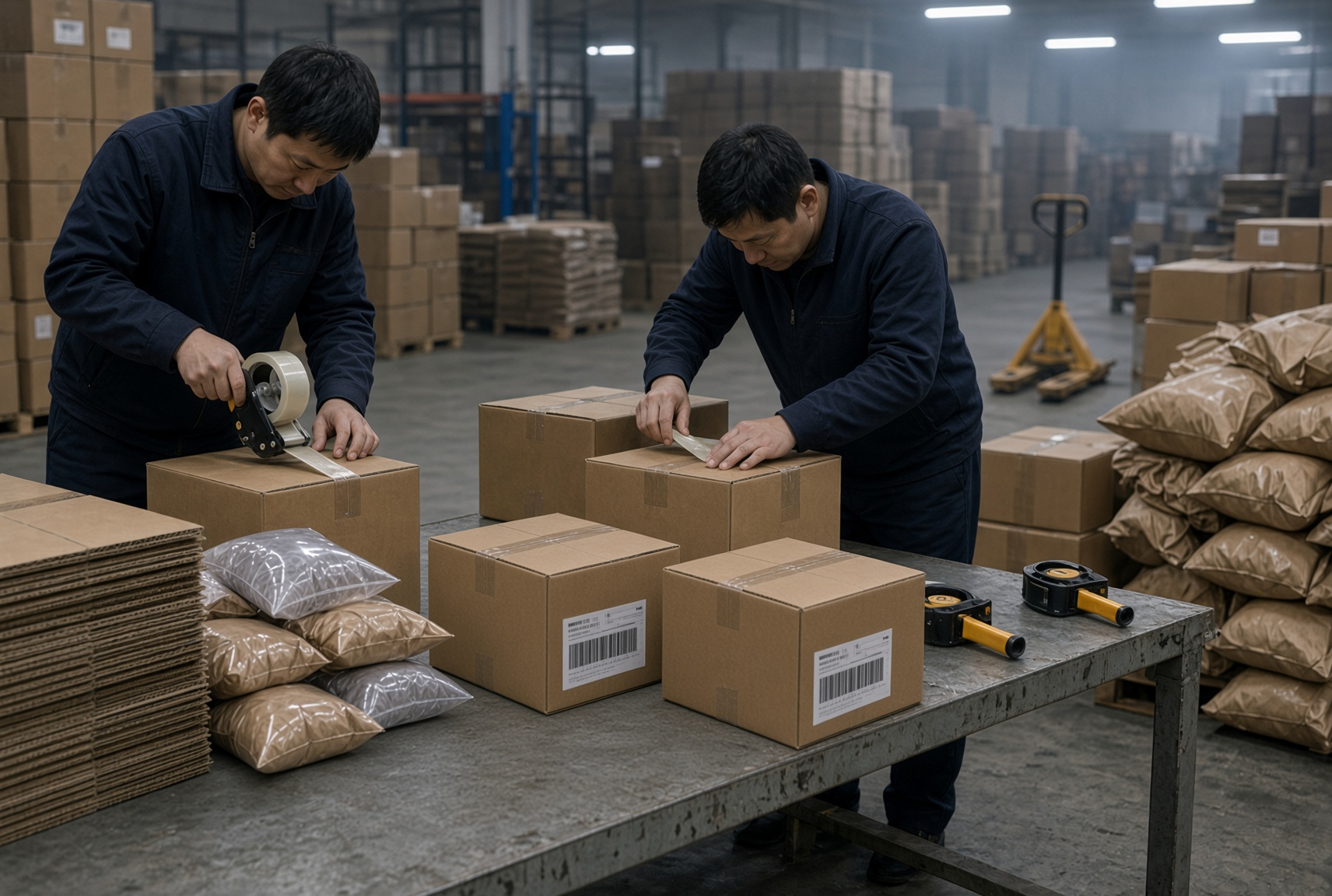
Internal packing should prevent the products from shifting around in the carton without the carton becoming inflated. There’s a space for bubble wrap, air pillows, dividers and void fill. When too much is packed “just in case” it leads to the opposite issue: bulging side, extra weight and hard-to-stack or scan cartons.
There’s a helpful origin test. Seal the carton, press on top, and observe on the sides. If the walls bow, the contents will move again as it is being transported and may cause the barcode face to curve. It will scuff or break before it is received if it rattles. Pack to the product and to the carton limit – not to a general “more foam is better” mentality.
Special packaging considerations for certain products
Fragile must be separated from carton wall and neighbouring units. Any sharp edges should be protected to prevent the box being cut from within. Amazon and the carriers will accept secondary containment for liquids and product with a tendency to leak. Settleable products, such as hardware, clothing stacks, or kit components, require hardware, clothing stacks, or kit components to be wrapped with dividers or inner packs to prevent the carton from appearing "half empty" when it arrives.
Fit packaging to the current FBA policies of Amazon and the freight way out from China. Though a carton may appear neat on a factory table, it can be a mess in two weeks in a carton. For battery powered, chemical or other restricted products, packaging is just one aspect of acceptance. Documentation and carrier rules have to be checked before labels are printed.
FBA Box Label Requirements for China-Origin Shipments
The FBA box label requirements China teams actually fail on are operational and not just decorative. Amazon must find a way to detect each carton, attach it to an individual shipment schedule and read it without having to re-stack the pile. A shipping mark that is neat in the factory is NOT a carton FBA label. Inbound stops if the bar code is not in agreement with plan or if the scanner can’t read it.
For origin execution – treat this section as an Amazon FBA carton labeling guide, correct data which is placed, and a carton list that matches what is physically in the carton.
What information must appear on FBA carton labels
Every FBA carton label must link that box to the shipment that Amazon expects. In reality it involves the correct shipment identifier, correct fulfillment-center routing, and a barcode that fits the receiving scanner. The name of the carton is the label. Amazon doesn’t know what the “Made in China / Destination USA” marks on a factory wall mean, because they can be generic.
The typical origin error is printing labels for a plan that is different from what is being used, duplicate shipment ID, or a packing list sent from a warehouse that is not synced with Seller Central. A third is using a factory export mark and mounting FBA labels on it so that the factory mark is facing outward. Make sure you check a sample before labels go from the printer and not against the last order the factory recalls.
Label placement and visibility on the carton
The main problem for FBA and China is how to label cartons for FBA. Place label on face which is flat and unbroken. Avoid putting it along seams, corners, tape lines and paths of the straps. Never wrap it over an edge. Don’t add additional tape, stretch wrap, or mark to it. If the carton is going to be placed on pallets, the label will need to be legible on the outside of the carton after the wrap.
A barcode under clear tape can still fail due to wrinkling of the tape or when the label is on a crushed corner. The top label of a carton is removed when another carton is placed on it. Origin teams should scan a sample from the packed stack, not from a loose box on the table.
Mixed-SKU cartons and multi-box shipments
Only when there is agreement in the shipment plan and carton contents can mixed-SKU cartons be allowed. Each box must also have a proper label. Multi-box shipments will fail if carton 3 is what the carton is supposed to be, as per the plan assigned to carton 7, or if the carton substitution that was made in the factory (in the “similar sku” section of the shipments) has not been uploaded to the file of the seller.
A common warehouse situation: the carton count is correct, the labels are clean and the inner pack is wrong when a carton is opened at random. That difference doesn’t come at a discount at the fulfillment center. It is then an inbound quantity problem, a stranded carton or a prep charge. Contents need to be inspected after consolidation, however, when multiple suppliers supply FBA shipment, this inspection should be done after consolidation as well as at each factory.
FBA Pallet Requirements for Shipments from China
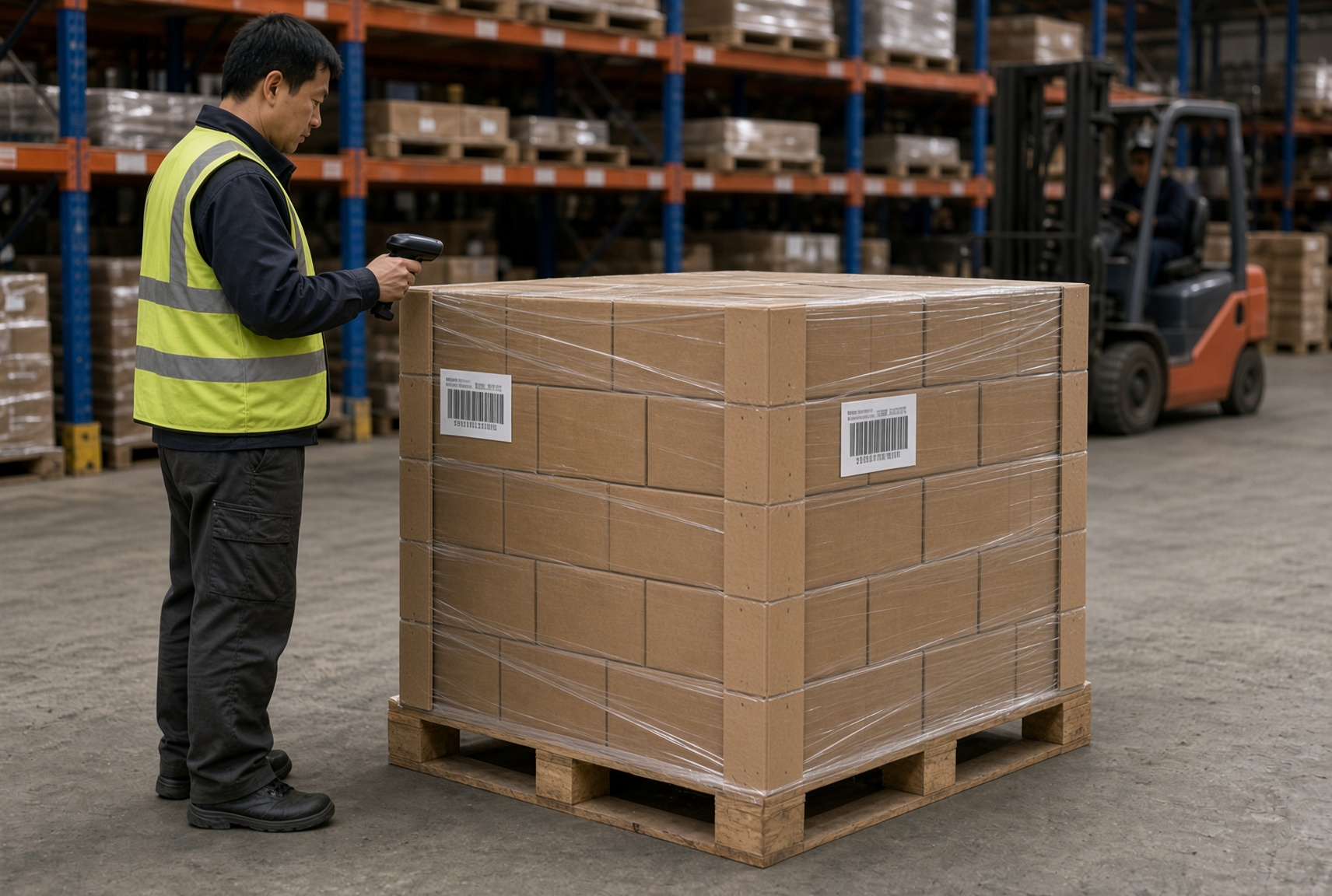
A large percentage of FBA receiving problems are pallet problems. The cartons might be fine, and the deck might be too low, the load may be overhanging the deck, the wrap may be loose, or the label may not be attached to the sides that Amazon wants to see. If shipping from China FBA pallets are required, they are a build standard at origin and not a last wrap before the truck leaves.
Pallet size, height, and stack rules
Amazon sets expectations for pallet size and pallet height for inbound freight. In the practical origin rule, the object must be square, and there can be no overhang. The foot plate of the pallet should be larger than the carton. Mixed sizes of cartons require a plan for stacking, not a pyramid that appears to be stable until the first forklift turn.
The height restrictions are in place due to the fact that fulfillment centers have racks, wrap machines and equipment for handling that is designed around an height range. The pallet might “full and efficient” out of a China warehouse but be too tall to receive at the dock. Measure height after wrap, not after last carton. Wrap adds bulk. You can use corner boards to bulk up the space. Take a measurement of the completed work.
Stretch wrap, corner boards, and stability
The success or failure of FBA pallet build and labelling China depends on stability. Stretch wrap must secure the load and should not simply be used to decorate the side of the pallet. The practice of under-wrapping to save film is a bad idea. Pallets will not provide a service of rebuilding a pallet stack when it collapses, nor will receiving staff go to the trouble of walking a pallet cart off the dray when it has collapsed.
The corners boards help to prevent the edges from cutting through wrap and maintain a square column. Utilize them for tall stacks, mixed cartons, or long ocean transit and additional handling. Again the origin test is physical: tilt the pallet slightly and push the top layer and watch for movements. Uncontrolled movement of cartons on the floor of the warehouse will cause movement of the carton.
Pallet labels and side markings
Pallet labels are not an after-thought. They must be visible on the appropriate sides without anyone moving the pallet. Some common origin errors are wrapping the pallet label and presenting it facing inwards or applying one mark on the top layer of the pallet label.
Don’t wrap if the labels will be concealed, and only make an unbroken window if it will not conceal the labels. Side markings that label the shipment assist the China warehouse and the destination handler. If the pallet cannot be recognised from the aisle, it will be dealt with as an exception.
Origin Checks That Prevent FBA Rejection and Rework
Being rejected by FBA for China is not something that can be done by hoping the factory is familiar with Amazon, rather it is a series of checks you need to perform. Routine and menial work—count cartons, read labels, open a sample, take a picture of the finished pallets and compare the actual load to the shipment plan before booking a pickup.
Pre-shipment label and carton audit
Short audit, long argument later. Do check carton count with the plan. Look at a sample of labels and placement of labels on packed cartons, not empty boxes. Look for corners that are crushed, wet board, split tape and labels that have been folded over an edge.
Random sampling is more important if there are multiple SKUs or multiple suppliers in the same shipment. It’s not always feasible to open all of the cartons. Opening none is the way mixed content errors get out of China. Discuss the sample size with the seller prior to packing day and avoid having the sample cut off at the warehouse.
Photo confirmation and documentation
Photos are not to be used for decoration. On the day the freight departed they are the record that packing, labels, and pallets were in accordance with the plan. Attach labels that can be read from the carton faces, be sure to label the pallet sides and label the stack height using a reference, and record any damage that is discovered during audit.
Sellers only know about problems after they leave by using a factory message that says all labels are done. The final carton list should match the photos and the FBA shipment plan. If the three sources differ, then stop and correct in China.
Rework in China vs rework at destination
It is easier and cheaper to relabel, repack or rebuild pallets in China than it is after being brought to the country. Destination rework does not await the receiver’s capacity, incurs handling charge and may not coincide with the seller’s inventory window.
If it is a high volume or a mix of SKUs and/or the factory has not packed FBA before, allow for an origin inspection or a warehouse check. Not a separate process just for that’s sake. There is a difference between the label correction on a packing table in Dongguan and Shenzhen and the correction after the freight has been shipped to the destination network.
A Practical Origin Checklist for FBA-Bound Shipments
This is an FBA packaging checklist for China suppliers and for the warehouse consolidating the goods from China suppliers. Walk it in order. NEVER PACKING FROM MEMORY.
Packaging and carton checks
- Quality control of packaging and cartons.
- Cartons are heavy duty enough to international handling and stacking, have intact corners and no soft walls.
- Size and weight fall within Amazon published FBA carton size/weight limits for product type.
- Sealing even; no open flaps, taped on necessary flaps.
- No bulge or weight due to internal packing to prevent movement.
- There are no wet cartons, crushed cartons or overstuffed cartons loaded.
Label and pallet checks
- All carton labels are identical to the on-site FBA shipment plan and not an old packing list.
- Labels are not attached to seams, corners, straps or wrap.
- Packed cartons are placed in stack for scanning the sample labels.
- Mixed-SKU and multi-boxed contents are the same as the carton level plan.
- Pallets are square, fit within published size and height expectations and have no overhang.
- The load is not leaning on the stack, the load is held by Stretch wrap and Corner boards.
- Pallet labels are located on the necessary sides and can be read without moving the pallet.
- Photos and the final carton list agree with what is on the floor.
Frequently Asked Questions
What happens if my FBA cartons or pallets do not meet Amazon’s requirements?
Both can work if the team is capable of printing from the proper shipment plan, applying labels to the spots where they will be scanned, and maintaining the contents of the cartons. Rare shipments of FBA and mixed-SKU detail are missed by factories that do not ship FBA frequently. After receipt and checking of contents a warehouse with consolidation of several suppliers can label. Select the location that is going to inspect the completed carton, rather than the location that has the lowest packing fee.
Should my Chinese factory apply FBA labels, or should a warehouse do it?
Check printed labels against live shipment plan, scan a sample on packed cartons, and open cartons to check contents (if possible). Labeled carton faces and carton list, on date of pick up, provide a record for the seller. The scan will not be successful if it fails in China, it will fail at receiving.
How can I check FBA label accuracy before cargo leaves China?
Yes, if the shipment plan is permitted and each carton is labeled and packed to the shipment plan. When the physical contents drift from the file (substitutions, inner packs left over or two factories packing “the same” box differently), mixed cartons fail. It’s a time for reconciliation, when consolidation is accomplished, not when they’re done at the fulfillment center dock.
Can I ship mixed-SKU cartons to FBA from China?
Yes, if the shipment plan is permitted and each carton is labeled and packed to the shipment plan. When the physical contents drift from the file (substitutions, inner packs left over or two factories packing “the same” box differently), mixed cartons fail. It’s a time for reconciliation, when consolidation is accomplished, not when they’re done at the fulfillment center dock.
Do pallet requirements differ from carton requirements for FBA?
Yes. The carton size, weight, strength, internal packing and carton labels are covered under carton rules. Pallet rules include: footprint, height, square stacking, wrap, and side labels on pallets. A carton which is perfect, on a leaning un-labeled pallet can be rejected or delayed.
Is it worth doing a pre-shipment inspection for FBA-bound cargo?
It’s worthwhile if the shipment is mixed-SKU, multi-supplier, a new factory for that SKU, the unit value is high, or the shipment is tied to a tight launch. It’s less expensive to do a few hours of origin checking than it is to rework parts or miss inbound parts. If your carton packing is done correctly in the warehouse, and your warehouse has only one SKU, then maybe a photo audit and scan for a label would suffice. Match the risk to the check and perform the check prior to closed container.