The price of shipping an Alibaba Mini Excavator from China depends on a variety of factors. The bill does not require the unit to be stripped down, uses the freight method, is an origin-to-destination route, and includes destination charges for clearance, duties, taxes, and last-mile trucking. A “shipping” line on a machinery listing is not the complete landed price. There are a large number of offers that only apply to a section of the journey or that are based on estimates that are adjusted after the introduction of real cargo data and Incoterms.
It is for importers, contractors and equipment dealers who require a realistic budget – not a bogey average rate! It splits the quote into layers to indicate who bears the cost of each layer under the common Incoterms and provides a way to compare offers on the same scope.
What Drives How Much It Costs to Ship an Alibaba Mini Excavator from China
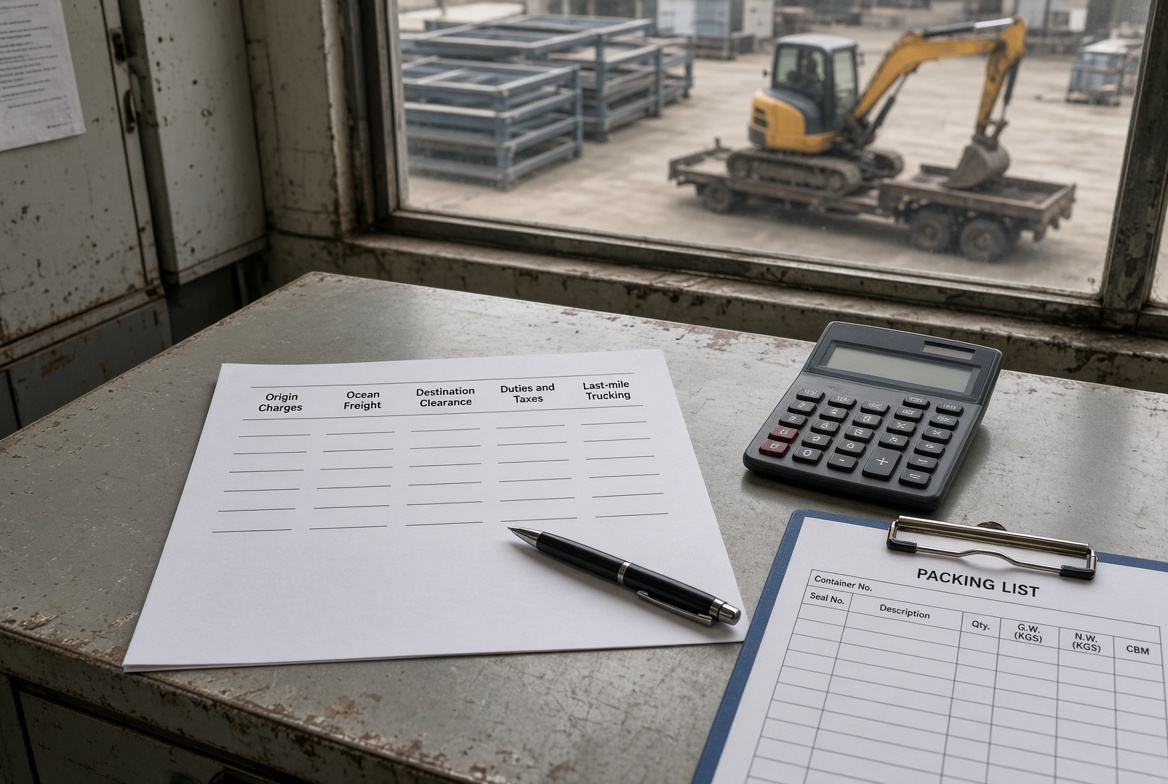
Total cost is not one number, but a stack of jobs. There are separate invoices for origin work, international main leg delivery, destination clearance and duties and taxes, and last-mile delivery. Incoterms determine who is going to pay which bucket. They don’t wipe away the work.
Ocean line prices are often the cheapest element of an arrival, and the customer might not have thought to factor in the price for crating, export filing, terminal handling, a customs entry, or a low-bed truck to the yard.
Origin charges: inspection, crating, and export
The factory gate takes origin for cost. These activities are placed in this bucket: Pickup, partial disassembly, crating/steel shipping frame, export declaration, origin terminal handling.
A typical situation: the unit price of Alibaba appears to be competitive until the buyer realizes that the term is EXW. That is not a crate, that’s not an export filing, and that’s not a truck to the port. The factory gives to the machine at the factory workshop. The buyer or the buyer’s forwarder will handle everything thereafter: survey (if needed), boom or bucket removal, timber or steel packing, inland haul and customs release for export.
You can’t save a few hundred dollars at the origin by not packing and sacrificing the machine’s service life. The boom is dented, glass cab is cracked or hose is leaking at destination – far more expensive than the crate that would have protected it.
International freight: container, flat rack, or RoRo
The main way for most mini excavators to get out of China is by ocean freight. Some units (after partial disassembly) are fitted into a standard or open top container. Machines that remain together tend to ride on a flat rack. For larger, or non-containerizable units, RoRo or a special heavy lift booking may be available in some lanes. This cargo class is seldom used for air transport because weight and size are, in most cases, too costly to be viable except in a very small compact model, which can be classified as breakbulk air cargo.
This layer is based around space and handling rather than on the supplier’s unit price. An open top or flat-top cab can add over a few hundred kilograms of additional machine weight, and this is the ocean quote that can be changed by a cab change.
Destination charges: clearance, handling, and delivery
One area where many new buyers of machinery are taken aback is destination cost. After the arrival of the vessel comes agent fees, terminal handling, customs entry, possible inspection, and trucking to a yard or job site. If only the China side number is taken, then that invoice goes unplanned.
Duties and import taxes are once more a layer. They do not constitute “freight” even if a seller includes an estimate in a DDP amount.
How Incoterms Change What You Actually Pay
The EXW, FOB, CIF or CFR, DAP and DDP terms have no impact on the physical work needed to transport the machine. They switch who’s booking those jobs and who’s paying each invoice.They switch the people who book the jobs and the people who pay the bills. The word split is not the word included.
EXW and FOB: Lower origin price, more buyer-controlled cost
EXW and FOB may appear to cost less on the supplier’s quotation as the factory is quoting less work.
EXW involves the exporter (or the exporter’s forwarder) arranging for the factory pick-up, packing (if not done by the exporter), export formalities, main carriage, clearance to the destination country, delivery. FOB usually involves the seller delivering the machine to the named Chinese port and on board.Under FOB, the seller will generally deliver the machine to the named Chinese port and on board, or to the place which is specified in the contract. As long as the main ocean leg and all gear on it is not covered by an additional service, the buyer remains the owner of that leg and all gear after arrival.
That division provides control. You select the forwarder, the packing standard, the vessel/service and the destination agent. This also implies that you will have to budget those lines yourself. EXW unit price is NOT a like for like equivalent to a DDP unit price. There is one machine in the workshop. The other one is a machine plus a knot of logistics hypotheses.
DDP and “shipping included”: One number, many hidden assumptions
One attractive door or job-site number. The risk is scope. Shipping included” on an Alibaba listing may imply main-leg ocean only, inland China only or delivery to the port of destination. May include destination terminal storage, inspection fees, duties, GST or VAT, or last truck to job site.
Request a written explanation of what the number is for:
- Origin pickup, disassembly and crating
- Export declaration and origin terminal charges: charges for the exports.
- The quote is inclusive of the main-leg freight as well as any surcharge for bunkers or peaks.
- The destination clearance and agency.Destination clearance and agency.
- duties and taxes: included, estimated or not included
- Final truck load to named address, which address is a port, a bonded yard or the job site
If the seller is unable to identify those items, use the number as a partial, and not a landed number. Only useful for DDP shipping mini excavator when the scope of the written order is the same as the order that you need.
Freight Method Choices for Mini Excavators
The choice of method is a cost profile. Match it to the machine and the destination; don’t match it to “always use a container.”
Container shipping: when the excavator can be disassembled
Minis can be partially dissembled (bucket, boom and perhaps tracks) so that they fit into a container, or into an open top. Then the pieces are protected by crating or a steel frame and stuffing is safer.
This route can also save ocean freight compared to a flat rack as the cargo is transported in a closed or semi-closed box that is already priced by the carrier as a regular container service. The trade-off is "origin labor," which means additional hours are required to unbolt, package and then rebolt and re-connect hoses, pins, or electrical connectors; and a potential risk to damage hoses, pins or electrical connectors during a rushed teardown.
Not all compact models are a one-size-fits-all option for a 20ft or 40ft box. But the marketing term “mini” is determined by the height of the cab, the track width and the lifting points, not by the name.
Flat rack and open-top containers for non-disassembled units
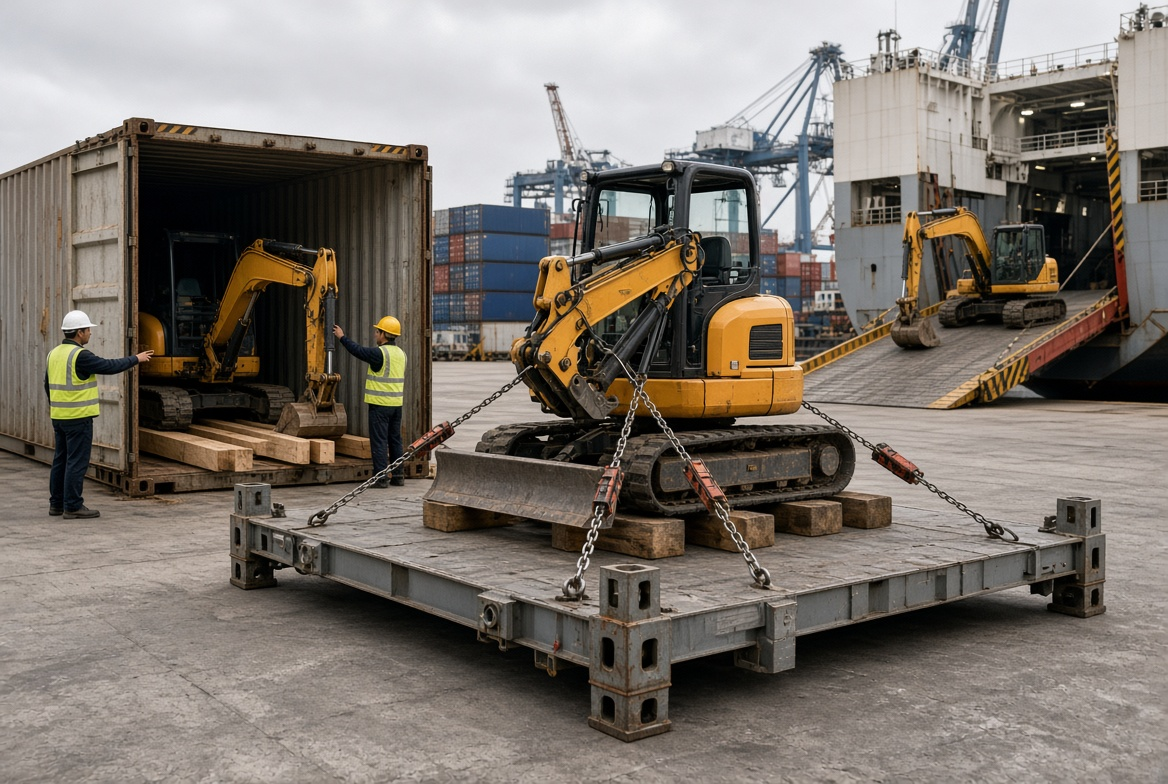
A flat rack is the typical response when the machine should be kept together. At origin and destination it is easier to handle. Ocean freight is typically more expensive because the unit requires special equipment and may require out of gauge, survey and/or lashing treatment.
The drawback of this is that it assumes any container works. Before someone books space, the height above the flat-rack floor, the width over the side posts and a safe lift plan are important. If the only issue is height and the machine can be lowered into a box, then an open-top may be a better option. Measure first. A standard-box booking becomes a last-minute flat-rack booking when there is guessing around the completion of the production.
Unlike the quality contest for container vs flat rack container ships, there is no such thing as a quality contest for a mini excavator! It is a geometry and handling decision which appears on the freight invoice.
RoRo and specialized heavy-lift options
The RoRo shipping for mini excavator can be offered on the lane in which the mini excavator can be rolled on or driven on to the vessel and the port of destination is willing to accept such service. There are differences between documentation, insurance and fuel-state rules and container traffic. Not all compact excavators are suitable and not all destinations have a suitable RoRo discharge.
Heavy lift is another tool: when the unit is too big to fit in a container, and RoRo isn’t an option. The cost behaviour is greater than a standard box rate for cost of booking, lift and destination handling.
One comparison that works is when there is one route, one machine, three methods: container after breaking loose, flat rack assembled, RoRo if available; and then a landed-cost perspective that includes origin labour, risk of damage and destination trucking. The lowest fare on the sea may not be the lowest fare at the port.
Machine Data That Moves the Needle on Cost
Carriers/forwarders charge for what you actually have, not what they see in a catalog. The handling fee and the method change with the weight and dimension, center of gravity, packing and commodity detail.
Weight, dimensions, and center of gravity
It is not as much about the slight weight differences as it is about space and lift difficulty. If the machine is just slightly taller than standard container doorways then an open top machine or flat rack is forced. Be sure that the width of the track frame is wider than the inside of the box even if the operating weight is “small.”
Center of gravity has a direct impact on lashing and also on the surveyor’s decision as to whether or not to accept a given stow. After any fluids are removed, give the length, width, height, operating weight and shipping weight. When the factory just gives you the number of tons in an “about,” the first number you get is a placeholder.
Disassembly, crating, and packing choices
This is not only a reduction in space but helps protect the machine and should be considered for partial disassembly and proper crating. They also include labour and material for origin. This is a trade, not an actual saving.
Huge cost of origin is often missed by skipping the crate. Impacts on construction machinery in terminals and on the road. The cost of a damage claim will be more than the timber that you didn’t purchase. Confirm packing spec in writing: Timber crate, steel frame, wrapped cab glass, drained/reduced fluids, loose implements traveling.
Commodity, HS code, and special handling
The cost file contains classification. Changes in document and inspection intensity are based on fuel type (diesel/electric), implement attachment, spare buckets, and any remaining fuel or battery. A generic description like "construction machine" will slow the quote and can yield the incorrect HS suggestion.
Provide the model and serial (if applicable) number, engine type and a set of photos, along with the packing list to be used by the factory. Proper specifications would avoid a second estimate after the first estimate was based on the wrong cube.
Destination-Side Costs Buyers Often Forget
In the destination invoice is where “cheap shipping from China” frequently falls apart. Think about these before signing on to an origin-heavy quote.
Duties, taxes, and classification
Freight is not duties and import taxes. They follow the tariff of the destination, the HS code, origin rules and any anti-dumping or special measures that are applicable for the machine class. There is no responsible guide that can come up with an all-county, all-mini excavator duty rate.
Please refer to your tariff line of goods or consult a customs broker with a license to trade in the country of importation. Inquire from the seller if the “duty” is a firm number or just an approximation that will be billed on final entry.
Terminal, agency, and last-mile fees
The realities of destination terminal handling, agency and possible inspection charges, plus final trucking can be easily overlooked when the focus remains on the China port. A flat rack machine might require a different lift, different truck than a boxed machine.
Last-mile for an excavator is not a parcel van! Ensure the address will accept a low-bed or container chassis, a crane and/or forklift are available and if delivery hours will be restricted by site access. Those limitations affect the trucking price.
Be aware that not all surcharges are covered by DDP. Read the written scope.
Demurrage, detention, and storage
Any delays after arrival will result in additional charges. Each of these problems causes storage, demurrage, or detention to be incurred: slow customs entries, missing documents, missed pickup window, or a late return of a flat rack or special container.
Set a fair clearance date and email commercial invoice, packing list and machine specifications to the destination agent prior to ship arrival. A lack of attention to paperwork makes destination charges for machinery imports increase the most as the cargo sits.
How to Compare Mini Excavator Shipping Quotes Like a Pro
Comparing quotes for excavator shipping is an art: do the same job, then read the inclusions before reacting to the general bottom line.
Put all quotes on the same Incoterm and scope
Normalize the file, then:
- same Incoterm
- Made in the same factory or warehouse.Origin same factory/warehouse.
- Same destination address type (port, yard or job site)
- The machine data (weight, dimension, packing, disassembly yes or no) is the same
- The same service scope (export filing, destination clearance, duties, last mile).
If the EXW ocean-only number is next to a DDP job-site number, it’s a different job. The bottom figure is not a good deal without the layers added back.
Ask what is explicitly included and excluded
On each quotation, write a brief list:
- Does this entail dis-assembly and crating?
- Does this cover export filing charges and charges at the export terminal?
- Does the primary leg include clearing and delivery to the destination or not?
- Is there a duty and/or tax included, estimated, or excluded?
- What are the surcharges that can be applied after booking?
If the dimensions taken are not the same as the factory drawing, what will happen?
Watch for too-good-to-be-true numbers
An outlier that is a far cry from any other offer is likely to have missed a layer, or that the offer was simply to the terminal or that it did not contain duties in a “DDP” label.
That’s a red flag. Request the provider to provide the quote again using your measured specs and named destination address. The cost of a shipping Alibaba excavator must be measured as a whole file, not the smallest in a chat window.
Frequently Asked Questions
Why do mini excavator shipping quotes from different suppliers vary so much?
There is variation in the price of scopes, depending on the supplier. Another factory offers EXW without crate. Another quotes FOB basic packing. The third pastes a “shipping included” figure, which just includes the cost of shipping to China and a rough estimate for shipping over the sea. There are also different types of machine data (assembled vs stripped data, actual height vs catalog height, additional buckets for the same booking). Quotes are not comparable until there is a match between Incoterms, packing and scope of destination.
Is it better to ship a mini excavator in a container or on a flat rack?
Both are good, but neither is the better. If the machine can be disassembled to an acceptable degree and hydraulic systems, cabs, and other structural components won’t be damaged by the process of packing and unloading, a container or an open-top could be shipped using standard box equipment and may reduce the ocean line. In case the unit remains to be assembled, or it will not fit in the box, a flat rack is the practical tool.
Does “shipping included” on Alibaba mean DDP door or job-site delivery?
Typically not, unless the seller specifies DDP in writing along with the delivery address. Shipping included may refer to factory to Chinese port, main leg ocean or port to port. Confirm origin charges, last truck, duty, tax, destination clearance etc. as separate charges. If no lines are listed, the listing price is not a door delivery.
Are duties and taxes part of mini excavator shipping cost?
They are not a part of freight, but rather of landed cost. The machine is transported by freight. Duties and taxes are levied by the government of the destination country, according to classification and local regulations. Some DDP includes an estimate. This estimate may be revised at the entry. Set aside a budget for them and check HS treatment with destination broker.
When does RoRo become an option for mini excavators?
RoRo is relevant when the machine is driveable or rollable and the trade lane provides the service and the port destination is able to offload without an impractical onward move. Availability is lane-specific. In the comparison of RoRo vs. container and flat rack, consider total landed cost and handling risk, and not just the ocean headline.
How can I avoid surprise destination charges on machinery imports?
Lock in writing before cargo leaves China. Provide commercial documents and dimensions, weight and packing information as early as possible. Verify if it is someone filing the entry, who pays the terminal and agency fees and what method the machine will be used in to get to the yard or job site. Schedule clearance for the unit to avoid storage or equipment-return fees. A full destination plan is less expensive than an unpaid destination bill, which is received upon arrival.