
The high bill often comes as a shock when you’re importing building materials from China, and generally not from the ocean line. They begin with a carton that can’t handle the load, a flexing slab crate, an LCL booking for cargo requiring exclusive loading or a truck that just can’t get to the jobsite. The preservation of tiles, stone, sanitary ware, doors, windows and hardware depends on packing, choice of packing container and destination clearance.
It’s not a freight brochure, it’s a selection method. Get the cargo brief right first. Then select packing and FCL or LCL based on the total landed cost and breakage risk.
What to Define Before You Import Building Materials from China
There are many things you need to do when you are importing building materials from China.When importing building materials from China you need to do many things.
Never ask for a rate on “tiles one container” or “stone about a ton”. A usable will include brief, carton/crate size, gross weight, fragility, stackable or not, Incoterm, and all Chinese cities to be picked up. Those facts determine packing, how cargo is loaded into a box, and if destination charges outweigh the nice origin rate.
Weight, fragility, and stackability
LCL freight is typically priced on a volume (CBM) basis and the weight limit may determine the charge if the cargo is heavy enough. FCL is determined by the amount of load that fits inside the container and the way the weight is distributed on the floor and against the sides of the container. Both are affected by stackability: Cartons that do not stack on second layer waste cube and crates that appear stackable but collapse at corners result in claims.
One ton and a standard crate are not units of measure! Check with the factory for outer length, width, height and gross weight per carton, pallet or crate. If the supplier is unclear, take a picture of the tightly packed unit and measure them. An "educated" guess on a loading plan may either result in underloading the cube or overloading a pallet with the boards and bands.
Material type and handling needs
Building materials are not the only cargo type. Strong cartons, corner protection is required and pallets are essential for ceramic or porcelain tiles and sanitary ware that want to keep the stack square. Typically, stone slabs require a stone crated with A-legs or stands to keep the stone off its side and prevent it from collapsing onto its flat surface. Packing, door and window vertical packing, edge guards and space to prevent frames from racking are required. It may seem simple – hardware and fittings – until multiple SKUs are put into a single carton, and the invoice doesn’t match the packing list.
The common error is to take everything for granted and say that it’s “heavy but fine.” There are other risks besides weight. Fragility, damage to the edges, moisture on raw wood and the order that you will unpack on site are just as important.
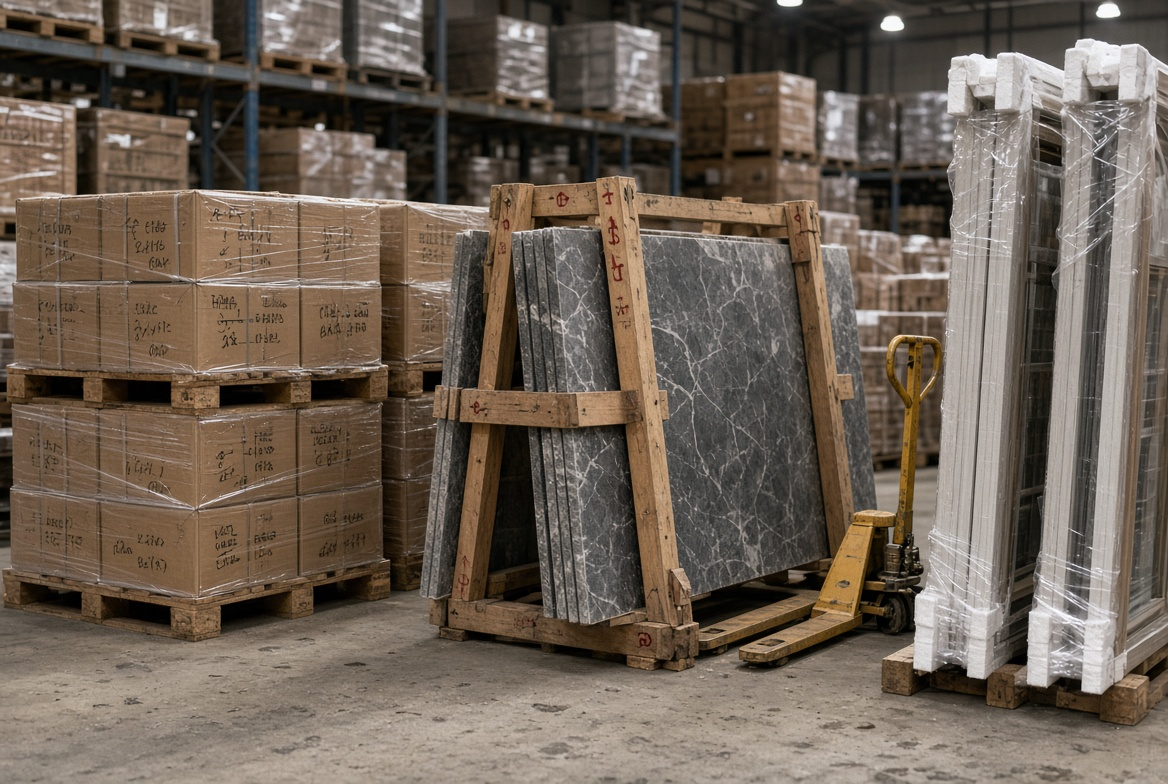
Packing and Palletization for Building Materials
The functions of correct packing are twofold: It protects the material and it provides a unit for the warehouse and for the container to lift, stack and block. Until you understand the meaning of “export carton,” you’ll never know what it really means.
Carton and crate design
Double wall cartons could be used for boxed tiles and sanitary ware provided their height in the stack is limited and corners are protected. Another pallet is placed on top of the weak single wall boxes or a forklift clips an edge causing the failure. If the piece is heavy or irregular or is destined for more than one use, wooden crates are the best option; LCL cargo is also loaded at origin, loaded at the CFS, and loaded at destination.
Stone slabs should be stacked in A-frame crates with the stone on its edge, the timber should be of adequate strength to prevent racking and there should be internal blocking to prevent knocks between stone slabs. Edge protectors and vertical braces must be used on doors and windows to keep them square. There shall be no raw corner of the container left exposed to the wall of the container.
Common problems are obvious in photographs: A carton that is bowed at each side, a stone that has a no bottom skid, or foam that has already been compressed, or a stone that was built into an A frame, but is too heavy for the structure.
Palletization and weight distribution
The size of the pallets will be the same as the carton’s footprint to prevent any overhang. Other than in the thin deck, with high load in the center, block pallets can normally be entered from more sides than stringer pallets can, and either type will fail if the load is in the center. Band or wrap the stack to the pallet – not around the cartons. Record the gross weight on the pallet and adhere to a load limit of the boards.
A full load pallet collapses in the warehouse or rolls over at sea. If your pallets are not loaded, then you are wasting cube and you are inviting other pallets to lean against your pallet in an LCL load. If multiple factories are shipping to a single warehouse, reach an agreement on pallet height and direction prior to the first truck or the consolidator will be in rush to restack.
Container Choice: FCL vs LCL for Building Materials
Compare the full shipment, not the initial freight line, before shipping any building materials FCL LCL from China. The cost of LCL may appear more affordable at originating points where you’re charged for a portion of the container. That is often coupled with destination CFS charges, extra handling and increased risk of impact. The cost of the FCL is higher initially but you will receive the box. Heavy or fragile construction goods are often landed at a lower price when breakage and destination work are added in when using exclusive use.
When FCL is safer and often cheaper
Reserve FCL for items that are near full load, are heavy, or are susceptible to damage, or when multiple product types are shipped together and require a particular loading order. A near full LCL shipment still pays destination handling on someone else’s time frame and on the same container as an unknown shipment. Tiles, stone and sanitary ware don’t take that risk lightly.
A well loaded FCL also allows for heavy pallets to be placed on the ground, A-frames to be blocked and a walking aisle (if the site team will unload the box themselves). If buyers already have unitized cargo and are interested in FCL or LCL ocean shipping from China, they should look at the total cube and weight and not just the single origin rate.
When LCL makes sense
LCL is used in the shipment of small renovation orders, sample orders or the first shipment that is much less than a 20ft load. It is also suitable for hardware and smaller fittings which can fit into a small space and can withstand additional handling. A very bad default for big tile volumes or stone slabs.
The danger is not focusing on the destination charges and other details. Each time a lift is made, there’s another opportunity to break a tile carton or rack a frame. If the quote does not include the details of how the cargo will be received, stored and delivered at its destination, the origin number is incomplete.
Loading Plans and Damage Prevention
Even with a correct mode, a load plan error will result in a failure. Materials used to create buildings are transferred in the form of mass. The claim begins at stuffing, not at sea, if that mass is allowed to slide, tip or rest on a weak carton.
Loading sequence and blocking
Place the heaviest pallets on the floor (see plan for this – against front wall if plan permits), and ensure weight is reasonably balanced from side to side. Fragile cartons go up or into a protected pocket and not under stone or under a stack of sanitary ware. Ensure that nothing can walk towards doors during rolling by block and brace.
When there are mixed SKUs and they are loaded in an arbitrary sequence, there are two problems: first, breakage in transit and, second, the “last in, first out” strip at arrival that makes the first customer off the truck the last customer on the truck. When the project schedule is known, load in reverse the install sequence of the site. Write on pallets to make it easy for driver and site crew to locate rooms, floors and/or SKUs without opening all pallets.
Special containers when needed
Most boxed tiles, hardware and palletized sanitary ware are suitable for storage in standard dry containers. If the long profile of the piece, or such as oversized doors, tall window frames, etc. is too large to fit through a standard door, then a different box must be used. In situations where there is no room for height or length, the candid reply is open-top or flat-rack equipment. If they are placed in a dry box, this typically requires the box to be tilted, protection to be cut or even the cargo left unsupported.
After determining the load plan and equipment type, furniture and building materials shipping is the cargo-specific route for packing, consolidation, and shipment planning on this product family, without having to enter a container discussion.
Customs, Documents, and Delivery for Building Materials
It is not a secret anymore that customs clearance applies to building materials. It is the same as for all other commercial cargo, but special care is taken in the description, packing, and delivery of the cargo. The absence of the documents and the imprecise names of goods are not only delaying the declaration but the truck as well.
Key documents for building-material shipments
A commercial invoice, packing list line-by-line and a bill of lading with proper consignee and delivery address are expected. Test reports, origin certificates or wood packaging treatment marks provide material-specific information, which is needed if requested by the destination and/or the commodity. Verify those needs for the true product and country; not assuming that the crates for stone or treated timber would be included on a tile invoice.
Typical document failures consist of inconsistencies. The invoice reads "ceramic tiles, glazed," the packing list reads "building material" and the bill of lading reads "STC general cargo. That does not match, and it raises questions. Consistency in the commercial name, quantity and packing count in each page.
Destination clearance and final delivery
Cargo still has to be brought in, may be examined and then assessed for duty and taxes and scheduled for delivery. Heavy pallets and stone crates don’t roll away like parcel freight. The site or warehouse needs to be able to accept a container or tail lift delivery, ground which can support the load and people or equipment to unload.
If the bill of lading is incorrect, there is no appointment window, or the street on which the house is located is a residential street, it is storage, whether it is a cleared shipment. Record the constraint in the booking: dock height, forklift on site, crane for slabs, etc., or require the slabs to be destuffed first at a warehouse.
Documents and routing should be coordinated. For those who require the declaration/compliance aspects of that handoff, they can read over export and destination customs clearance without this being a comprehensive customs manual.
A Practical Checklist Before You Book
A short one paragraph forwarding letter rather than a one line request for a rate.
- The type of material, outside measurements, weight and fragility of each packing unit.
- Packing method: carton, crate, a frame, pallet type, or allow units to stack.
- A comparison of FCL and LCL based on total landed cost, including destination handling and breakage risk.
- The custom documents that are actually available and who files at destination.
- Equipment on site, and delivery constraint (port pickup/warehouse destuff/jobsite appointment).
- Incoterm, factory cities, and pictures of the loaded goods.
The Incoterm, a packing list and some photos beat “tiles, one container, lowest rate.”
Sample scenarios
In the case where the cartons are robust and the destination CFS process is known, a small renovation order, a few pallets of tiles and fittings, typically remain on LCL. A full tile program loading (almost full 20ft or 40ft box) would typically be considered an FCL load where loading sequence and weight is under one party’s control. Stone slabs will very rarely go with FCL, and it is rarely advisable to share a container with mixed freight.
These are not real quotes, but planning patterns. There is still a need to inspect the volume, port pair and packing quality on the actual shipment.
Mistakes that send building materials to the wrong mode or packing
- Comparing origin freight line only, without taking destination charges or claims into consideration.
- Not using carton/crate dimensions and stating that the cargo is ‘about one ton’.
- Ignoring the difference between tiles, stone, doors and hardware and making them all the same problem to deal with.
- Withholding the commodity or describing the commodity in such a manner that it will not pass through customs.
- Because the first rate seemed to be lower, using LCL for high breakage or near full volume.
- No delivery plan for heavy pallets or slab crates, no appointment, no forklift, wrong address on the bill of lading.
Frequently Asked Questions
Is LCL or FCL better for building materials from China?
There is no right or wrong mode. Small renovation lots, and compact hardware and equipment can fit in LCL. FCL is typically safer and may even be more cost-efficient per unit landed when volume is significant, the cargo is heavy and/or fragile, or multiple SKUs must be loaded together under controlled conditions. The point is to focus on the total landed cost and handling risk and not the first ocean line.
How should tiles and stone be packed to reduce breakage?
Tiles and sanitary ware require robust cartons, corner protection and pallets with square stacking and within the pallet’s handling capacity. Use A frame crates with internal blocking with stone slabs, to prevent stone knocking and flexing. Packing errors that appear as claims are weak carton or flat-packed slabs.
What documents are needed for building-material imports?
Ensure that a commercial invoice, packing list and bill of lading with appropriate consignee and delivery address are prepared. Include certificates or test reports as appropriate for the destination and for the material. Do not change the name of the product or the amount of quantity from document to document.
Do I need special containers for doors or windows?
Standard dry containers can be used if frames fit into the door, and if they can be loaded up the wall, edge protection is used. Open-top or flat rack equipment is required for oversized doors, tall windows or long profiles. When they are forced into a dry box, it’s how a frame racks and glass cracks.
What destination charges should I expect for LCL building materials?
If documents or deliveries are delayed, LCL typically includes the charges for handling at the destination CFS, additional lifts, and possibly additional storage. The added touches come with an increased risk of damage to fragile construction materials. Request the destination charge structure at the same time as origin charge.
What details does a forwarder need to quote building-material shipping?
Provide what type of material, outer dimensions and gross weight per packing unit, photo of packed cargo, cities of pickup, destination, incoterm, and if it is to a warehouse or a jobsite. Those facts are the first steps in importing tiles from China, or any other construction SKU. It is not possible to estimate the cost to ship a building material from China on a one-line description.
If those details are available and you want an immediate shipping assessment of FCL or LCL and scope of delivery, provide building material information for shipping.