
The expensive failures are not usually those of the actual sailing but the shipping of the container homes from China. They begin with the booking of a module such as a carton: the module will not fit into a dry van or the lashing will damage the roof or the truck carrying the module will not fit under a bridge or a site gate. The type of container, loading and securing, and final delivery must be based on the actual dimensions, weight, modularity and route to the destination of the container—not a marketing image and the words “40-foot home.”
This article is a selection method. Find the physical brief first, then select the container family that really fits, and then design the lift, lash and journey to the site. There’s lots of units that require an open-top or flat rack. The biggest modules are not hauled in containers, but rather hauled in breakbulk.
Define the Container Home Before You Load or Book
The "one container home, factory in Guangdong, deliver to site" is not a booking brief. Only when the prefab home is considered as a cargo with certain limits can it be planned as a shipping from China. Before anyone speaks of a dry van, an open-top, a flat rack or a multipurpose ship, write those limits down.
Put in the commercial frame simultaneously: Incoterms, factory/china address, is the unit picked up or delivered to a warehouse or load at the factory. If agreed, OriginLink can coordinate factory pick-up, warehouse receiving, sea booking, customs and destination delivery. No such thing as that’s replacing drawings.
Unit size, weight, and modularity
Whether the unit goes in a box or on a deck, or requires an out-of-gauge slot depends on length and width. The height determines door clearance, hold limits, and later, height of bridges and wires on the road. Crane class, trailer type and axle load are determined by gross weight. The option of shipping one full home or a number of modules that have to be aligned at the site for assembly is due to modularity.
The equipment that is not correct is made from the words "about 40 feet" and "standard module. Check with the factory for the external measurements including eaves, lifting frames, roof pitch and after packing will be on the unit at the quay. Request the following information: tare and gross weight, if known, center of gravity, and a packing list conforming to drawings. If two modules have to be stacked or ‘mated’ on site, note this. A pair of 12 m boxes will be different stow and truck plan than 16 m wide box.
Lifting points and site readiness
A lifting lug/casting at the corners or a certified frame are not decoration. They determine the sling type, sling angle, and if the unit can be lifted without any twisting. Dams that bend under their own load will crack finishes, rack doors or dislodge glass even before the boat has pulled into the dock.
Verify the lift points and if they are rated for a vertical lift, tilt or both. Some houses come out of the factory ready to be put into use. Others come as a shell which still needs to be fit out on the inside after they arrive. That difference affects packing, weather protection and the expectations of what the destination crane will do.
Another item that should be included in the brief is site preparation. A unit may be legal at the load port but not at the farm gate or the area of a housing estate where the unit was never outrigged. Don’t assume that "delivery" is a line item that you will "figure out after the bill of lading.
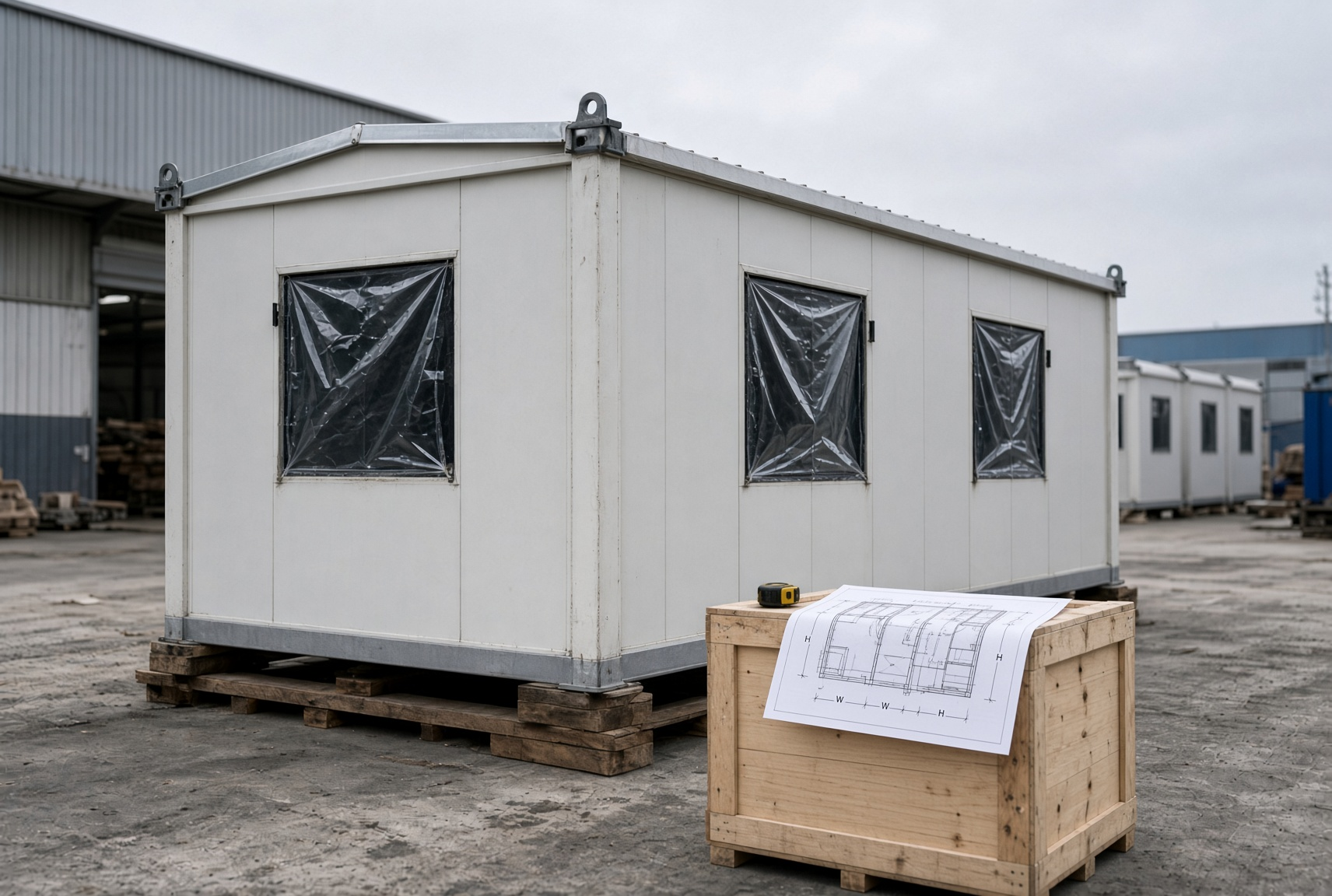
Container Options for Container Homes
Container homes are NOT all the same. The practical families are a typical dry container when the unit fits within the door; if not, special equipment like an open-top or flat rack are used, or breakbulk if the module is too large to fit in a liner box. Choice is an issue of measurement, not a branding.
As with oversized and project cargo, units outside dry-van limits require the same discipline as to equipment selection, loading, securing and a factory-to-site route check.
When a standard container works
If the home or one of the homes blocks during a sea passage, a standard container will do, as long as the home fits through the doors, fits into payload and is blocked during a sea passage. This occurs more often when you’re filling the interior of a compact unit, knockdown kit or loose cargo than with a fully completed body-on-two frame two story house.
Not all dry vans are created equal. There is a variation in the ability to open the doors, bend the roof and the clearance between the floor and the roof, depending on the type and age of the equipment. A unit that is “almost” too big will catch the head, cause a dangerous tilt at the door or not allow for dunnage. If the factory drawing is even close to the door line, STOP and check the actual box that will be shipped and not a drawing in a catalog.
When open-top or flat rack is needed
For units larger than door dimensions, but still capable of being shipped containerized as out of gage, there is open top and flat-rack equipment available. If the height is a concern, and the unit can be lowered through the roof aperture and secured at the bottom with lashing, an open-top will be helpful. A flat rack is good when width, lifting access and/or side loading are more important than a closed box.
This is the actual flat rack vs standard container for homes decision: If the container doesn’t move through the door without damage, then you should not use a dry van and hope the carpenter can fix up the eaves when you get there. Space is not confirmed until the factory drawing is sent to the carrier planner, and even then, there are rules to follow for OOG stowage, such as overhang and lashing points, as well as whether the unit can travel on deck.
When breakbulk is the only option
If the length, width, height and weight exceed all containers, the truthful response is breakbulk. Those units do not run on a multipurpose or heavy-lift tonnage that is a weekly booking with a slot that you can “just confirm.”
The problem is, language. If you say that all awkward modules are “breakbulk,” it won’t mean that a ship will be booked up. It is not a box that fits to be considered a true breakbulk unit ‘OOG in a special container’. Consider it a project lift: drawings, lift plan, stow position, and a vessel to carry the piece.
Loading, Lashing, and Route Planning
The right container still fails if the lift or the lash is wrong. Container home loading and delivery is a chain: factory gate to truck, truck to terminal, terminal to ship, then the reverse at destination. Each handoff can mark the unit or stop the move.
Loading sequence and lift plan
Even with the correct container the right lift/lash will not suffice. Container home loading and delivery is a chain: manufacturers gate to truck, ship to terminal and truck to destination. Handoffs can be markers or halts.
The sequence in which children load and unload their bikes and the plan they follow.
At each step state the crane or forklift class, the certified lift points, sling angles and if it can be tilted. If slings are too tight, or if the lift is applied through decorative brackets rather than the frame, then the roof may fold.
Lashing, dunnage, and weight distribution
The unit is secured against walking, tipping and cutting into the cladding by chains, webbing, timber blocking and edge protection. Weight needs to be positioned at the point the trailer and the stow plan dictate. Heavy at one end means that the axle or the corner of a flat rail will become overloaded in a home.
Protect finishes. This is a claim that needs photos: a chain over an eave that was painted, or a raw wedge against a window frame. It is not “a little extra width” that is overhanging when it infringes road or terminal regulations. Is a repudiated entrance or a police block. Place the load over the center and pad the points of contact, then note the lashing method against the drawing to avoid improvising at night.
Origin and destination route checks
It’s not a map pin, it’s also not route planning for container homes. Bridge height, wire height, axle limits, turning radius, seasonal road closures and terminal gate rules at either end. A unit that loads easily at a Chinese quay can get stuck at a factory canopy on the way out, or at a residential street that won’t accommodate the trailer on the way in.
Walk or survey origin exit and last portion to pad. Document the tightest turn, lowest structure and crane access for module set up. Local permits, escorts and delivery windows. They are also what makes it so that "port arrival" does not equal "home on the foundation.

Customs, Documents, and Final Delivery
Importing container homes from China remains a customs import and delivery task. The unit is cargo. It requires a steady description, a full set of documents and a final plan that does not include the terminal fence.
Key documents for container-home shipments
You can expect a commercial invoice, packing list, bill of lading, and the unit specific pack which the destination may require – drawings, material certificates or manufacturer statements. Unless explicitly stated otherwise, descriptions on papers must be consistent. When exams begin, they split differently on the invoice and packing list as "Prefab house" and "steel structure / furniture / appliances".
Use the same numbers on the packing list, the marks and the drawings if the home is made up of a series of modules. Unmatched pieces are not a "clerical" error. They are a hold.
Destination clearance and site delivery
Entry, if applicable, exam, duties and taxes, and trucking from port to site are all separate clock timings. Duties and taxes are classified and declared value in the destination country and are not a freight-line additional cost which you can imagine prior to shipment. Verify the name(s) of the person(s) completing and/or the payee, and the name of the person scheduled for delivery.
The address on the bill of lading must be an address at which a truck can actually deliver or arrive, or a named place to which it can be delivered or arrived, with an onward plan. No Appointments, No Crane and No Pad Access is NOT “Final Delivery”. Once the documents and entry route are cleared, the next layer of services that connects declarations to the same route is export and destination customs clearance—not drawings or a site survey.
A Practical Checklist Before You Book
Send photos, drawings, and a packing list. Do not send “container home, one unit, cheapest rate.”
- Exact external dimensions, gross weight, modularity, lift points, and whether the unit is site-ready or still a shell.
- Container family: standard dry van, open-top, flat rack, or breakbulk.
- Origin and destination route checks, including factory gate and site access.
- Loading and lashing plan for every handoff.
- Documents, Incoterm, and a delivery point a truck and crane can use.
Sample scenarios
A compact single module that clears the doors and sits inside payload can move in a dry van if blocking is designed and the destination truck matches the weight. A wider finished module that will not pass a container door belongs on a flat rack or in an open-top, with OOG stowage and a road survey. A very large or heavy module that exceeds every box limit is a breakbulk lift: different vessel logic, different crane plan, different booking conversation.
Those three cases are not price tiers. They are three different pieces of cargo.
Mistakes that send container homes to the wrong container or route
- Guessing dimensions from a sales rendering instead of a factory drawing
- Ignoring center of gravity and treating the unit as a uniform box
- Skipping the route survey because the port “handles containers every day”
- Calling every OOG booking breakbulk, or calling every large module a standard 40-foot
- Planning the ship’s hook and forgetting the factory gate or the site pad
- Writing different product names on the invoice and the packing list
- Putting a site address on the bill of lading that a trailer cannot enter
Frequently Asked Questions
What data does a forwarder need to quote container-home shipping from China?
External length, width, and height including roof and packing; gross weight; number of modules; lift-point drawings; photos of the actual unit; origin factory or yard; destination site or terminal; Incoterm; and whether the unit is fully assembled. Without those facts, any figure you hear is a placeholder.
When should I use a flat rack instead of a standard container?
Use a flat rack when width, side access, or lift geometry will not work through dry-van doors, or when the unit must sit on an open deck with proper lashing points. If the only problem is height and the unit can drop through a roof opening, an open-top may be the cleaner fit. Measure first.
Do I always need a route survey for a container home?
You need a route check whenever the unit is high, wide, heavy, or bound for a site that is not a standard terminal gate. A survey is how you learn about bridges, wires, axle limits, and turning circles before the truck is already on the road. Compact units that stay inside normal road envelopes still need a confirmed last-mile address and crane plan.
Can container homes move in standard containers?
Yes, when the module or kit truly fits the doors, payload, and internal height of the equipment that will be supplied. Many finished homes do not. Forcing a dry van to avoid special equipment is how eaves, doors, and roof panels get damaged.
What are the main risks in loading and lashing?
Unrated lift points, bad sling angles, missing edge protection, weight sitting off-center, and contact hardware that cuts into cladding or glass. A correct container type does not cancel those risks. The lift plan and the lash plan have to be written against the same drawing.
What documents are required for container-home imports?
At minimum, a commercial invoice, packing list, and bill of lading, plus any unit drawings or certificates the destination asks for. Keep descriptions and piece counts consistent. Destination duties, taxes, and exam practice follow local rules; confirm them against the actual shipment, not against a blog average.
If you already have unit dimensions, weight, lift points, origin, and destination and need those facts read against a live routing, share container home details for a shipping assessment.