You can only imagine how much damage has already been done to the fragile glass, ceramics and sanitary ware by the time they’re onboard the ship when you’re shipping them from China. Even an inexpensive freight line will crack tiles, chip basins, and break glass in the event of weak cartons, flat stacking, missing edge protection or a shifting container. The size, weight and packaging and volume will determine how you pack it, how you load it, and whether it’s safer to ship LCL or FCL.
Consider this as a selection tool. Packing and loading is the first priority. Mode and total landed cost are second priority. The third is the customs and final delivery. Please don’t consider these offerings as "just heavy cartons. Glass, ceramics and sanitary ware will break when placed under an edge load, corner load, or point load. When they can slide, they can break.
Define the Fragile Cargo Before You Pack or Load
Guesswork is a quote based on the terms “tiles, one pallet” or “standard sanitary ware”. Physical brief must be written before other people book space or design a crate: exact item size, gross weight per item/piece, packaging type, fragility, stackability, Incoterms and pickup locations in China. Those are the facts that determine carton strength, pallet height, container fill and the number of times the cargo will be handled.
Item size, weight, and packaging
There’s a task for each measurement. Usually, the charges for LCL are per volume (euros per CBM) with a weight limit that may be relevant in dense ceramic or sanitary-ware lots. FCL is based on the tightness or fullness of the pallets or crates inside a container, and the extent to which they leave space for containers to shift. Units are determined by the height and footprint, and are either stacked or must be provided as a single layer. Even a toilet, basin or tall glass panel that is “about one pallet” still can be too tall or too heavy for a weak carton beneath and on top of it.
Measure length, width, height and gross weight of the selling unit and export pack. Name the pack: carton only, carton on a pallet, or a crate or mixed. Describe the ability of pallets to be stacked. If multiple factories are used, enter each pick up city. Those numbers are on the critical path for any warehouse to plan stowage, and a buyer can’t compare LCL services against FCL service on anything other than origin freight.
Fragility and handling needs
The fragility is not a carton that says fragility. Is a handling rule. Edge protection and loading plan that will ensure that weight is not placed on the face of the ceramic panels and tiles is often necessary. Vertical or A frame stowage may be required for certain glasses and some ceramics to allow the load to be stowed on the edge and not a flat stack. Sanitary ware is bulky, cumbersome and prone to rimming, corners and fittings. Excessive moisture inside a carton can cause stains, compromise the carton quality or create the appearance of transit damage when it arrives at the destination.
The mistake people typically make is to consider the load as “heavy but fine”, and load it like normal consumer products. The same thing happens with point loads on a lower carton, a mixed SKU pile (no blocking), or a pallet that leans after the first handling, and there is no way to prove the claim.
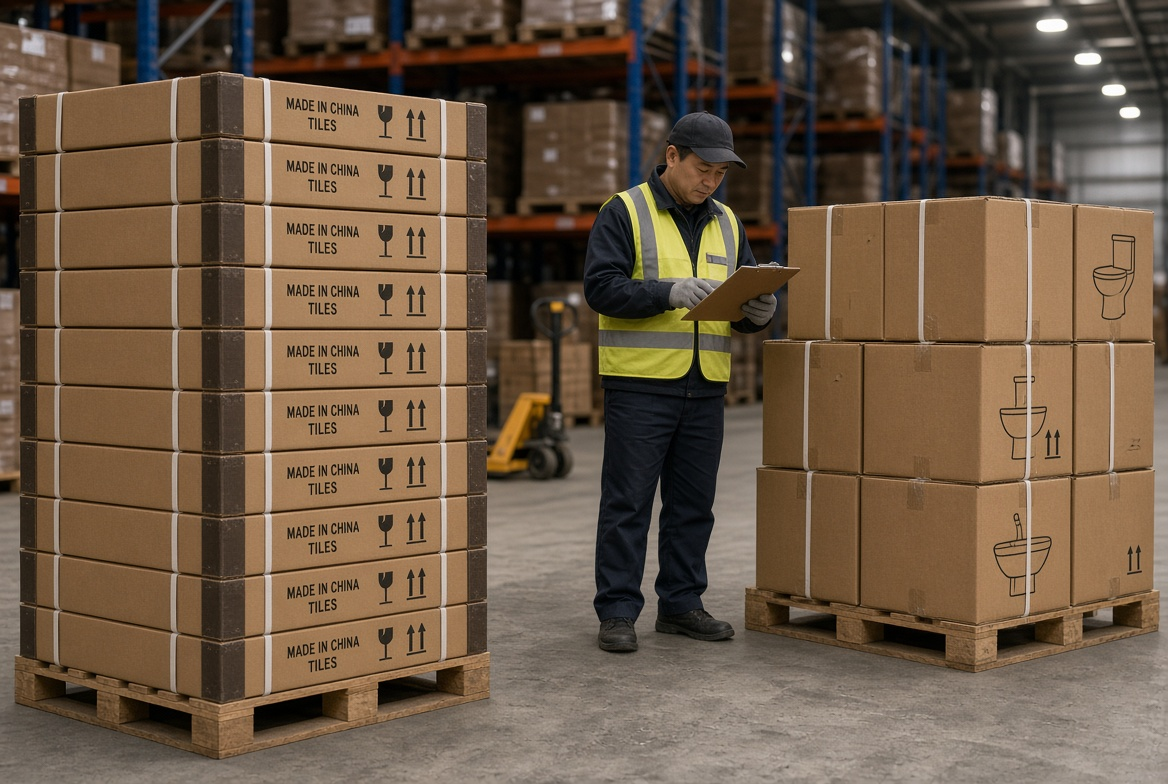
Packing and Palletization for Fragile Glass, Ceramics, and Sanitary Ware
There are two benefits of good packing. It insulates the merchandise and provides a unit for the warehouse and container which can be lifted, blocked and counted. There is no specification on the term “export-standard carton”. The stack height and transit must all be equal with regard to strength, edge protection, and moisture control.
Carton and pallet design
Do not use a carton that will only accept the one item – it has to be able to stack the whole pile. Double-wall board or even thicker is frequently used when tiles or ceramics are going to be installed under other packs. Straps and upper cartons will not cut faces with edge protectors and corner boards. Wooden pallets must be large enough based on the pack but not exceed the carton overhang. Crates are suitable for glass, large-sized ceramic panels, or sanitary ware which cannot withstand being stacked in cartons.
Typical packing failures when using tiles and ceramics from China are the same as when packing any other type of item: the first failure is the crushable carton and the second is the lack of protection around the edges and corners of the pallet. If there is a loose carton and not a pallet or crate, the first forklift move should count as the first damage event. Request photos of the active unit, rather than just a product photo.
Moisture and corrosion protection
Even if a container appears dry, moisture can be introduced through ocean transit and storage at the warehouse. Desiccants, waterproof wrapping, closed liners are useful for long transit periods with tiles, ceramics or sanitary-ware fittings. Condensation may cause marks or corrosions to metal parts on sanitary ware. The pitfall is a carton that is already finished at the factory and has wet board, stained faces or collapsed packaging.
When multiple suppliers are packing differently, it’s time to inspect the quality of the wraps, not to miss the inspection. If one wet load is placed in a mixed load, it may ruin the packs which surround it.
Container Loading and Cargo Protection
Even if the freight’s chosen correctly, a container will still fail if it is loaded and is used in the same way as general cargo. Fragile cargo container loading is all about pressure, voids and motion. The following should be included on the loading plan for fragile goods: Units to be placed on, units to be placed on top of, and how the load is blocked to prevent it from walking on the voyage.
Vertical and A-frame loading
Some ceramic panels, glass or tiles may often travel better in an edgewise orientation. Vertical (A-frame) loading for glass and ceramics distributes the load along the edge and decreases the point pressure on the bottom of the piece. Flat stacking means that the weight is concentrated at the bottom of the stack. This is the way a “full but cheap” container can get to be with bottom row cracked tiles.
Not all items require an A-frame. Cartons of sanitary ware can be stacked on pallets using blocking materials. Where large glass or slab cargo is required, frame may be necessary. The decision should be made in the short term and not when the truck is waiting at the loading bay.
Blocking, bracing, and weight distribution
Blocking and bracing prevent the load from moving around in "empty space. Weight should be placed on the structure that can support it (pallet, crate or frame) not on the carton corner. There are two issues with having mixed SKUs loaded in random order: They break during transit and the destination warehouse is unable to unload without re-stacking the entire box.
Once loading and protection are planned, importers who require packing and delivery of their cargo to meet the requirements of glass, ceramics or sanitary ware can consider furniture and building materials shipping with identical loading and protection handling rules (not generic cartons).
Freight Choice: LCL vs FCL for Fragile Cargo
LCL and FCL are not just price levels. They alter the number of times the load will be handled and who will have responsibility for it. Compare total landed cost: freight from origin, handling from origin, charges to destination, additional handling risk, breakage cost. Never lock a Mode on the 1st Origin Rate.
When FCL is safer and often cheaper
When the volume fills or approaches the fill level of a container, fragility is high or mixed SKUs must be loaded under control, FCL is typically the preferred structure. With exclusive use, you can determine the stacking order, blocking, and weight distribution. For tiles, glass and sanitary ware, that is the source of control. The error is to take a full load lot on LCL as it appears to have a less expensive origin rate and then escalate the cost per unit once destination charges, extra handling and damage risk are added.
When LCL makes sense
LCL can accommodate a smaller order of a project, samples, or volume that does not make sense for a container. Still requires export ready packing, as LCL cargo is received much more frequently into a consolidation warehouse, loaded with other lots and frequently reconsolidated at destination. LCL is not as expensive as it’s made out to be; ignore any destination charges or handling risk. In the case of high breakage cargo, that additional handling is not a footnote.
After cargo has been unitized and the question is port-to-port or door planning, compare the ocean shipping FCL & LCL from China with the actual CBM, weight and packing, not a generic “container or a shared box” label.
Customs, Documents, and Delivery for Fragile Imports
Fragile glass, ceramics and sanitary ware are still requiring goods to be shipped in with a clean customs clearance and delivery plan that can handle heavy pallets. This isn’t a complete customs guide. It is a component of the cargo that causes the ship to slow down when it stops.
Key documents for fragile shipments
Produce commercial invoice, packing list and bill of lading with the same description of the goods. The name, quantity, material, and pack count for items should be in sync. Include certificates or test reports where applicable. The delays in customs clearance of sanitary ware and building goods are frequently caused by discrepancies between the invoice description and the packing list description, or by discrepancies in the number of cartons and goods.
If you are packing fragile building materials from China, be sure to pack documents consistently. Without the paper, a warehouse may not be able to defend in case of a damage claim, or a shortage.
Destination clearance and final delivery
Once the goods have arrived, they must also be admitted, potentially examined, have the duty and tax processed by the responsible party, be released, and be given a time to deliver. Heavy tile pallets and sanitary-ware crates require a site which can accommodate them, such as a dock, forklift, floor loading or booked unloading window. Typical failure is the wrong address on the bill of lading, or no appointment when a load can’t be placed on a curb.
Those readers who require documents and declarations and routing for work side by side will find export and destination customs clearance as the planning page where they can find this information without having to go into country-by-country duty details with this article.
A Practical Checklist Before You Book
Provide facts for warehouse and booker. The picture, the packing list, the dimensions, the weights, the Incoterm, the origin cities and the delivery address outdo “tiles, one container, lowest rate.”
- Specific item size, gross weight and packaging type, such as is pallet or crate stackable.
- Packing and palletization: carton strength, edge protection, moisture wrap and pictures of the packed unit.
- Total landed cost – FCL vs. LCL – including destination charges and destination handling risk, not just origin freight.
- Customs documents and delivery plan that will hold heavy pallets.
- Breakage/de_delay risk tolerance. If one can be broken down and destroy the order, then don’t select the mode that has the most additional handling.
Sample scenarios
If the cartons are robust, the CBM is low, and destination charges are included in the comparison, then a small project order of mixed ceramic samples may remain on LCL. Typically, a "full" or "almost full" lot is loaded into FCL, where the loading plan, blocking, and height of the stack remain within one team. If the sanitary ware is oversized, for example tall bowls, wide basins or awkward crates, a special loading pattern might be required, additional blocking may be needed, or the container layout may be anything but a standard carton stack. Those are not rate guarantees, they’re rate cases. Check the exact quote with the exact cargo that you have.
Mistakes that send fragile cargo to the wrong mode or loading
- Only comparing origin freight, without taking into account charges at destination or damage risk.
- Treated tile, glass or sanitary ware as heavy general cargo having no edge or vertical plan.
- Keeping item details "one pallet" or "standard carton.
- Booking without a delivery date and equipment for heavy pallets.
- High-breakage volume comes into play and is already approaching a container for which LCL is requested.
Fine goods shipping from China isn’t a single line on the origin invoice. It’s the cost of the goods plus the cost of handling and the cost of the goods that you can’t sell as a result of breakage.
Frequently Asked Questions
Is LCL or FCL better for fragile glass and ceramics from China?
Typically, FCL is safer when the volume occupies the container, or when the load must be controlled stacked and blocked. Handling at origin and destination is added when using LCL, although it does accommodate small lots and samples. Compare the TOTAL landed cost and breakage risk NOT JUST the first freight line.
How should tiles and sanitary ware be packed to reduce breakage?
Use cartons that are stackable, and add edge and corner protection; palletize/crate units which can be lifted without crushing. Don’t let moisture get into the pack. Under a point load don’t stack product flat, when it requires vertical or A frame stowage.
What documents are needed for fragile cargo imports?
At least: commercial invoice, packing list, bill of lading, and description and count (matching). Include certificates or test reports as appropriate for the product or destination. One of the frequent clearance delays is inconsistent paperwork.
Do I need special containers for oversized sanitary ware?
Not always. If crates fit, many lots are moved in a standard container, and if a loading plan can block the weight, this will be done. Oversized or awkward items may require a different stowage pattern, or additional bracing. Please check the container dimensions prior to booking.
What destination charges should I expect for LCL fragile cargo?
Typically, destination handling is an added value in LCL for deconsolidation, storage windows, and delivery from the CFS or warehouse. These charges are in addition to ocean freight. Before using LCL as the cheaper option, ask for the destination structure.
What details does a forwarder need to quote fragile-cargo shipping?
The size and weight of items, packaging pictures, CBM, origin city, destination, Incoterm and whether it can be stacked. If you have such a short description, but want a true assessment, provide some details about fragile items to be shipped to get a shipping assessment that reflects actual packs, not a generic carton description.